The Fergana valley

Ferghana is a watered, fertile and temperate valley in this dry and mountainous region. It’s been the centre of ancient empires, and fought over many times. Now it is mostly part of Uzbekistan, spilling into Kyrgyzstan and Tajikistan, with very complex borders that don’t match the (mostly old Soviet) road and rail networks. Until a month before, travelling from Tashkent into the Ferghana Valley meant going via Tajikistan, which involves two border crossings and significant wasted time – and for the round trip we’d needed a double entry Tajik visa and a triple entry on our Uzbek!  But only three weeks before we embarked, a new rail line was opened, which stays entirely on Uzbek territory, albeit pretty winding, and thus slow, for a significant part. The carriages were new, and by UK standards, extremely roomy and comfortable. One suspects a UK operator would put twice as many seats in the space, and charge at least double. The line was built with Chinese help, and includes a substantial tunnel. Which we never saw. Because, it’s secret! As the train approaches it, the staff draw the curtains, and then, one stands at each end of the carriage to ensure nobody peeps. Goodness knows what they keep in there – the world’s only plov mine, perhaps? Anyway, it does translate to a splendidly attentive train crew for the rest of the journey.

Margilon, being roughly in the centre of the valley, was a great place from which to explored by bus and shared taxi, with Al Cave, another travelling retired teacher from the UK.

Yodgorlik  silk factory Margilon – Clare

 Yodgorlik  silk factory Margilon – Gideon


Rishton ceramics museum

Where the clay is so pure that they only need to add water before putting it on the potters wheel.

_ctf3020


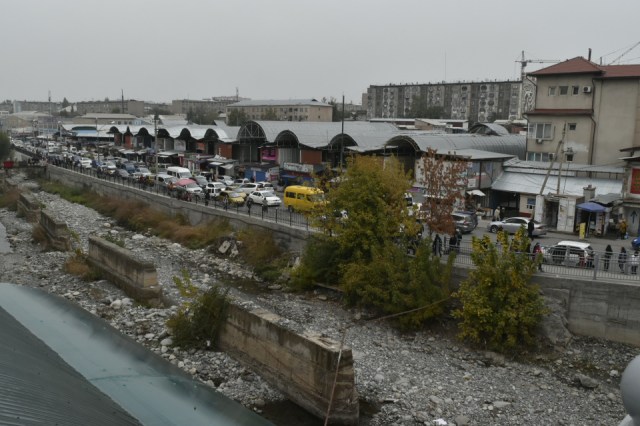
Kumtepa Bazaar, Margilon

Kokand / Qo’qon – Khan’s Palace

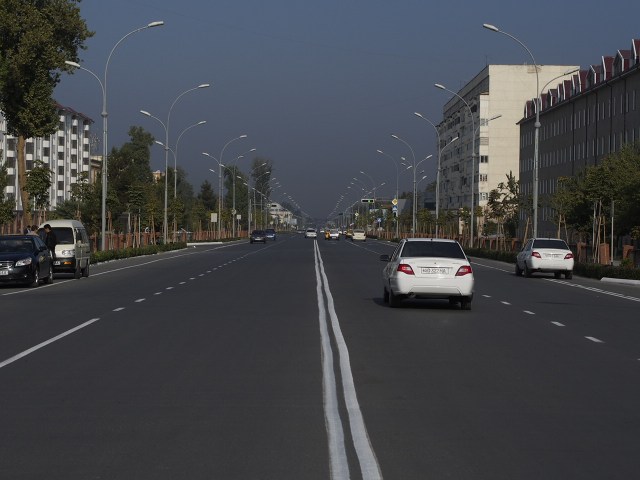
And, in case anyone thinks the entire Ferghana Valley is only full of old things, here’s a photo of downtown Ferghana itself:

OLYMPUS DIGITAL CAMERA

Kyrgyzstan and then …

A new country, but we’d only planned one day’s ride, from the border to Bishkek, Kyrgyzstan’s capital. It’s the end of our Central Asian cycling, as season and politics means we must fly to Delhi for the next big stage. We planned to stay in Bishkek a couple of weeks, to rest, receive supplies, sort India visas and bikes, with maybe a side trip into the Kyrgyzstan mountains or possibly Kazakhstan’s biggest city, Almaty.

After a long penultimate day in Kazakhstan, the border day ride was a short one. We set off in pleasant, sunny, conditions,  but with an unhelpful easterly headwind. Wheat fields were down to stubble, sometimes set aflame. A few trees glowed golden yellow, but most were still in end-of-summer drab green. The border was friendly and low key, but whilst in its short queues, autumn kicked in with a vengeance. The sun pulled a thick, chilly cloud over its face. Not long after we stopped, in Kara Balta, it started drizzling, and by dusk it really was raining, dampening our exploration of the bazaar.
We woke up in the crumbling old Soviet hotel to see a few inches of snow everywhere, especially in the trees, as most still had their leaves. Slightly surprisingly none was actually in the hotel (do I mean snow or leaves? Does it matter?).

The snow quickly melted off the road, giving us a scenic, if chilly, ride into Bishkek. This western road into Bishkek is pretty horrible to ride. Traffic is pretty heavy, and the road is rough, the alleged hard shoulder even rougher. The road is wide enough for the marked 2 lanes, but not when there’s overtaking up the middle, which is frequent. I ended up swallowing my pride, and dropping to a crawl in the side gravel. Dispiriting.

Having researched a bit before, it was easy to find accommodation in Bishkek. Royal Memory Guesthouse was comfy, though water, Internet and service erratic. As we planned a long stay, we moved to Nathan and Angie’s At House, one night camping, then indoors. This fabulous institution is actually free for touring cyclists, and a fount of local advice. We started to relax, recover, and prepare for the next big stage.
Then, disaster! Rest ruined! Thinking about possible (restful) side trips, we called by the Community Based Tourism office, thinking of visiting Issy Koo lake, or a short horse trek. (Gid wouldn’t entertain a three day hunting trip, with eagles, on horse back.  Something about his backside.)  Unfortunately Clare mentioned “Pamir”, which we’d written off when we abandoned riding via Tajikistan on grounds of our feebleness. Although the Pamirs aren’t in Kyrgyzstan, we were promptly offered a motor tour. Oh bugger! End rest, cue – frantic preparations. Quick! Visit Bishkek’s second hand clothes street to obtain warm coats and jumpers (all 4 garments £14, later warm socks in Osh’s bazaar for £1/pair). Thanks to Nathan for that tip, and loan of a capacious rucksack.
Practicalities: One can’t rock up and rush into Tajikistan’s Pamir area. But we still had two weeks left on the Tajikistan visas.  We’d got them in preparation to  ride the Pamirs, via Dushanbe, but not used, and the CBT office provided the GBAO permits.
8am next morning we approached Osh bazaar (that’s the bazaar in Bishkek, not in Osh), from whence depart the shared taxis to Osh. We’re instantly spotted and herded into a reasonably serviceable looking people carrier where we remain, apart from wee breaks, for about 90 minutes as it gradually filled up. Once 7 passengers are loaded, the driver stops yelling “Osh, Osh” in the street, lights up, boards, and we’re off. 10 metres later we stop to pick up post, which, infuriatingly, takes several minutes.
The drive is interesting in itself:
  • Distance: over 600km
  • Time: About 11 hours
  • Driving: Pedal to the metal
  • Overtaking: In all cases
  • Road: Winding
  • Snow: Lots on north side of one pass
  • Stuck: Trucks and cars in the snow – but not us.
  • Music: A fuse of Kyrgyz folk and dance, interspersed with Boney M.
  • Stops: Enough
  • Passengers: A friendly gang, although not sure what some were drinking or sniffing.
  • 19th century: Toilets
  • 21st century: Showing the other passengers our house on Google Streetview, at 100kph, in the dark on a winding mountain road.
Unfortunately the memory of the drive is a bit marred, as one of the other passengers invited us (in sign language) to overnight at his place. But at his drop off point we’d got well out of Osh, then he had some argument with the next stage taxi driver, whereupon we realised he was pretty drunk, too. It all started to look pretty dubious, especially in the light of some other oddities. We backed out of the plan and jumped in another taxi to our originally planned Pekin Hotel.
Which was remarkably close to Osh’s bazaar:
_ctf4193
Then to the Pamirs, a separate posting.
Footnote: When we took the shared taxi back from Osh to Bishkek, it was altogether a much nicer experience. Possibly because it seemed to be partly pre-booked by three generations of ladies, or maybe they knew he was a calm driver and we were lucky to choose his Honda!

Photo gallery – The ancient silk route cities, Uzbekistan

We took shed loads of pictures in these gorgeous historic cities. So this posting is organised a little differently. There’s no narrative of the actual cycling, it’s just a number of panels by each of us from each city.

Khiva – Clare

Khiva – Gideon 1

 Khiva – Gideon 2

Bukhara – Clare

Bukhara – Gideon

Samarkand – Clare 1

Samarkand – Clare 2

Samarkand – Gideon

A night in a yurt at Ayuz Kala

We heard about this while in Nukus, the manager at the hotel there helped us make a rather un-firm booking (as we weren’t sure of our travel speed). In the end it was a fairly easy ride, and we got there in plenty of time to ramble around the ancient fortress of Ayuz Kala (or Ayuz Qala or  Ayuz Kale), next to the camp. We also met there a party of French (d’un certain age…) on a tour organised with coach transport and daily rides on a fleet of hire bikes – seemed a nice easy-going option. They were the first of many French tourists we met in Uzbekistan, there seems to be something of an affinity.

The ancient fortress itself was lovely, especially in the evening light. The main Ayuz Kala looked down upon two others, called Ayuz Kala 2 and 3.

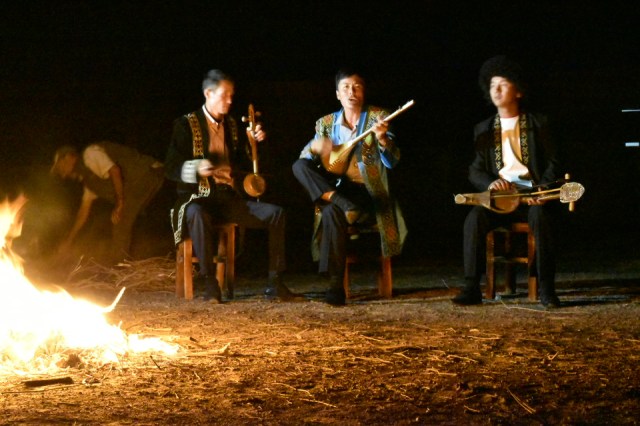
After returning from the fort, and a rather splendid supper – this being an altogether more civilised form of touring than cycletouring – we were treated to a concert of Karalkakpakstan music. We’re not sure if this is a standard part of the package, or only because of the presence of a film crew.

_ctf2297


The Aral Sea, or rather Not the Aral Sea

Sorry folks: This posting from the beginning of our time in Uzbekistan is published out of order, after some ‘later’ ones. We went on this taxi trip during a rest day at Kungrad.

Kungrad (also transliterated as Kongirot/Qo‘ng‘irot, all of which seem an improvement on an old name of Zheleznodorozhny) is not a major, or even minor, tourist town, but for a road traveller entering Uzbekistan from the west, it’s the first town of any size (see end of the last posting).

This western area of Uzbekistan is also known as Karakalpakstan, which in some senses can be regarded as a different country, with its own language, Karakalpakstani. We realised, too late to take much of a photo, it has its own hats, too – giant fuzzy wool ones, making the wearer resemble Michael Jackson circa 1975, if not usually so cute. As discussed in earlier postings from Georgia or Azerbaijan, in this part of the world there’s a complex overlap, or often difference, between the citizenship of the states, and the identity of individuals. There’s significantly more edge to being, for example, a Tajik in Uzbekistan (thus an Uzbekistani, but not an Uzbek), than being, say, a Scot in England, assuming you can work out who is such (Sorry Nicola). We were told by one local that Kyrgyz and Tajiks can be distinguished by nose size, and it is true that in the four ‘stans we visited, one can roughly distinguish different numerically dominant facial types. But just in case this doesn’t work, each ethnicity has its own hat as well.

Kungrad is about the nearest place on the main west-east road to the Aral Sea. The owner of the place where we stayed was happy to arrange a taxi excursion to Muynak, previously a significant port on the Aral Sea, now a desert town. To actually set toe in the remains of the sea involves a much longer road trip, substantially off road (If I remember correctly), we couldn’t face the hours in a car to see not much, so we settled for Muynak.

It’s rather a sad place, as you might expect. The town has helpfully lined up the abandoned hulks near the war memorial.


After Kungrad, we cycled on to Nukus, capital of Karakalpakstan. It has one tourist attraction – an outstanding modern art gallery. Where, naturally, we didn’t take pictures.


To and through the Uzbekistan border

Sorry folks: This posting from the beginning of our time in Uzbekistan is published out of order, after some ‘later’ ones, because we don’t want to ‘fess up to illegal tourist camping and teahouse stays (even though we had little choice, daylight and legs being limited), until we’re out of the country.
Just about the time we boarded the Caspian Sea ferry, it was announced that Uzbekistan’s longstanding president was seriously ill. By the time we left Aqtau, he was dead. In the nature of such governments, that meant Uzbekistan might face some serious political disruption; they’d recently closed the frontier just for their national bank holiday. Our entirely selfish fretting about this was in the background as we planned the next section. In the event, there was a smooth political transition and no border closure.
We deliberated about the next section, probably the most committing part of our trip so far, through the desert from the Kazakh town Beyneu to the border with Uzbekistan, and to the western towns thereof.  On the one hand, there was our pride, we’re on a cycle trip of course we’ll cycle it, weighed against the reality of not knowing where we could stay or take on provisions.  Food would be fine, carrying enough for 3 or 4 days is doable but water was a far more serious issue. This, together with several nightmare descriptions in blogs: sand storms, double punctures, heavy rain and head winds, as well as slow & hard work because the road has not been reconstructed, shook our confidence. So, we went to the railway station to check out our options. Yes, we could go by train, albeit starting at 3am and taking about 15 hours.
OLYMPUS DIGITAL CAMERA

Nope!

We kicked around our options and decided, given the ideal cycling conditions,  we should not duck our rite of passage as Central Asian cycle tourists. Next morning, a bit late, we saddled up in perfect weather.
The road out of Beyneu was as alleged – dreadful, worn concrete slabs with reinforcement rods protruding. But it soon settled to 15km of fair asphalt, before the dirt road started. In truth, and dry September weather, it was at the good end of dirt roads. Dropping the tyre pressures smoothed out some of the bumps allowing us to whizz along, albeit, only looking up to catch the view occasionally. There was one fleeting moment of hope, when for perhaps a kilometre or so, a smooth new road went under a new looking railway line, not on our map (we suspect it’s part of China’s new route West).
Enthusiastic locals: a bus load of pensioners, cars that passed, the local lads hanging out by the town sign, shepherds on motorbikes, kids in the few villages… have all whipped out a phone or smartphone for a photo together. Thus, making us feel very welcome, unusual, and feted in Kazakhstan, despite the many blogs making us think cyclists must pass by here daily.
OLYMPUS DIGITAL CAMERA

Beyneu: By no means all scenic ruins

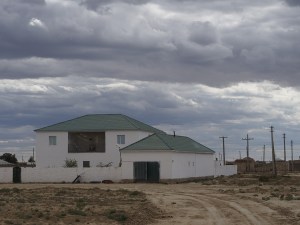
We keep on posting pictures of scenic old things, ruins, old cars, wonky power lines, and so on. Just in case that leaves the wrong impression, here’s a picture of one of the many new houses we saw occupied or under construction in the desert towns.
We reached the frontier at about 5pm. Formalities took a while, but both Kazakhstan and Uzbekistan staff, who whizzed us to the front of their queues saying ,’Tourist, tourist’ were very helpful.
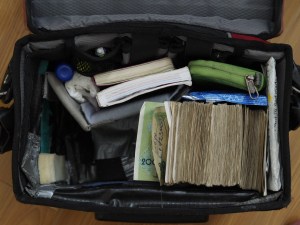
By 7pm we were through and immediately pounced on by, it seemed a family of, money changers. Prepared by blogs, Gid had a plan, and knew at least the official rate, quoted on the Internet. Later experience suggests that entering a bazaar, with foreigner stamped firmly on our foreheads, means someone will quickly accost us with double that, at least when dollars are involved. Anyway, we were only changing our remaining Kazakhstan Tenge, about €40 worth. For this we got 139,000 som, in 1,000 som notes – a huge wad. Later on it was more convenient to change $100 at a time – at the bazaar rate that’s 630,000 som. The picture below shows Gideon’s barbag with it in. At least we’ll never be short of toilet paper.
OLYMPUS DIGITAL CAMERA
Besides being officially maintained at an unrealistic value, the Uzbek Som is generally available in notes up to 1,000: roughly 20p or 30 US cents. There is a 5,000, but we rarely saw one, until Samarkand. So everyone has huge wads, and Uzbeks are the fastest money counters we’ve ever seen.
Seting off with thoughts of camping, we were flagged down from the roadside after a few km. They saw us coming. Sleeping space at the teahouse (Chaikhana/Chaihanna) was free, but the food  was priced up to cover everything.  It worked out comfy and secure enough with a friendly crowd inside. The outside karzi was as expected: 50m behind the house, a hole in a wooden platform that was best not to look down. The only pain was that there was nowhere Clare could wash. Supper was an huge pile of cow chunks. Staying there was not officially allowed, as such places can’t do the Uzbekistan government’s registration requirement, OTOH the places that can do are pretty hard to find outside tourist towns.
On rising, we skipped breakfast, and were off by 7:45. A real novelty was that it felt a tad chilly. This day’s cycling on this “dreadful” road was, err, not at all so. The asphalt is old and worn, covered in cracks and craters, occasionally reverting to gravel or fine sand, but it’s not a bad ride.
The surprise for us as was: Police checkpoints. There were two on this first day. We stopped at “stop”, and a friendly fellow in a green uniform carefully wrote down our details in a log book. At the second one, adjacent to Jasliq, he told us there was an hotel very soon. Then there were signs, then an hotel. It felt a little simplistic, but it had all we needed for food and a comfy night. And, our first registration slips, rah, rah, rah! Overall, with our tailwind, we covered roughly 160km in less than 9 hours.
The traffic consists almost entirely of fairly recent but clearly pre-owned artic curtainsiders, and full cars or minibuses already fully loaded with more bags piled on the roof.  We figured this is a flow of Uzbek workers going to richer Kazakhstan or beyond to work – overseas worker remittances are apparently a major element in Uzbekistan’s economy. There are big potholes, so the trucks barely go any faster than we did. We don’t know if this slow, crappy, road is a significant element in Uzbekistan’s foreign trade. Whatever an economist might make of these trucks and travellers, over half wave or hoot as they go past. 
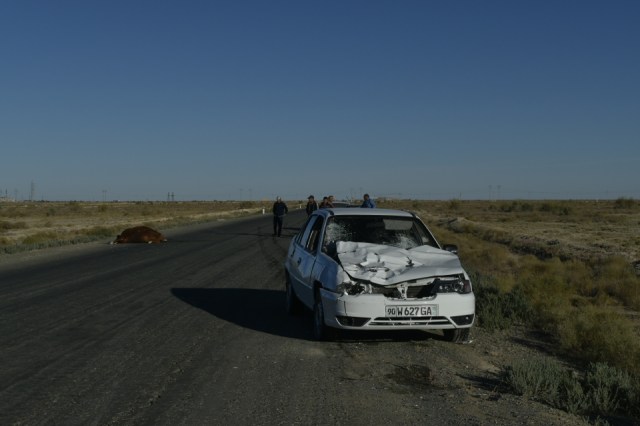
Immediately after leaving in the morning, we came across an accident. A couple of carloads of locals had stopped and were scratching their heads wondering what had happened. There was a very large, very dead, cow on the east bound side. And a very crumpled Daewoo Nexia on the other. But no driver. We figured maybe he was the big guy still asleep on the divan at the hotel. Probably the urgent thing was to contact a truck and a butcher._ctf1954
This tale ends at Kungrad, a fair sized town with our first bazaar, and a population who seemingly have no knowledge of the accommodation it offers. Kungrad marks the transition from desert to agricultural land; there are rivers, wet ditches, and crops, especially cotton, and also,  we think, a few paddy fields. We stopped at Kungrad for a rest day, in which the hotel owner and a friend drove us to see where the Aral Sea used to be.

A night to remember

Our one month visa in Uzbekistan was always going to be stretched. We were both very aware of the blue tiled silk route cities that adorn the country with spectacular minarets, domes and madrassas which have to be high on any tourists agenda but throw in yurt camps in off the beaten track desert areas and Margilon, the centre of silk production in Asia, plus days lost with travellers tummy, it was looking pretty impossible. The obvious answer was to short cut the cycling to get us quickly from one place to another. It feels like cheating; we’re on a bike trip and want to be able to hold our heads up, once we get home, and say, ‘Yes, we cycled’.
We’d spoken a few times about catching a train across the desert between Khiva and Bukhara but we hadn’t booked a ticket. Dropping further behind our travel itinerary due to tummy problems, and wanting to avoid staying in teahouses for the same reason, we decided, after a day cycling, to try hitching the remaining 100km to Bukhara. We put our thumbs out as we coasted to a stop: The very first truck picked us up. We had to ride into town to a pre-chosen hostel in the dark, but that was a small price to pay for a day saved.
On leaving Bukhara, we decided to cycle out of town and once again hitch, but our luck had run out. Having wasted several hours waving a thumb around at various locations over about 70km, we cut our loses & diverted to the next train station. The train left at 2115 leaving us a couple of hours to munch some supper and fret over our 0130 arrival time in Samarkand. The station policeman was very helpful both while buying the ticket and by assigning us a platform helper.
As the train ground to a halt we sped along the now gravel ‘platform’ to the designated carriage. The train guard immediately started ranting along the lines of: no space, too big, won’t fit, but our platform helper was quite insistent –  yes, the bikes were coming. Some further gesticulating resulted in them being quickly stripped and shoved up the steps all but blocking everybody’s passage. Bags followed. Gid & I, plus other passengers, we’re still on the platform as the train started to pull away with a grinding of metal on metal. Some 20 odd carriages from the driver, the outburst of protestations had no impact.  A mad scramble ensued: the platform helper off, a throng of people on, as I was anxiously climbing the steps & looking back for Gid.
We’d boarded on carriage 5, our cabin was in 3. As the train rumbled on we made our way along; pigeon steps, straps caught, doors swung, passengers waiting.
We finally reached our cabin eager to dump the bags. Tucking them under the bed was obvious except there was no under the bed. Once all in we stacked them up as best we could. Thankfully, the other passenger was traveling empty handed and the fourth bed wasn’t taken yet.
Settling down, having made the bed, the peace was shattered as the train guard was back, once again, gesticulating wildly.  ‘Bikes, bikes. Move the bikes’. He had to be joking! There was nowhere to move them to. Not only did they have to be moved but they had to be moved NOW!  He wasn’t prepared to wait for Gid who had popped out for a pee break. Back I went to carriage 5 in a state of disbelief.  Where did he think I was going to put them? There was barely room for two people to pass along the passageway and now we had to leave our bikes outside our cabin. Even this guard didn’t suggest we should get them in it.
With the train rolling, people in the corridor, flapping metal doors, intersections between carriageways and bikes swerving – barely maneuverable around the tight corners – it was quite some task. Once outside our cabin the guard flapped his hand suggesting we took them to the next carriageway access point. They blocked most of the space and limited the use of the connecting door. More wild gesticulations, ‘Can’t I fold them!’ Nope.
Violent jerking on the four hour journey resulted in a tangled heap of bikes, but thankfully nothing broken.
As we approached our station it all started again – move the bikes. They were at the wrong doorway. But this guard was perfectly friendly and kept trying to reassure us that there’d be plenty of time to disembark.
Finally, we left the platform, with the staff wheeling my bike across the tracks. Once through the gates we were greeted by a huddle of taxi drivers eager to take us to poor unsuspecting hoteliers, even at this unearthly hour.  Encouraged by this we made our way to our chosen hostel. The metal doors were firmly locked but rattled outlandishly against the still of the night. The bleary eyed proprietor opened up, the expression on his face said it all. One brief flicker of forgiveness flashed across his face with the words, ‘2 nights?’.

Crossing the desert is gruelling.

During the first multiday section from Bejnue to Nuxus the desert had a lot of ground cover. You could see the sandy soil but there were plenty of small shrubs growing. With that was an abundance, I would now say, of wildlife.
Camels and horses were frequently spotted off in the distance,  hogging the fast lane or moseying across in front of you. Cows , especially around any villages, also making an appearance.  In periods where none of these could be seen it was the turn of our feathered friends with equally frequent sightings of large birds of prey accompanied by marmots, sand rats and gerbils hopping about. (Gid managed to get a photo good enough to identify a Steppe Eagle).
The traffic was so sparse that we were often two abreast, occupying the broad expanse of their highway, chatting away the miles or fumbling around with cameras trying to take action photos while on the move.
But this second section from Khiva to Bukhara is very different. The desert itself has far less vegetation. It’s possible, at times, to see the classic ridges in the sand which is sparsely populated with taller but wispy shrubs. Traffic passes more frequently now but there is nothing out there. Not a living thing that we have seen. Endless kilometers of nothing.  Hour upon hour of nothing.
Except, that is, for  winged torpedoes that dart across my face waiting for a break in my demented arm flapping to make their attack; ears, eyes, nose and mouth are the targets where they can feed on my sweat and spittle.

(Gid managed this section a whole lot better than me. A brief, ‘ bit boring isn’t it’ cast over his shoulder and he was away.)

A Dash of Kazakhstan

Reaching the eastern shore of the Caspian felt like a new chapter in our adventure. Off the ferry, we headed into Aqtau. First impression is – what a normal place. The buildings aren’t notably tatty; nor are there excessive amounts of new marble. The roads are in good repair but not brand new. There weren’t convoys of vehicles that looked overdue for scrapping, nor Baku’s fleets of shiny limousines and SUVs. Curiously,  there were lots of new Ladas, new designs, smooth and round and modern, not seen before. Driving was kind of relaxed, so cycling was unstressful. We easily found a serviceable supermarket with a working ATM. We headed for a slightly posher than usual hotel recommended on a tandemists blog. And who did we see outside, but the little pickle from the ferry. Small world. Topping up the number of seas we’ve swum in, we finished the day with a celebratory dip in the Caspian, as it started to spot with rain.

We looked at a forecast: Rain until tomorrow lunchtime. We can cope with rain, but if we are on dirt roads, everything gets horribly gritty, and camping on bare mud is horrible too. Blogs described some of the next roads as spectacularly awful. Fingers crossed for asphalt and grassy camping.
We made a slow start: overslept, faffed, walked to the Migration Police to register. They said we didn’t need to (later, we exited Kazakhstan without trouble).  We spent an hour at the outdoor shop, getting new bootlaces and hot weather shorts for Gid. Finally, we set the Garmin to guide us to Shetpe, roughly 100km north; and set off in light rain.
Leaving Aqtau. There are, according to Gizi’s map, three roads from Aktau to Shetpe. A loop north west, a loop south east on the main trunk road, or more directly on a smaller road, which I recall someone confirming was asphalt. We, or rather, the Garmin, naturally took the shorter, middle route and it was indeed asphalt, although in places it was poor and bumpy, for 1km dug up. But we liked it: it was very flat, deserty, villages off it occasionally, a rail line and a pipeline, and …  Camels! So lots of photostops. There was not a lot of traffic, but clearly there was a quarry or two ahead. It rained sometimes, and with standing water too, soon the bikes, and parts of us, were caked in fine sand and grit. After about 25km, a quarry truck passed, with the driver half hanging out of his window, making strange, urgent gestures. After 30km, another stopped ahead, and the driver flagged us down. Road closed! Despondently, we turned around. It was already 3pm, we weren’t going to get anywhere today. We went back to the same hotel. At least we were able to clean the bikes, ready for better weather.
Take 2: Porridge for breakfast – Yay! Thankfully it went to plan, and the road was OKish, although on this route, Shetpe was too far to consider staying there for the first night, so we pulled 100m off the road and camped in wet dust – not mud – behind a gas pipeline cock hoping for some concealment.
Shetpe. The morning was still showery, so when we reached Shetpe around lunchtime,  after 60km, we both felt a bit low. Seeing a sign for a “hostel”, there was a unanimous vote for a short day and dry out. The hostel was a work in progress.  The man saw us coming and broke off from building it to open the big steel gate, allowing  us into the bumpy dirt yard. The building was new and the room looked splendid,  with a smart looking shared bathroom. The price was reasonable and dropped to 6000T when we dithered. Only after unloading did I spot the missing link. The karzi was a long drop jobbie in a little blue shack on the other side of the truck graveyard behind.
_ctf1764
One to add to Clare’s toilet tales!
The hostel was mostly quietly occupied by young Kazakh chaps working 8-8 shifts at the quarry. One had been learning English for 3 months, very successfully I thought, and was keen to practice with me, which helped a lot with the visit to the pharmacy, and allowed him to observe that outside, not to say distant, toilets are a Kazakh thing: Practically I suspect the desert doesn’t yield enough water to run flush toilets, or enough slope to design sewers.
Apparently a month before the hostel hosted two girls cycling from Manchester. Exotic indeed – neither of us has ever been there! From the hostel we watched the afternoon’s weather cheer up and dry our laundry.
Next day the weather, and road, changed to the good. We had our first ride really out on the steppe, with a smooth new road, gentle sun, and a bit of a tailwind. There were gentle undulations,  and one hill, signed,  in English,  “the dangerous section” and 12% climb. It was being rebuilt, and so the steepest 1km was a dirt road, but I don’t think more than 8%. Older blogs bemoan this horrible stretch, but short, partly rebuilt, maybe already regraded, and in perfect weather, it isn’t even nibbling at the foot of Turkey’s list of awful climbs. Just as we started it, a van pulled up alongside and offered us water, ain’t that nice. The roads often have a shallow ditch, then low bank, at the side: We camped in the lee of suchlike on a dirt road turn off, after 115km.
Friday, 9th Sept, was also perfect cycling. The westerly side/tailwind was stronger, the sun not too hot. The road undulated gently with one long fast downhill, and maybe a slight loss of height overall. The surface was new and great, except one 10km section being reworked,  diverting us to the old dirt road beside: but after about 4km we thought “sod this” and dragged across 100m to use the tarmac, a decision the few road workers were content with, as long as we stopped to shake hands. We often find this with eastern roadworks, if the work is minor we can go through. The bikes cruised effortlessly at around 30kph, all day, and there were just enough little tea shops selling bottles of iced tea to keep us comfy. We’d planned to camp, but when, around 4pm, we passed “Beyneu 60km”, we both thought we’d go for it, get a comfy bed and a shower. Which we did, covering a record 195km for the day. It was a long day and we were both pretty tired. But 195km, that’s almost 122 miles! This section had been reported as horrible in older blogs. With headwinds it still could be painful, but the road itself is now great.
Honourable mentions to Robert Lange, a German motorcyclist going the other way, we chatted for maybe 20 minutes, and he topped up our water. And the lorry driver who overtook, stopped, and asked if we’d like a lift.
Beyneu. Has many hotels, the first we tried in the gathering dark was fine. Following our mammoth effort we declared a rest day and stocked up on provisions.
Kazakhstan is a relatively rich, and equal, country compared to many we’ve visited. But today here in Kazakhstan I was again aware of poverty I’ve never been exposed to before when in a shop teeming with people buying their groceries. We guessed it was payday in a cash economy. The queue was far too long to wait in a hot stuffy atmosphere, our purchases weren’t vital, so we decided to return later. Whereupon, I waited behind a lady to pay.  She brought out a small pack of coins all counted into smaller bags according to their denomination.  The coins were very small and the process was time consuming.  Once counted they went into a large ‘ice cream’ container behind the counter along with all the other small coins.  Clearly, quite a few customers paid in small coins.  Passing by outside, the lady was loading her shopping into a Lada.  It was covered in rust holes and the door didn’t quite shut but presumably it was going to get them home and live for another day.
The day after, we set off for the Uzbekistan border, blogged separately. So we had only 8 days in immense Kazakhstan. It feels like we barely scratched the surface of its intriguing potential, and friendly people. Some final pictures of Beyneu:


All Aboard

Deciding early on we didn’t like the hassle of Turkmenistan’s visas and conditions, left us the route options of a northern route via Russia, or taking the “ferry” from Baku, Azerbaijan to Aktau (Aqtau), Kazakhstan. The “ferry” is not arranged like a scheduled public ferry, it’s more that tourists can have spare space on a rail/truck shuttle. That was what we chose.
Cycle touring blogs abound with tales of the hassle, faff, and hardship involved. A lot of it is probably due to language issues and Soviet approach to service: Although most individuals are helpful, the system isn’t. The operators publish no user information, so the web is full of garbled advice, from everyone’s individual experience, but perhaps too often folk assume their example shows what the system is, when really it’s quite variable and ad-hoc. So here’s our experience:
Following online advice, we went to find the Baku ticket office. The directions on welovemountains were helpful, although Baku changes fast and the last bit differed: the rough road and grey tatty building are gone. The new port entrance is smart. To the left of it, the port’s electricity substation is stone or marble clad and lettered in gold. Right and just inside the port entrance barrier (and its helpful guard) is an old shipping container, painted white and turned into the ticket kiosk. The recommended lady, Vika, inside from 11am on our days, does indeed speak English. So far so good.
It took me a while to fully grasp what Vika was saying: “Call tomorrow to find out if there’s a ship tomorrow. Yes, on the same day. We open at 11am. The ship will go from Alat, 80km away.” So depending on sailing time, it may be impossible or a terrible scramble to actually catch the boat.
I asked, “Can we only buy tickets here”: Answer, “Yes, here”. It sounds clear, but three English lads in a car bought theirs in Alat, so clearly incorrect. Probably Vika didn’t get the “only”. Or meant that she didn’t sell anything but tickets (my bad English!). But I believed it, so with a day or two in hand, we checked out travel options to Alat:
Cycle: Allow 6 hours, dual carriageway, not too hilly. Ok if getting to port at 6pm is acceptible. Actually, on the day, it pissed down, so just as well we didn’t.
Coach: Station is about an hour’s crap ride from the ticket office. Bus ticket sales staff not able to help, I couldn’t find timetable. Not even sure if a full size coach goes that way. Small coaches can’t take bikes.
Bus: Service 195 apparently, from 20-ci. But getting bikes on buses is not easy.
Minibus: (from coach station, services for Sabirabad). No fixed schedule or tickets, drivers helpful about the bikes “no problem”. Probably best cheap option, but cycling cross town, then waiting for it to go could make it little faster than riding.
Train: English no use at train station, couldn’t even get times. Staff told us bikes not allowed on Azeri trains, although other Azeris say that’s not true.
Taxi: Almost all are saloons & can’t carry bikes. We wandered about the day before until we saw a big estate taxi, flagged it down and got a number. Got the hotel to call driver, agree a price and times. This worked well, and was quick, although at the end there was a disagreement about the fare. No idea if genuine or if driver was trying it on. We took responsibility for the last stage of navigating, driver wasn’t familiar with Alat Port.
Anyway, next day at 11, I call, and wooooo, there’s a ship: Be at Alat at 17:00. Rushed over to ticket office with both passports (needed), and cash. Prices were quoted in USD, but Vika said we could be paid in Manat or USD. $110 each, bike free, including cabin, bedding, food. I took Manat, using the typical exchange rate, and had a pleasant surprise that the exchange rate used worked out significantly cheaper. There was some delay finding the cashier person, but really it was smooth enough.  I did, however, get entangled in Baku’s one-way system on the way home. Anyway, we got tickets for Merkuri 1.
Again advice was confusing, we saw stuff online that cars and trucks can be loaded at Baku, whereas rail and foot passengers board at Alat, or occasionally vice versa. We boarded at Alat, where we cycled on, via vehicle ramp, noting the presence of rail tracks from inside the port onto the boat, so they could have loaded rail cars. But in fact we were followed by trucks, and finally a Ford Fiesta containing three English lads, Ivor, Martin, Andy on a post college jolly. I suspect that, as the entire fleet has the same dimensions, any of them can load anything at either port, but perhaps they don’t mix road and rail cargoes – another ship alongside was filling up with railcars. I don’t think trucks were part of these ship’s or docks original design, as the artics and dolly towers alike all had to reverse off.
The whole paperwork and loading process, both our personal bit and the whole ship, was way slower than a European car ferry. We’d been told to arrive 17:00 and were early, waited to be called up about 17:15, and were on-board about 18:15, bikes tucked in a corner before loading trucks. The three lads in a car, waiting before us, boarded last, car filling last gap, after 21:00 when the canteen had closed. Actual departure was about 22:30.
On boarding, and lashing down, we carried all our bags up (groan) to our room, including the heavy provisions we’d bought for the journey, after terrible online warnings about the food.
There’s no announcements on ship, but it’s easy enough to stroll along to the bridge and ask the current plan. I was originally told we’d dock about 22:30 (having departed almost exactly 24 hours before). But at 22:00 we heard the anchor going down, and I strolled f’ward to be told it’d be the morning (the dock was occupied). That was good for us – a comfy bed for the night, instead of dumped ashore at midnight. In fact it was about midday when we docked. And the crew were correct in predicting about an hour for Kazakhstan customs. All passengers had to leave the ship (and bulky luggage), do the paperwork (ok), reembark, and roll off. Customs then did a moderately thorough search, and in my case, had a go on the bike. I guess we were rolling by about 13:30. In our case just into Aqtau, to stock up for the long empty roads of Western Kazakhstan.
As for the ferry and voyage, it was fine, nothing matching the dreadful online reports. The sea was calm. Merkuri 1 was showing her 31 years, but everything important worked. The 2 bed cabin was rather tatty, but spacious, with an opening porthole, shower (sometimes hot, sometimes not), desk, loads of storage, and really comfy new mattresses. The 3 meals a day were basic but ok. It took me a while to find it, but there was always cay available. There didn’t seem any way to spend money on the ship, except for using phone data while near land.
Clare was violently ill in the first night. It must’ve been food poisoning.  But the timing makes it difficult to pin it on the ship’s cook. Just as likely to be the dodgy supermarket sausage sandwich she had while we waited to board. However we did thereafter both avoid the salad at mealtimes, as raw, unpeeled, fruit is generally a known risk.
Crew were friendly and helpful, but mostly without English. But in a fix, make for the bridge – I guess English is mandatory for marine VHF on international waters. Special mention for the stewardess who bangs on the doors at mealtimes, actually she more or less dragged us out of the cabin to the dining room. Below, she is putting out the laundry.
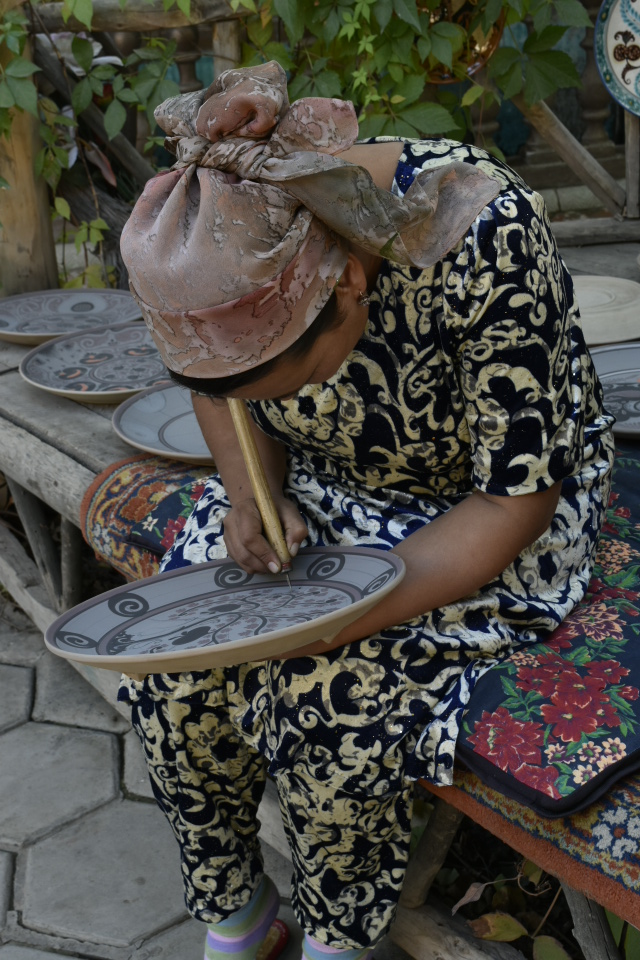
Other passengers mostly Turkish truckers, all friendly, the 3 English, and 3 folk from Aqtau, 2 ladies and a little pickle, who was spoilt rotten by everyone. I’m sure P&O wouldn’t have been keen on the round-the-ship-chase, climbing the mast at night, and steering-the-ship-even-though-you-can’t-see-over-the-console (tho’ I suspect the autopilot was on).
So yes, we had to be a bit flexible on timing, but apart from needlessly rushing from ticket sale in Baku, and Clare’s tummy, it was a walk in the park.
We celebrated passing this milestone with a dip in the Caspian (much cleaner looking in Aqtau than in downwind Baku). As it started to patter with rain.
img_0408