This is a quick update post by Gideon, with unfortunate news.
From Peru, we made a quick transition across – not down – Chile, to Argentina. We expected to return to Chile at some point south.
But, after only a few days in Argentina, Clare had an accident. She’s not badly hurt (thanks for asking!), but has a broken collarbone and cracked rib. At the very least, she can’t ride for many weeks.
The Argentine emergency and medical services have been effective and helpful. No other vehicle involved, so no complications with las policias. Who very helpfully recovered her bike to the station, for retrieval later. No charge for this excellent service. The ambulance and hospital also very easy to deal with, even with my limited Spanish. some fees, but very modest. After a few hours with the medics, Clare was discharged into my care at a convenient hotel. Travel insurance engaged quickly, but it doesn’t look like it’s any sort of claim scenario, as the costs have been negligible.
The accident was rather hard to explain. We had just come out of some roadworks onto tarmac, in a sparse queue of traffic, which was slowly gaining speed, but still at maybe 25-35kph. I was behind, Clare’s bike suddenly started to fishtail and swerve, before falling on its right side and sliding across the road to the verge. Luckily no traffic coming the other way. There was a strip of thin, slimey, mud from the water-sprayed roadworks, and I guess there was virtually zero grip for a little bit. Neither of us spotted it coming, although I wasn’t directly behind and didn’t see or traverse that muddy bit. Neither bike nor Clare hit much solid. So really quite a minor tumble, she’s quite unlucky to break stuff. Maybe the Helite saved some injury, maybe not as she might have hit the ground still seated. A lot of bikers do apparently repeatedly break collarbones. I dropped my bike on the verge and ran over. Someone stopped. One guy called the emergencies, I cared, a lady prayed. Bike is ok, BTW, a few scuffs.
Clare can’t ride in the time left available to us. And maybe won’t want to afterwards. Or maybe it’s just not wise, after this warning, to continue into the known difficult riding conditions in Patagonia – we are quite old, and not expert riders on loose surfaces, after all. We have some awkward choices to make.
Stash the bikes, fly home, and return in either 3 or 7 months. If riding more seems ok.
Send the bikes home, then continue in a hire car. Shipping is very expensive though.
“Sell” the bikes, then continue in a hire car. We can’t actually sell them in Argentina, but we can lend them to another foreigner on a poder (like an English Power of Attorney). The poder is needed to take out insurance and cross borders. Once they exit Argentina we can sort out the Alaskan title and registration.
The dominating factor is, bizarrely to UK eyes, the Argentine (all of SA, actually) regulations appertaining to foreign vehicles brought in by non-residents. Still, we’ll find a (legal) way through.
Decisions – But these are still first world problems. We’ll sort it out.
Apologies, we’re a little behind with our blog: It’s now October, and this relates our time in Arizona and Nevada, 25th Aug to 7th Sept. More soon!We also had a bit of an IT disaster and lost a lot of Clare’s pictures from August and September, so the imagery isn’t what it should be.
Next on the list of must see destinations was the Grand Canyon. Having done our homework we knew that the Northern rim was thought to be the more spectacular of the two. We set off from Flagstaff heading in totally the wrong direction – southwards. We wanted to take in the scenic roads that were either marked on the map or had been recommended by other bikers. But we were in luck – to get to the northern rim – we had to ride along the southern rim – bonus! Being a weekend the super route out and round to the south was rather over crowded and we were happy to get out of it but crowds were something we were going to have to get used to as we reached the more populated areas.
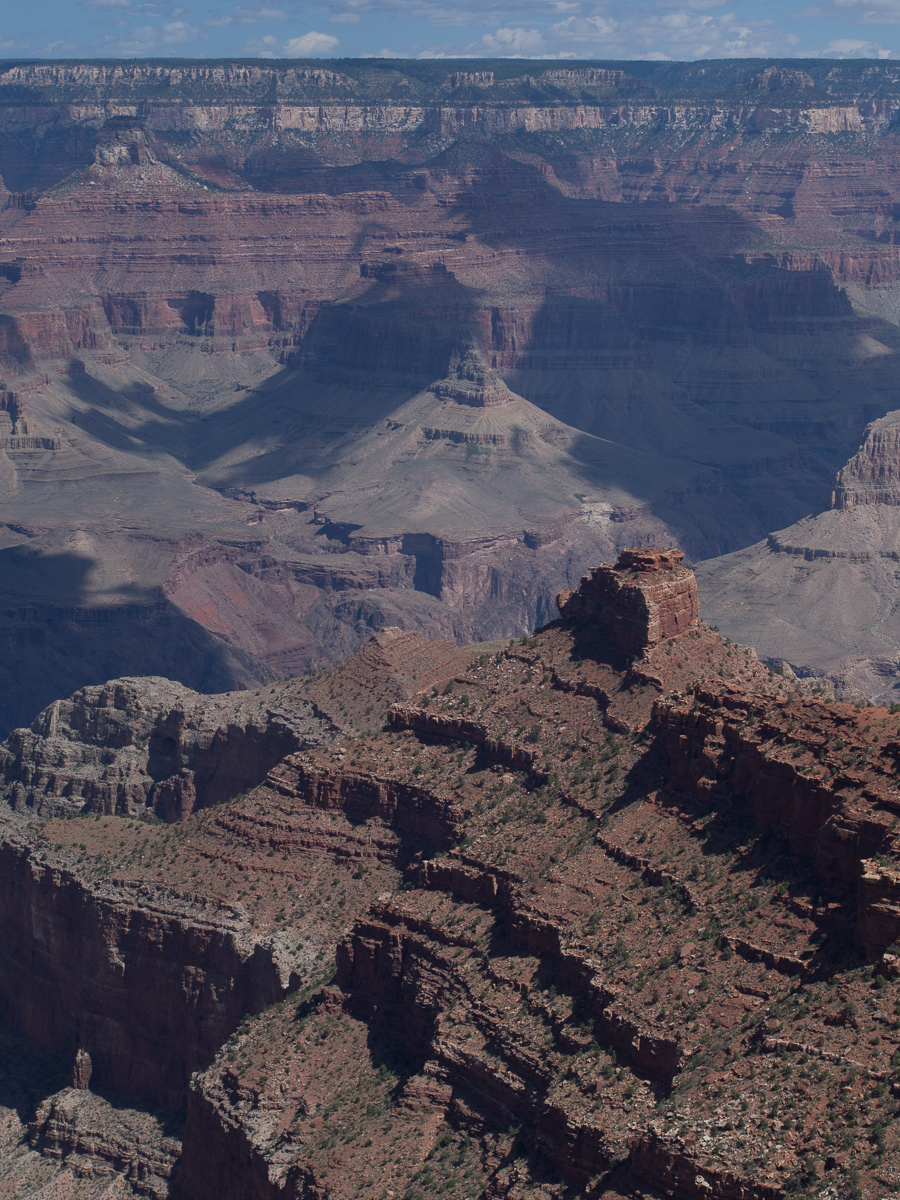
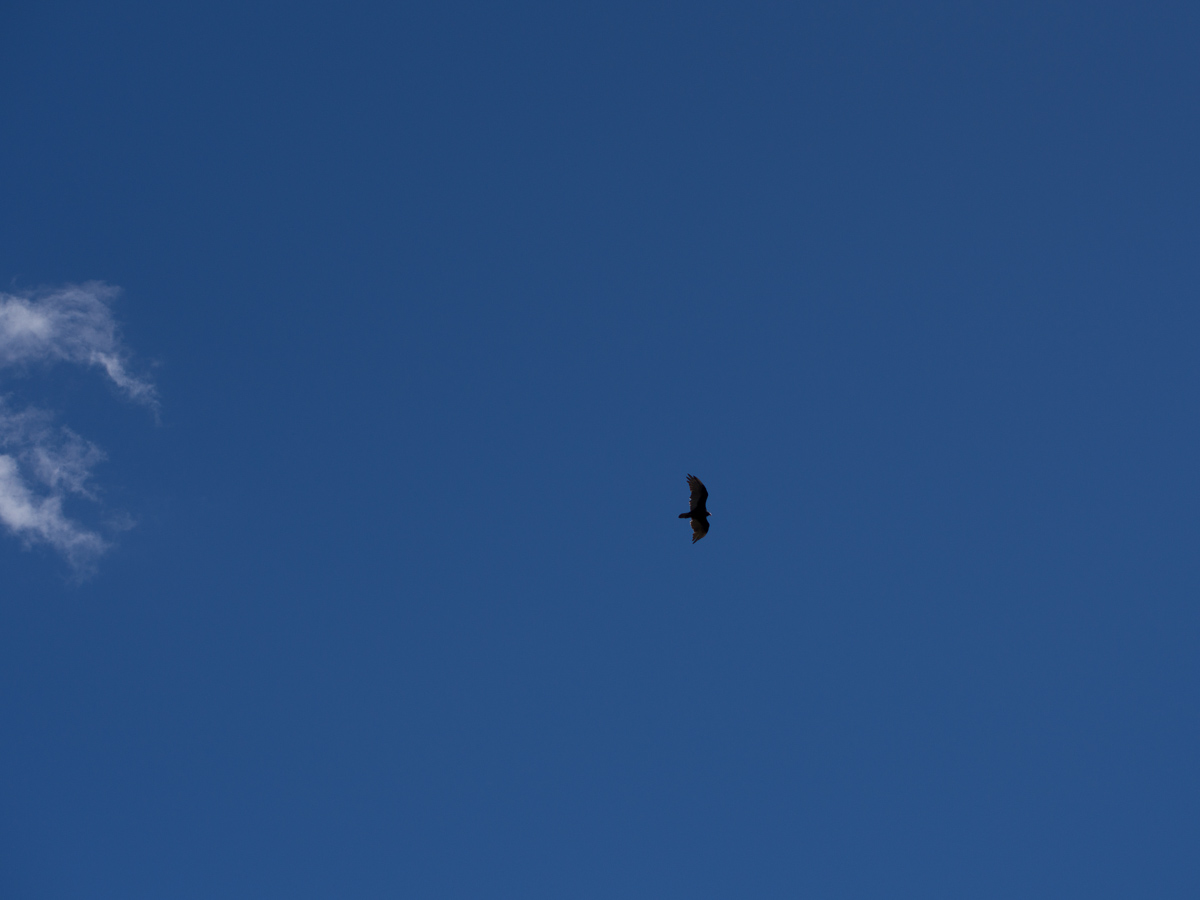
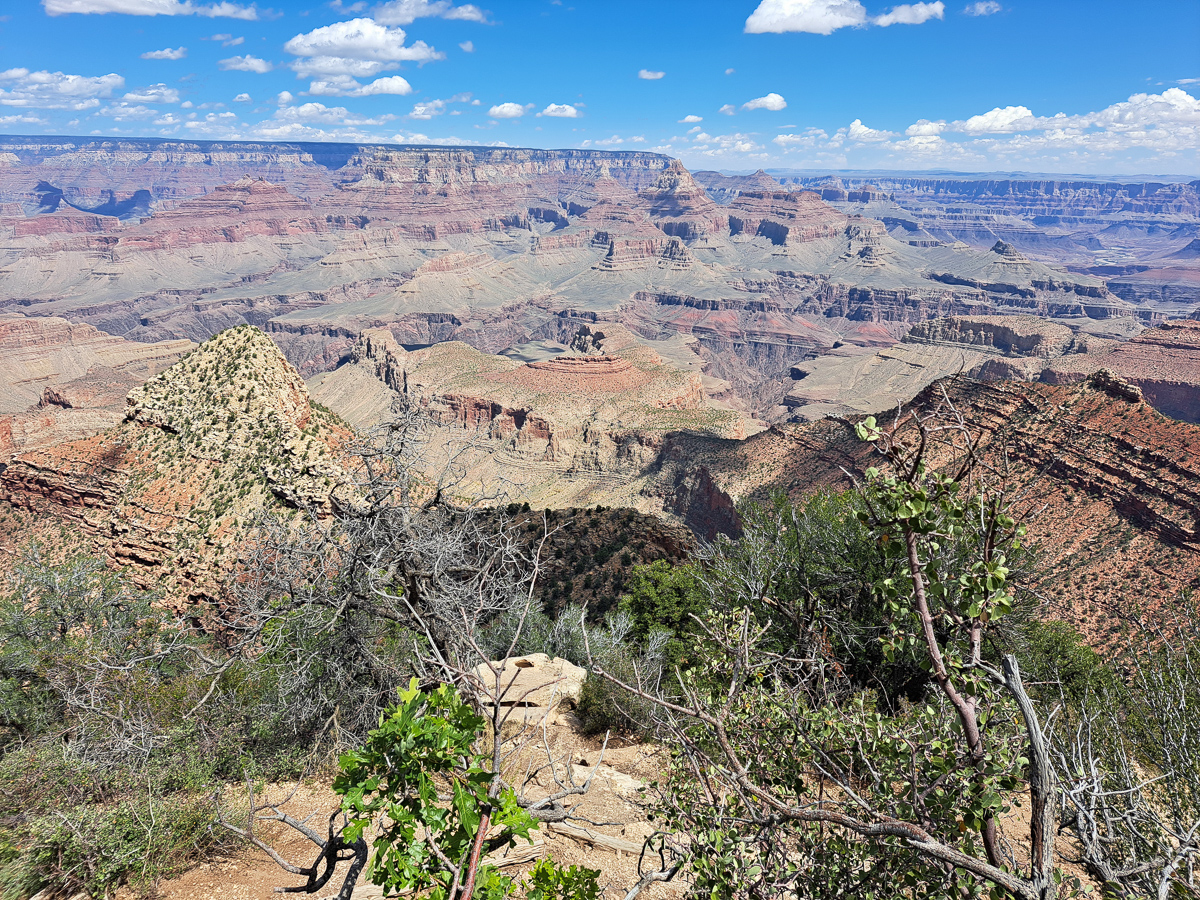
Along the southern rim we stopped at three vista points and learnt that the gorge was formed by opposing tectonic plates clashing and forcing each other up. This created a raised plateau. From there the Colorado river cut through the rock. Because there is not enough information left geologists don’t know why the river didn’t take an easier route around the outer edge. The high levels of silt carried by the river have carved a deep gorge which continues to cut its course to this day. The gorge was beautiful but the vultures stole the day. Several vultures and some falcons rode the thermals swooping to and fro right in front of us. ‘Have you got it? Have you got it?’ we cried as another swept past.
Up at the Northern rim an elderly park guide was enthusing to us about the benefits of doing the North Rim road. He told us that there were many viewing points and it was good use of our time. But Gid was keen to do one of the walks. Neither of us considered the whole day North Kaibab trail. An 8 mi down 8 mi up marathon but we did think we could do one of the shorter ones. Was there time for both? ‘Of course there was,’ I exclaimed. And off we went.
On the rim road the information boards were very useful although I couldn’t see the ‘obvious’ fault lines on the southern side of the canyon. We were excited to glimpse the Colorado river on a number of occasions as we stopped and started along the route. We seemed to have swapped the birds for some views of the murky river. I was pleased we’d seen both sides.
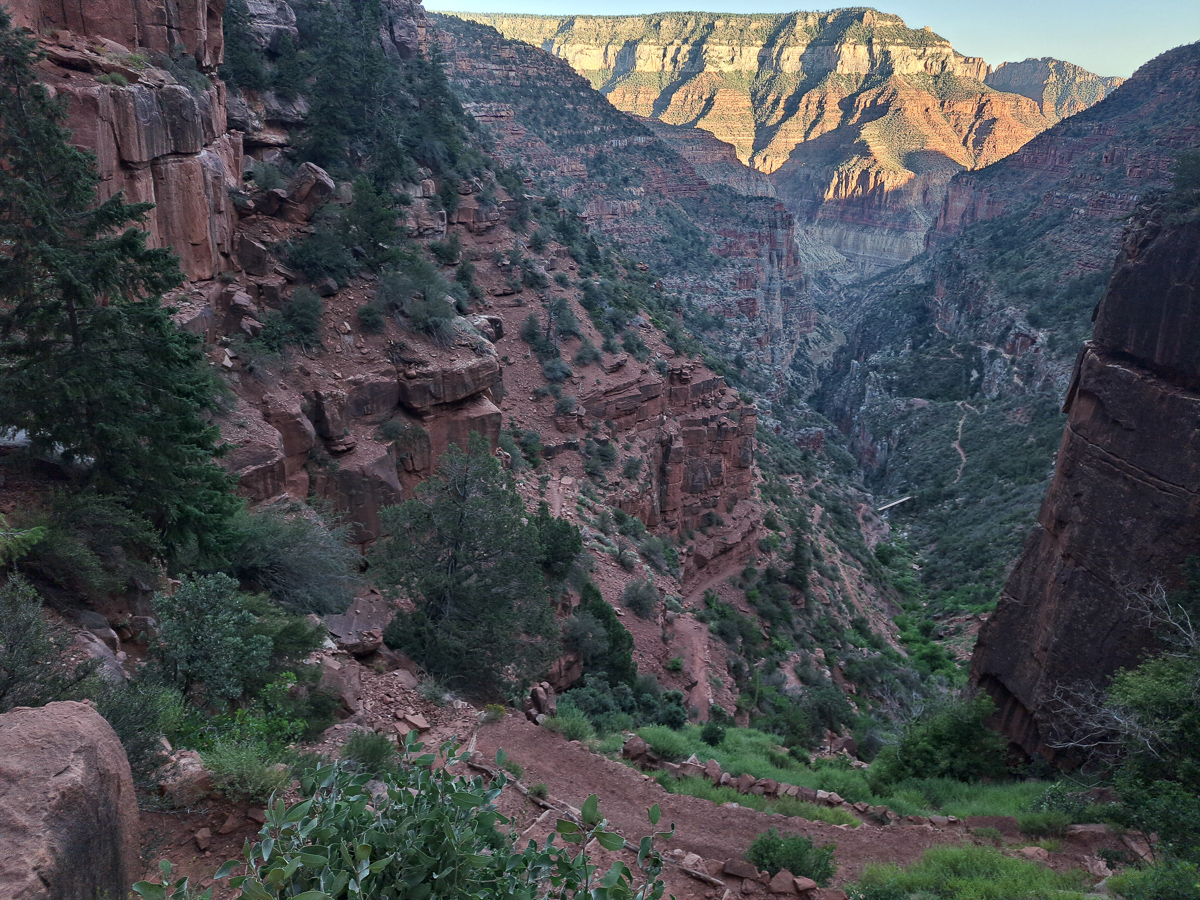
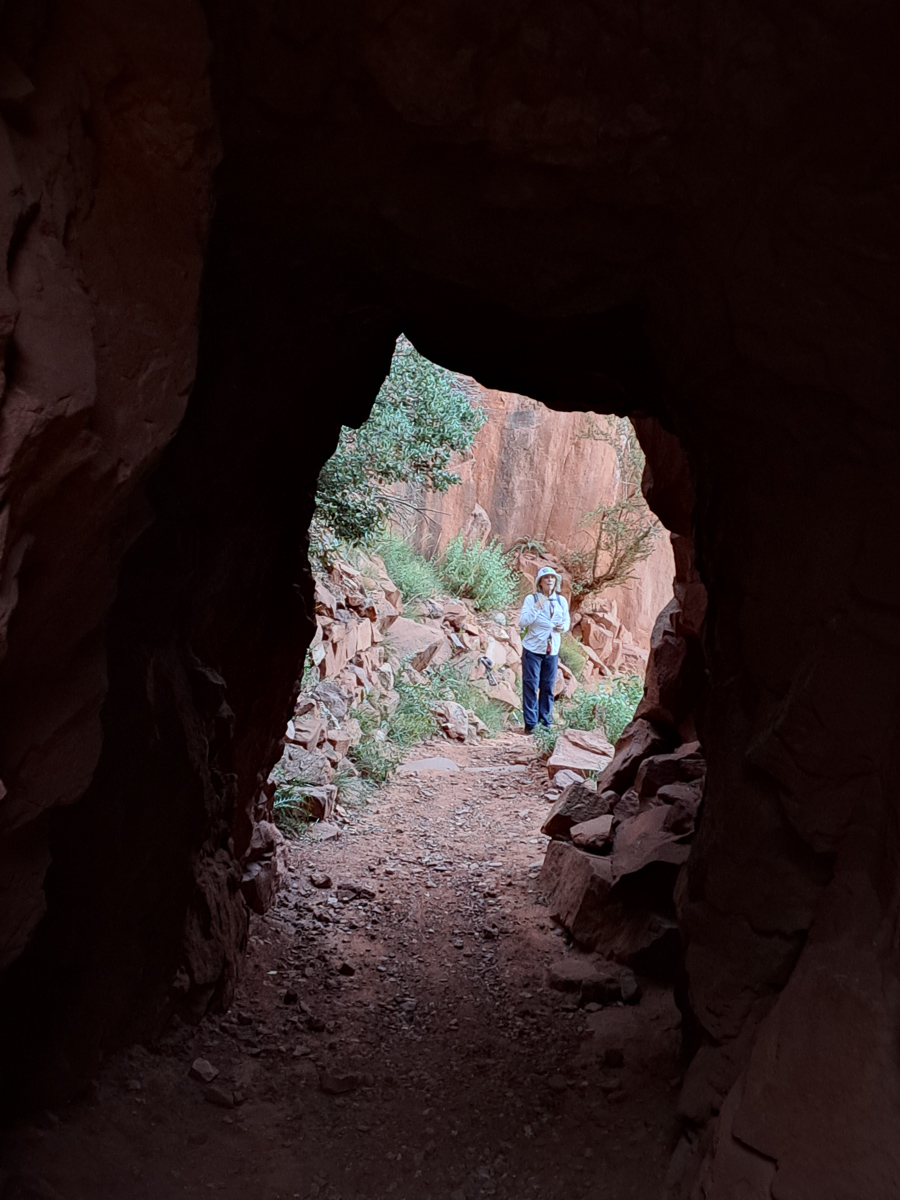
We hurried back to the start of the scenic tour road to pick up the hiking trail. It was 5:15 when we set off on what was described as a 2-4hr hike. We had torches and had been advised to take more water which we dutifully got. Our walking speed is middling on most timed trails so I was predicting our return at around 8:15. It’s dark by 8. On a very uneven track how good was my torch? Gid normally leads down hill and me coming back up, but I set off at a fair pace. I wasn’t messing around we needed to speed this up. Meeting a few people along the way was encouraging. They were all on their way back but it was still nice to know we weren’t totally alone. A few ‘not far now’ comments gave us encouragement but meeting a father and young daughter a few hundred metres short of our destination, Supai Tunnel, was quite a surprise. We went through the tunnel, gazed down at the zig zagging path disappearing into the depths of the gorge and were ready to turn back. One couple we’d met had done the whole day hike. They’d set off at 8 in the morning and were on course to make it back completing their trek in just under 16 hours.
We made it back in good time just about catching up with the youngster and her dad. Amazingly we did the round trip in just over two hours with just enough daylight, to pack our kit and set off back to the campsite.
We hadn’t got far the following morning before stopping for fuel. Parked on the apron was a Royal Enfield Continental GT. Paying for our fuel in the garage it was obvious who the Enfield belonged to. This distinguished gent with a broad grin, a thick red beard and plaited hair readily admitted it was his bike. We asked him about the unusual racking system he had and his tin seat. Out we went to look at them. He enthusiastically told us about his project to reduce the weight of the bike. He lifted up the tin seat shaped to fit the gap between the metal rods and read from the bottom what the old seat had weighed and what his new tin seat weighed. He proudly declared weight the saving. He repeated this exercise with the side guards which were now leather flaps with another recorded saving. The next project was the rear rack he declared. That was trickly though as it had to take the cat. At first I thought the bag of empty 5lt water bottles somehow housed the cat. The cat, his travelling companion he informed us, was out prowling around back at camp. The cat, he told us, could only manage three hours at a time on the bike. With that saddle I’m sure I couldn’t manage any more.
Jamie Burns, the distinguished gent, had never been to Scotland even though he was directly related to Robert Burns the infamous Scottish poet. ‘I can’t go!’ he exclaimed. ‘I’d have to set foot on English soil and I’ll never be doing that.’ A little later Gid pointed out the he must share some considerable empathy for the Native Americans with the atrocities that they suffered at the hands of the new settlers. But he seemed to be handling American soil ok.
The Grand Canyon, Petrified Forest and our stop in Flagstaff ticked off Arizona: We were making good Pan-Am progress towards Ushuaia, on the southern tip of Argentina. Next stop Mexico? Nope. North westwards to northern California. We couldn’t miss the Pacific coast and the redwoods. So we turned, heading back north up towards the northern tip of California. We aren’t fond of megopolises, so for the second time, we avoided Salt Lake City, and this time, Las Vegas too progressing diagonally between them. We’d soon have 12000mi under our belts so we chose Reno, Nevada, for a service stop. It’s big enough to have everything, but not oppressively huge. Airbnb host Tyler was ok with us changing oil in the shade of his carport, and Royal Enfield dealer Eurobikes had got the service parts and our three new tyres in.
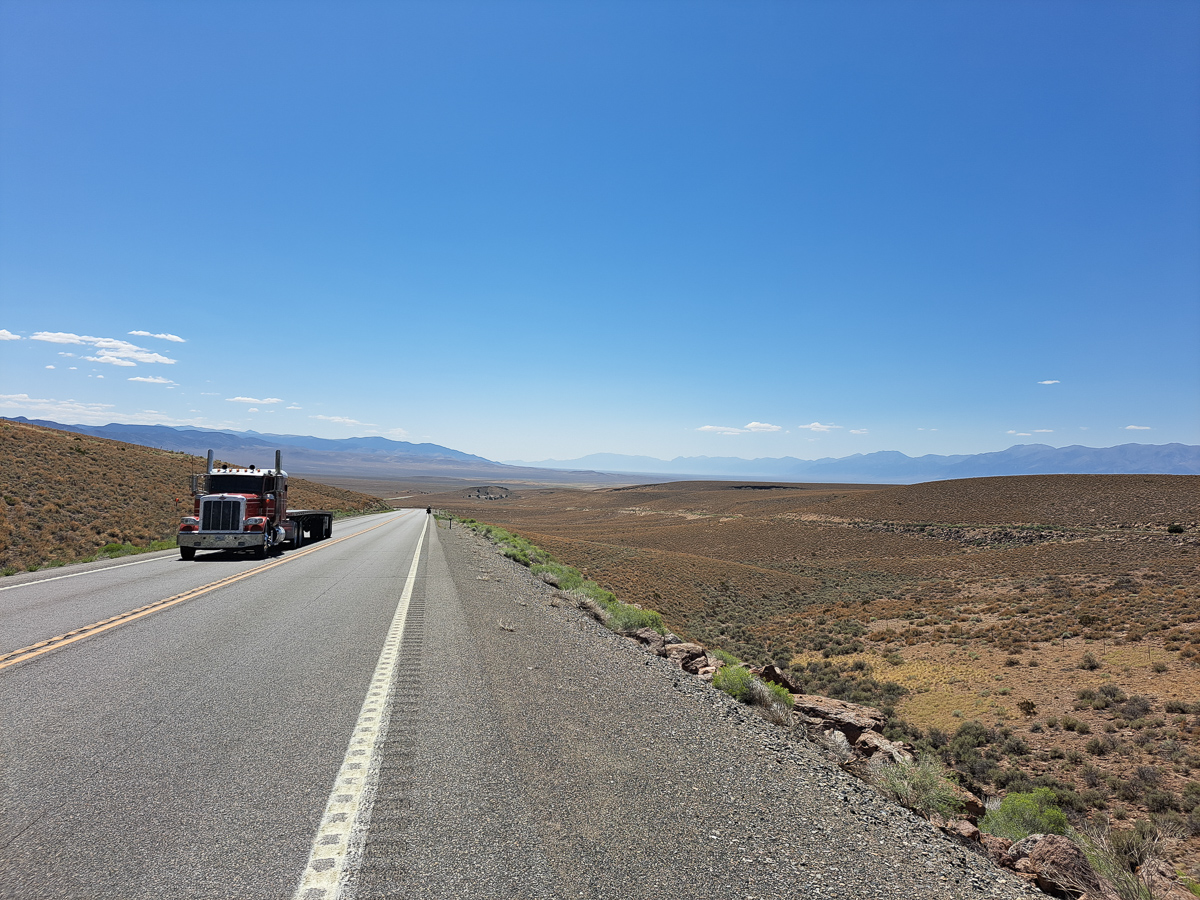
We headed westwards towards Reno along Highway 50 crossing the often empty Nevada, which passes just south of Reno. It’s dubbed ‘the loneliest Highway in America’ and served us well as it had little traffic. The section we travelled from Ely to Silver Springs traversed great plains where there was very little to see except the next mountain range to cross. It took ages crossing each plain, then we’d ascend up the mountains. Most roads carve a pass through the summit with rocky cliffs towering on either side. Pancake pass – 1988m – being the unusual one because it was flat.
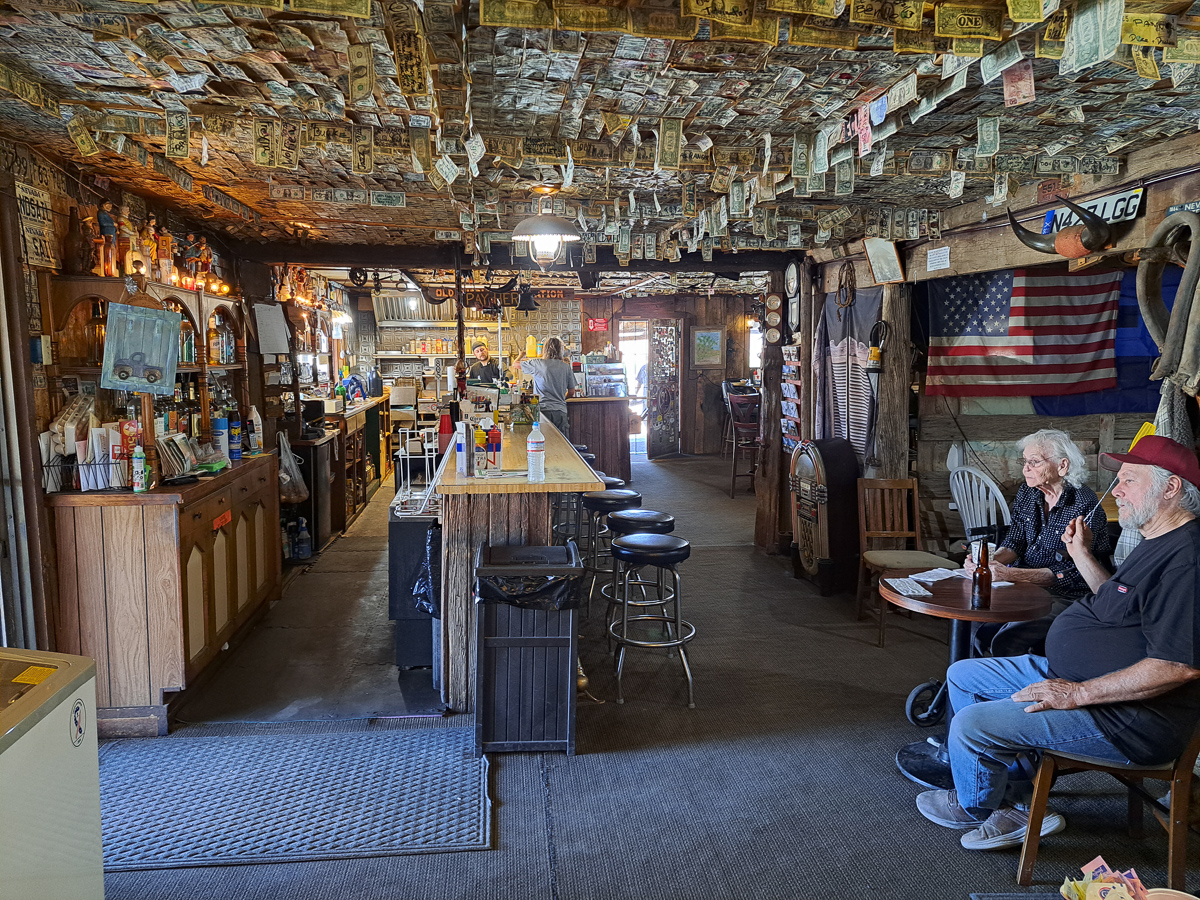
The Pony Express central change over point at Old Middlegate Station on HWY50 was a wonderful choice for a stopping place, full of memorabilia with posters for ”Wanted’ criminals – Dead or Alive’, legalised prostitution advertisements and pony express riders job offers not to be missed. Providing, that is that, you were under 18 and preferably an orphan who was prepared for high risk and possible death from their chosen employment. The place was stacked with relics from the past both inside and out. A quaint mix of old and modern as the petrol pump boldly claimed ‘no lead’. Not now perhaps but there’s been no shortage of lead flying around this place I’m sure. To add to the authenticity signage pointed out that Ned Kelly’s house was a stone’s throw away.
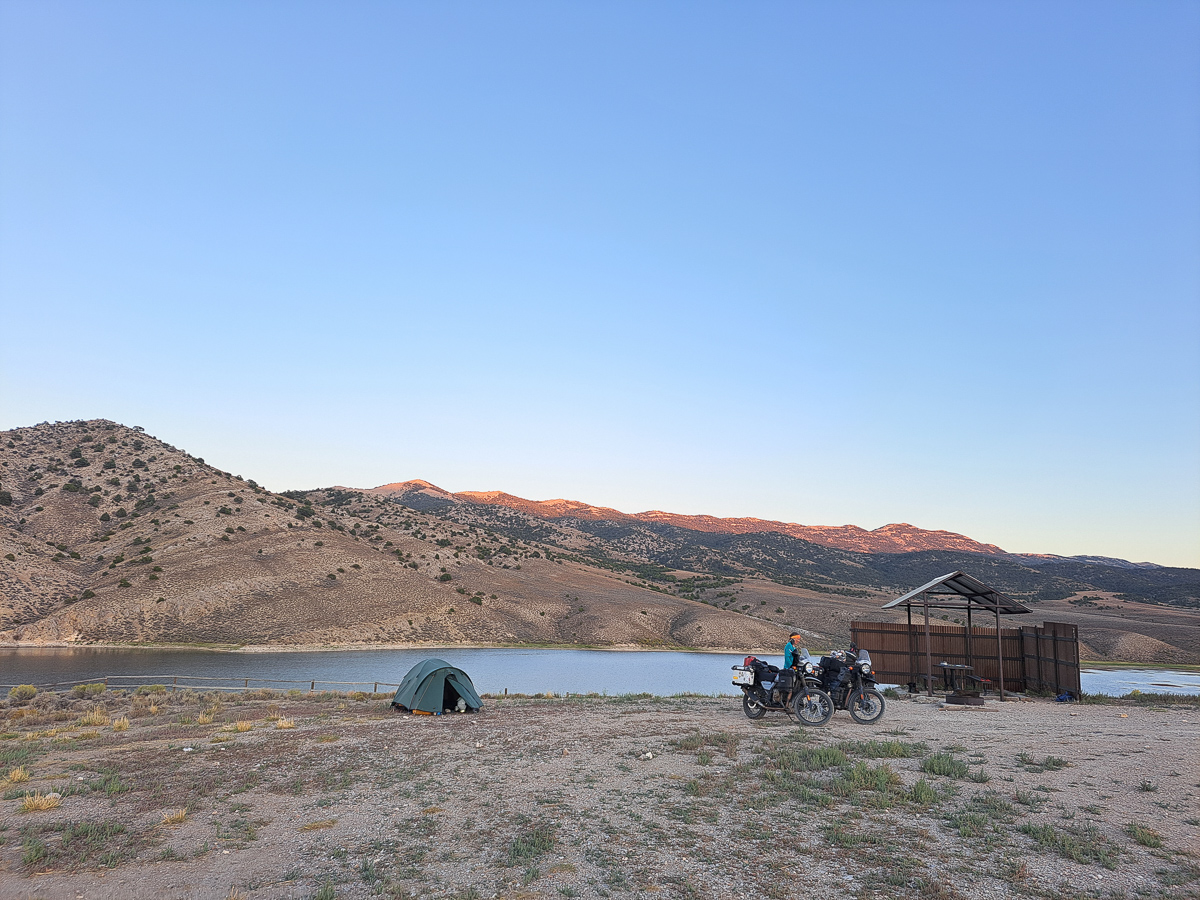
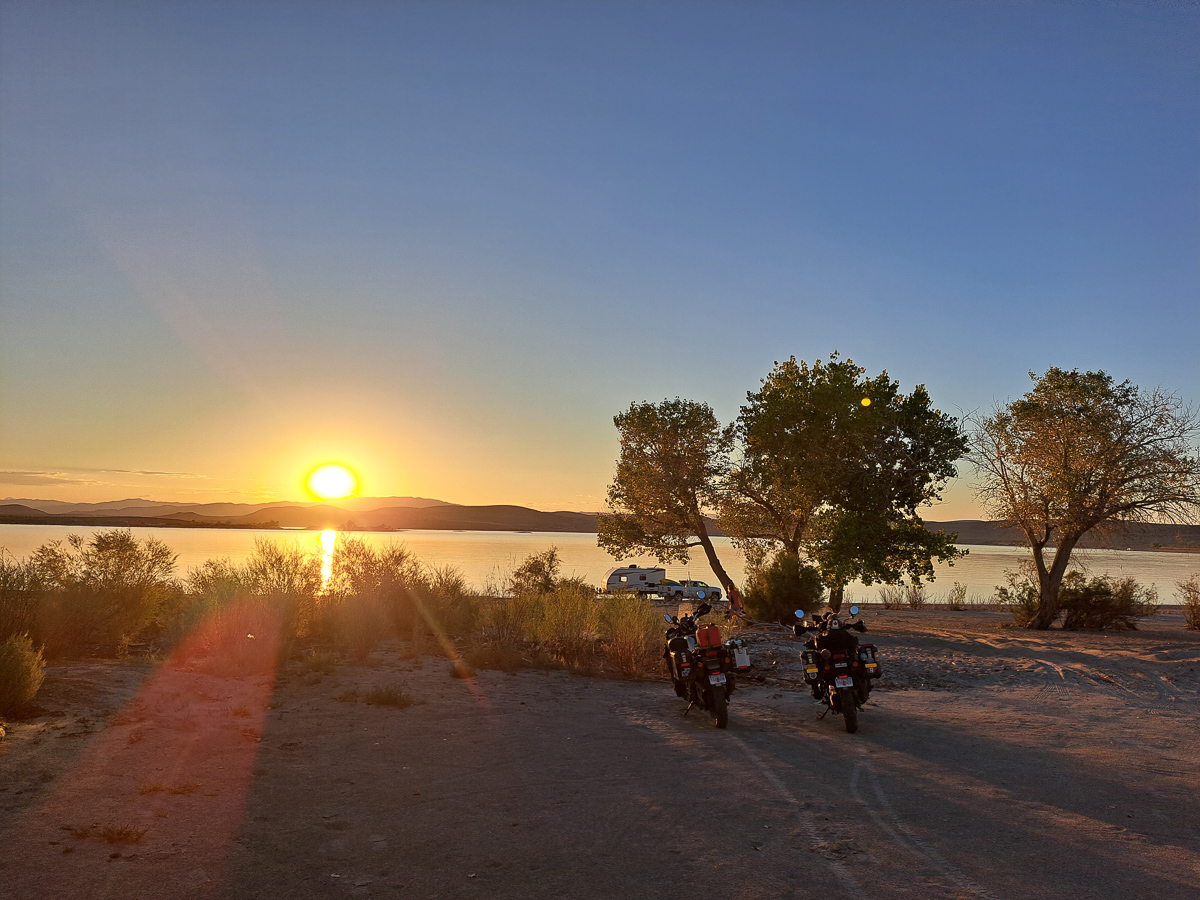
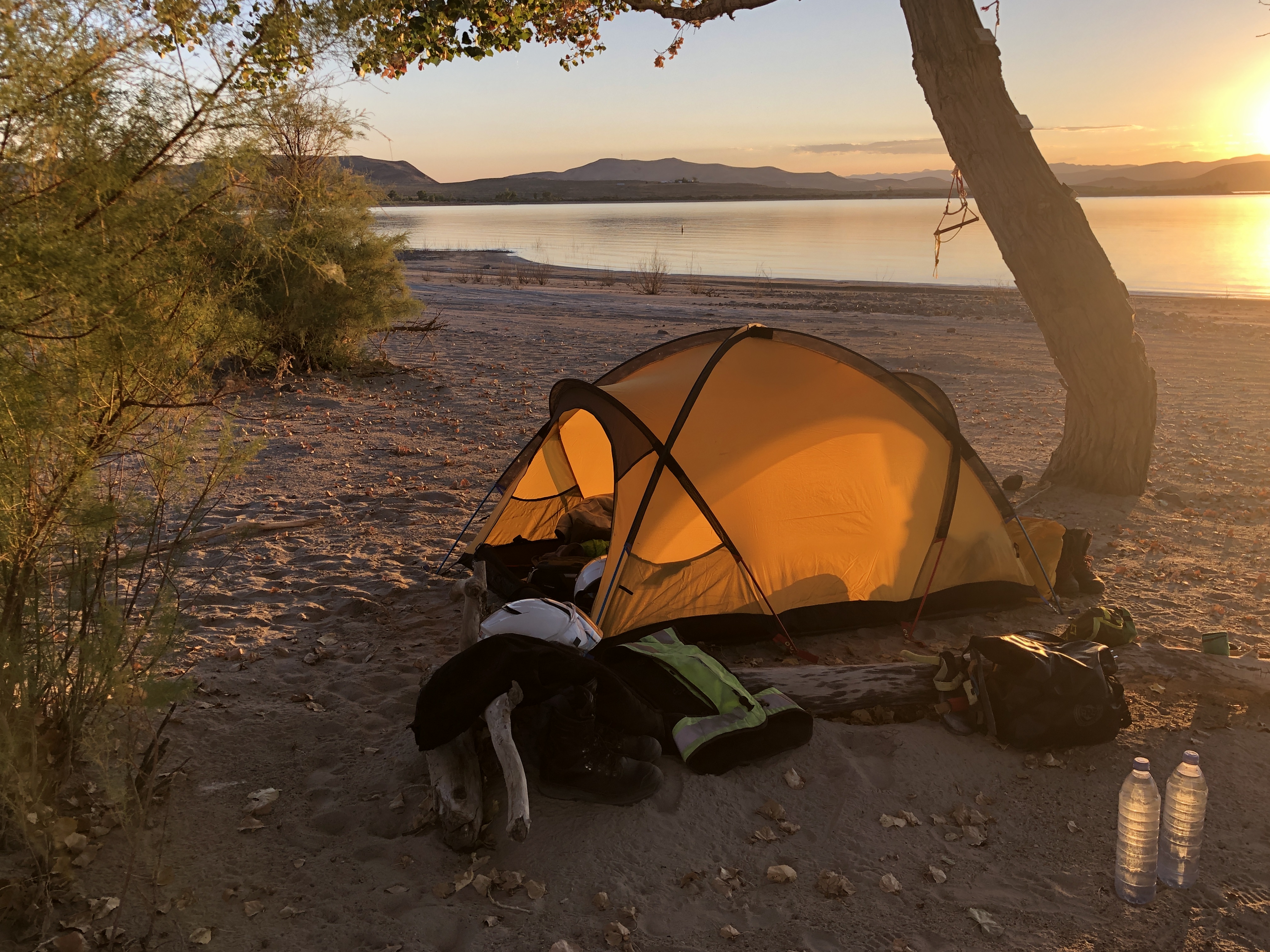
Our arrival in Reno was a little bit complicated, as we’d booked the Airbnb for Sunday onwards, not realising Monday was Labor Day. Eurobikes and almost everywhere would be shut. We needed to be close by Friday night, ready to hit the store Saturday morning to collect the service kits. Experience told us that even ordinary summer weekends could crowd out the campsites leaving us struggling. Lake Lahontan State Park was 30 miles out, a big reservoir with sandy shores, it seemed like a great retreat. We arrived with some trepidation about availability, but paid our fee at the unattended gate. We’d hoped for a pitch we could swim at, but there was a Red Warning stating that the lake was unfit for recreational purposes because the algae levels were unacceptably high. Oh no! But we trundled round the shore, surveying the ad-hoc camping. We found a beach spot facing the sunset: firm sand to park, soft sand and shady trees to camp. One RV right down on the shore was 50 metres away. The next units maybe 200m one way in a thicket, and 1000m the other. On this side of the lake, people were swimming. Definitely one of our nicest sites! We stayed two nights, enjoying a starlit evening chat with the neighbours.
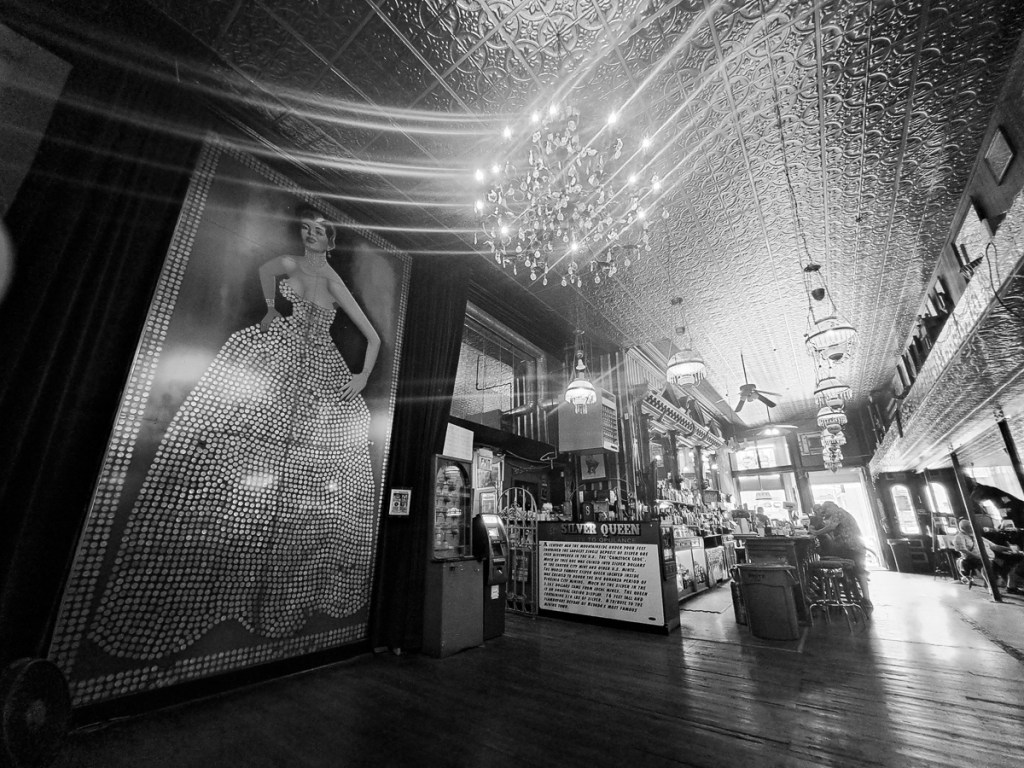
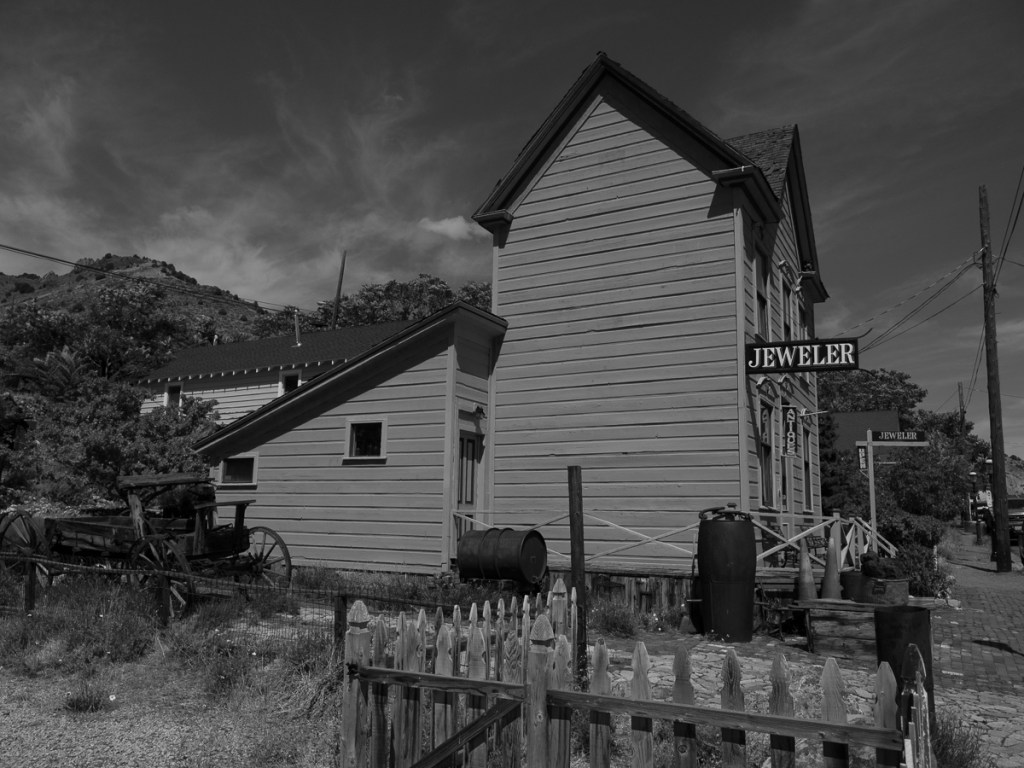
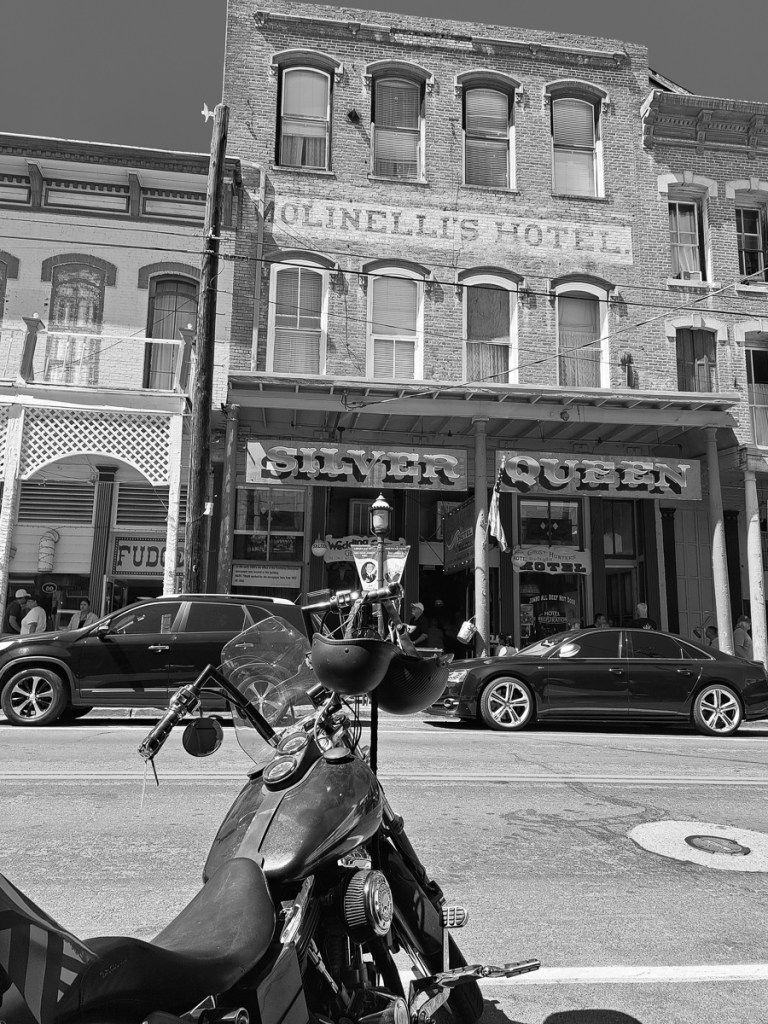
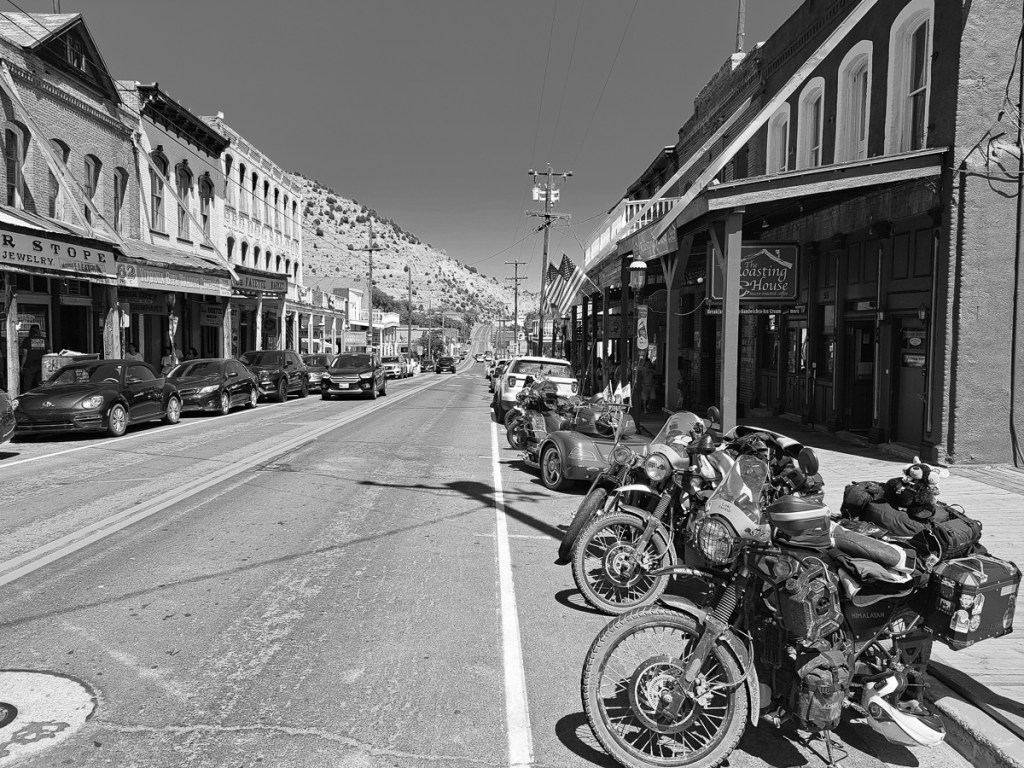
It was a short freeway ride to Reno on Saturday, but to return, we saw a wiggly back route going through Virginia City and tried it. It turned out to be a local bikers’ favourite. Virginia City – City it says. Obviously swayed by the city part of it’s name I was expecting something big. Bigger that is than a half mile main street, and not a lot else. Rather than the boom and bust of many towns where a natural resource is found, Virginia City, once the mountain of silver under the city was depleted, has managed to maintain prominence albeit now as a tourist attraction. Its high street is frozen in the style of 100 years ago with original buildings and facades, as are the rickety board walks beneath the overhangs. There are tourist attractions like: the Silver Queen Hotel where the lady’s silver dress is a floor to ceiling art work modelled in silver dollars mined beneath the city. There are many saloons, some with swing doors, eateries and tat shops, and events like camel races for the more competitive amongst us.
OLYMPUS DIGITAL CAMERA
Mark Twain, at least his wax model, peers out of one window where he used to work as a newspaper reporter. Words such as ‘never let the truth get in the way of a good story’, accredited to him, live on. His famous novels, Huckleberry Finn and The Adventures of Tom Sawyer still make it onto many a reading list. The local museum claiming ‘Of great interest to adults and children’ displays many relics from past life in the area. Virginia City became our regular route between Reno and Lahontan.
The servicing went to plan. Having done it all before it was quicker this time. Now Gid is becoming familiar with the process he’ll let me play too – next service I hope to do the oil changes.
We’d noted the bike chains had needed occasional adjustment, but annoyingly, as we approached Reno, Gid was having to tighten them every couple of days. Knackered. We ordered replacement chains and sprockets at the Reno dealer but RE gave no delivery date. Were they coming from Wisconsin or Chennai? We decided to wait into next week before requesting that they might be posted forwards. The dealership had a branch at the coast and was happy for us to collect them en-route but we couldn’t continue to stay with Tyler. With time to kill we needed a new home.
To get away from the bustle of city while we waited we went off to explore Lake Tahoe. Our Lonely Planet guide book describes it as a very popular location for winter skiing with slightly fewer visitors in summer. Wrong! It, or rather its shoreline, was teeming with people. Adding to the frustration most campsites were closed because the trails were being repaired and supplies were dumped in campgrounds. We u-turned and got out of there as fast as possible, riding right back up the 9,000ft pass we’d come in on, returning to Mt Rose campsite near the top. It was beautiful. Pine trees spread around large boulders – the sort of things that are called erratics in Norway having been randomly dropped by the receding glaciers but here they were at 10000 ft high! It was beautifully peaceful, until the generators started. The site host agreed that it was a beautiful area informing us, with a wry smile, that the noisy school group had left 2hrs ago. It was nice for one night, but we couldn’t think of a better option than returning to Lahontan. The exact same spot, and now the nearest neighbours were maybe 2km away. No cossies needed.
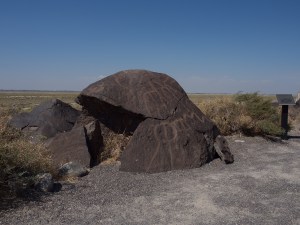
Having missed petroglyphs at the Petrified Trees NP I was keen to see the ones in this area. Grimes Point, the site of the petroglyphs and the Hidden Cave, wasn’t far away and reportedly had the best examples so it had to be done. We would have liked to have seen the Hidden Caves, also at the site, but on contacting the area office to arrange a guided trip we were informed that due to sickness that was off. Thousands of years ago the Hidden Cave appears to have been a site of storage: furs, tools and remains of clothing were found there. It’s under lock and key now to preserve the site for future generations but our wished for visit wasn’t going to happen. On the self guided walk around the petroglyphs, the boards told us that human habitation in the area dates back to 8000 years ago. Lahontan Lake, now some 20-30 miles away where our tent was, would once have been lapping the edge of this area. The boulders, plenty big enough to hide behind, would have been the perfect site to hunt the animals who came to drink. Shaman, responsible to communicating with the gods to ensure a successful hunt, may have been responsible for the pecked or carved rock art.
Finally – good news – the chains and sprockets were in. We’d already been on Bunk-a-Biker and made contact with a friendly soul who offered us a bed, a workshop, and a breaker bar, just over the border in California. We were off again, albeit only for 60 miles.
Apologies, this is published about 3 months after we got back! A certain lack of immediacy pervades it.
So, exit the wilds of Scandinavia to a different mode of touring. From here on,we have crowds of cities, book-loads of history.
We knew little of Finland before. One salient point striking us Britons, not just about Finland but everywhere until near home, was how recent so many countries are. From Finland through to Poland, for most of the last several hundred years they had been part of the Czar’s empire. Freed in the Russian Revolution, all but much of Finland were back under Russia’s thumb by 1940 or 45, until the end of the 1980s. So “independence” in the modern age lasted just 20 years or so, before restarting in 1990 or thereabouts. And in that 20 years, they’d fought amongst themselves quite a bit. In the last hundred years north eastern Europe’s national borders have been far from static, and don’t entirely match the language and cultural boundaries. So a lot of the “history” felt as if it were still lurking nearby, and might resume any moment. Well it did resume: The ongoing war in Ukraine added a very big dose of edginess to that feeling.
I should probably apologise for my historical ignorance demonstrated below, and for accidentally treading on anyone’s sensitivities.
We rented a budget apartment in Helsinki for a few days. Importantly, we were able to get one with secure parking, although access was convoluted. It was a sunny 4km hike into central Helsinki. Nice to wander and explore, as true tourists. We found a huge deli supermarket, the first time since Copenhagen there had been such a choice of yummy, or healthy, things. Though, no, there weren’t any paper maps of eastern Europe in the shops. Lots of history to visit and try to comprehend.
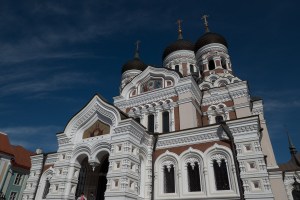
Russian Orthodox Architecture
Industrial era cannon on island of Suomenlinna outside Helsinki
WW11 Finnish submarine Vesikko
On 16th August, 2 months after our ferry to Holland, we boarded the comfy ferry from Helsinki, to Tallin, capital of Estonia. Aboard we chatted with pair of Latvian bikers and admired their Smartin Adventure luggage and crash protection on their bikes, a new TransAlp and a T7. Another young Lithuanian was on a CFMoto. Of course, we all had been to Nordkapp.
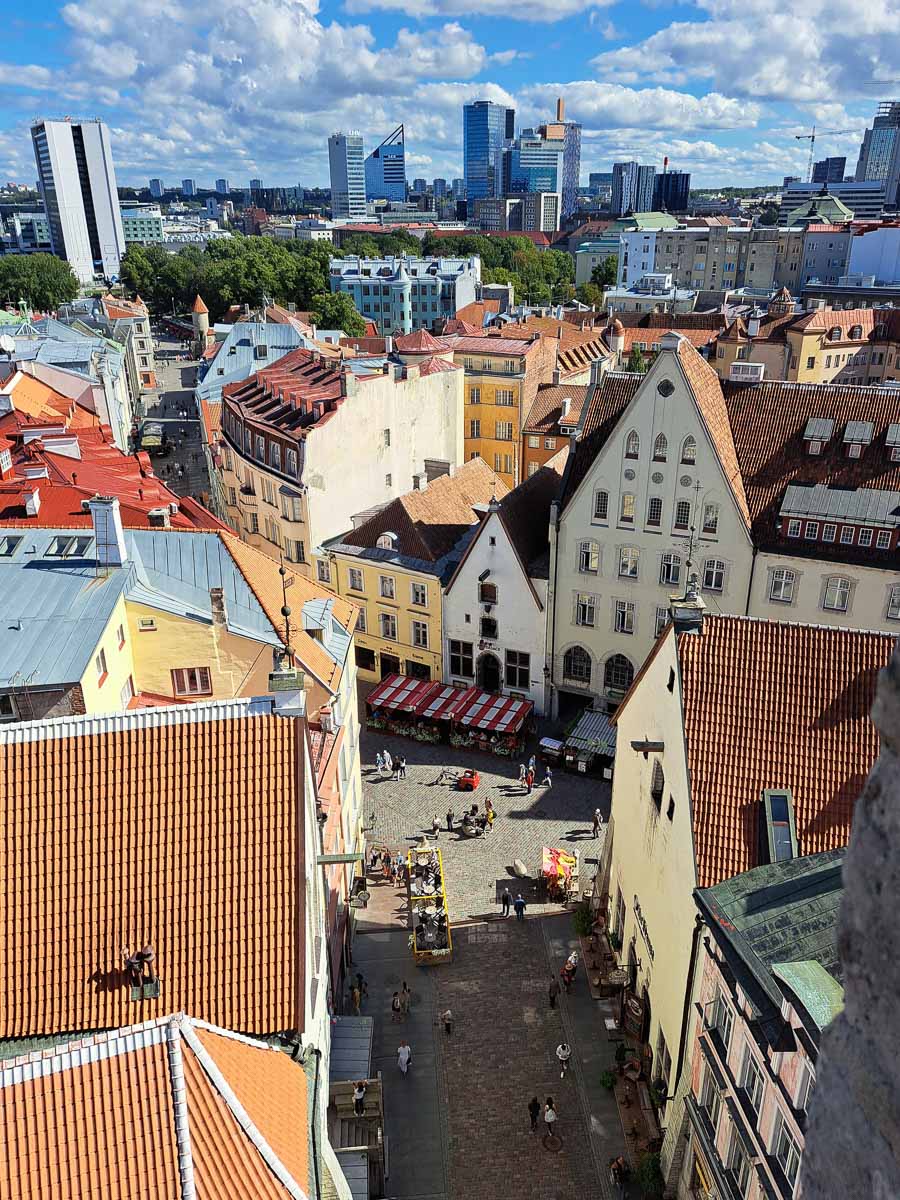
In Tallin we stayed at a curious camping-in-a-garden, in a sort of cubicle in a sort of gazebo. It worked well enough, and was walkable to the centre. It’s a lovely old town, although far less old than it looks, being rebuilt, after WW11 laid much of it flat. Like many Baltic ports, it is famously an “Hanseatic” city, founded by the medieval trading alliance. We started learning about the Livonians, and were surprised to learn that they and others brought (presumably, imposed) Christianity to these parts only around the time the Muslim Ottomans finally extinguished the Christian Byzantine Empire at Constantinople, in the 15th century, 800 years after the monks brought Christianity to the back-end-of-beyond island of Britain. But, of course, the Romans never controlled this territory or anywhere nearby. What did they ever do for us, eh?
We knew Clare’s bike would be due a major service while we were away, now it was due, and my rear tyre looked pretty sad. Unfortunately no outfit in Helsinki could fit the big service in over our three days planned stop, but Helsinki Honda did do me a new tyre. I’ve ended up defaulting to Bridgestone’s BT23, my earlier fitting of 80:20 road/offroad adventure tyres brought no reward on dry gravel tracks or wet grass, and they’re never in stock; the BT23s seem to always be ready, be it Oban, Worthing or Helsinki. Yamaha Tallin did Clare’s big service and a fork service too. Mechanic one of those slightly curmudgeonly sorts who will often go a bit beyond. Good value, that was. Two pillion runs as we shuttled about for a day exploring Tallin.
We explored further east in Estonia, along the northern coast, ending up in Narva, whose medieval fortress looks across a river at a contemporary Russian fortress. Nearby is a heavily secured border crossing, much less busy than it was before 2022. The mediaeval fortress was interesting to explore, but had been rebuilt. We recalled our cycling adventures in the ‘stans, also part of the Czar’s empire, later the Soviet Union, now independent. There also, the great historical castles were quite often thoroughly maintained, and kept in good repair. We saw a lot more of it as we worked our way west. A very different approach to here in the UK, dotted with scenic ruins, most of which have been left unrepaired since Cromwell blew them up.
We’re in Narva.That over there is Russia, the sea is not far to our right.
I’d always thought of the three Baltic states as “small”, but actually they are each very roughly twice the size of Wales; yet the combined population is less than twice that of Wales, so there’s plenty of forest. Somewhere in the Baltic capitals, we managed to acquire a paper road atlas of the three countries. It made planning a lot easier, and just fitted in my map case. Many of the minor roads were unsurfaced, often the atlas legend was a good guide. As remarked in our Finland posting, we’re pretty slow on dirt roads! Having escaped from the Soviet Union only 30 years ago, and being sparsely populated, the countryside in the Baltics is often a bit unimproved. As always in countries with lots of space, there are derelict buildings – it must make more sense to start again on a new plot.
It’s a small world. We stopped at a rather posh campsite, and there, again, was a German couple from the Tallin campsite-in-a-garden. Less probably then arrived 2 guys, Danes, a father on a Harley and son supporting in car, we’d met before at a curious backroad roadhouse in Finland. But, to confuse us, they’d parted from the second biking father & caged son they were then with, and, they’d exchanged facial hairstyles – the beard had moved to the son. Monthly shaves, like me! Beer was a reasonable €1.50 for a can, so I had my first since Denmark or Germany.
Speaking of beer, somewhere random in Estonia, we turned a corner on a country road, and dropped straight into a random breath test. Clear, of course, and no trouble, but a reminder that from Tallin on, there are really rather a lot of police about. In Scandinavia they are almost invisible. Poland, too, we were pulled over there for no apparent reason, and the cop’s explanation seemed rather, err, weak. Apparently there had been a lot of accidents, so he was certain he wanted to check our V5s (vehicle registration documents). Not sure how those avoid accidents, and he didn’t check our insurance, tyres, or breath. Perhaps he was just curious – seemed a nice chap.
We moved on to Latvia. And wondered in our ignorant English fashion – why are there three countries here, anyway? As so often: Language and religion. Each of the three is quite distinct: Estonia’s language is related to Finnish, and Lutheranism dominates religious life, plus a fair following of Orthodox churches. Latvia’s language is one of the last remnants of the Baltic family, and again Lutherans are the most common religious community. Lithuanian is also a Baltic language, but quite different from Latvian, and most of the population is Catholic. We were also noting, whenever we learned about recent history, that the monolithic Soviet Union, that dominated a lot of the UK’s foreign attention in our youth (the far off sixties, seventies and eighties), wasn’t quite so monolithic after all. The three Baltic states (and for that matter, the ‘stans) did a lot of stuff their own way, and were quite careful of their borders and differences. Much more like the USA than the UK, except that Russia was rather more dominant than the USA’s most populous state.
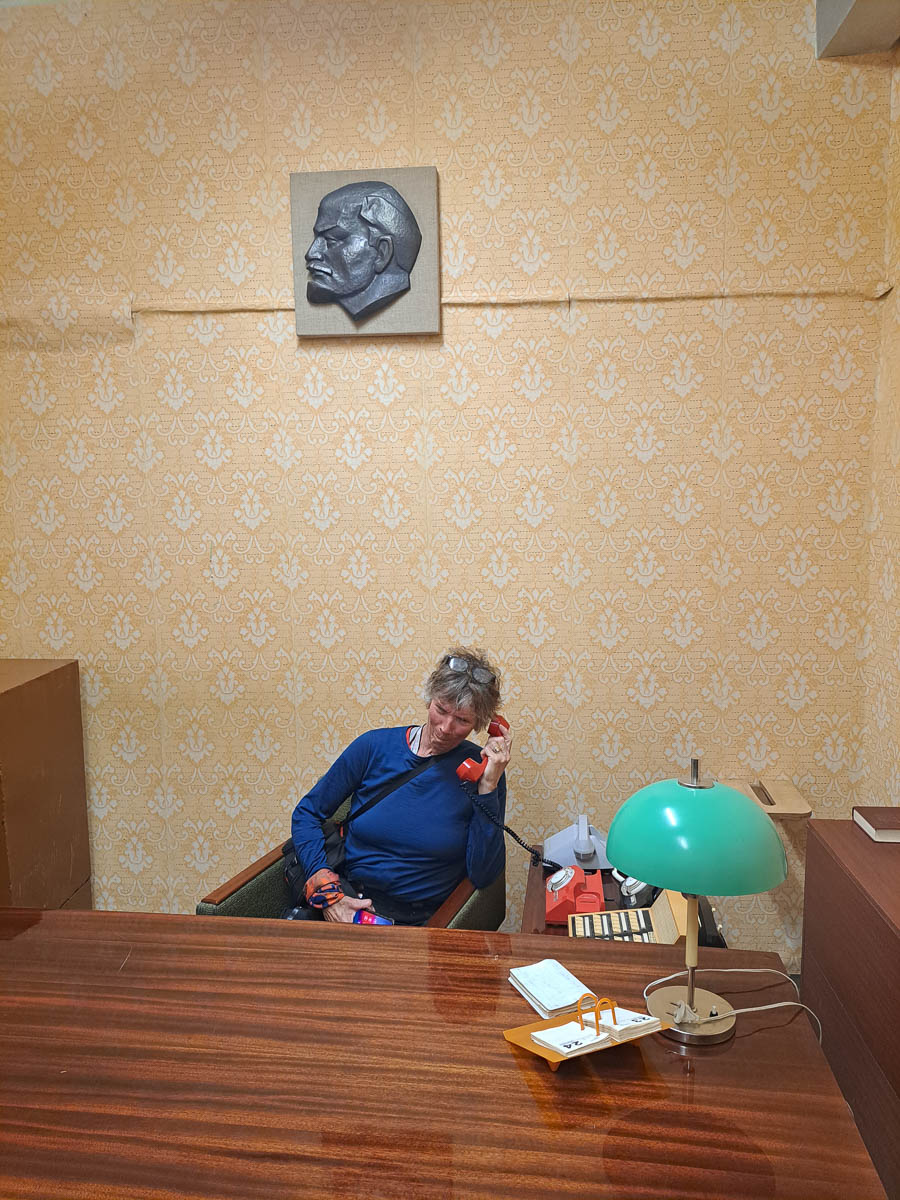
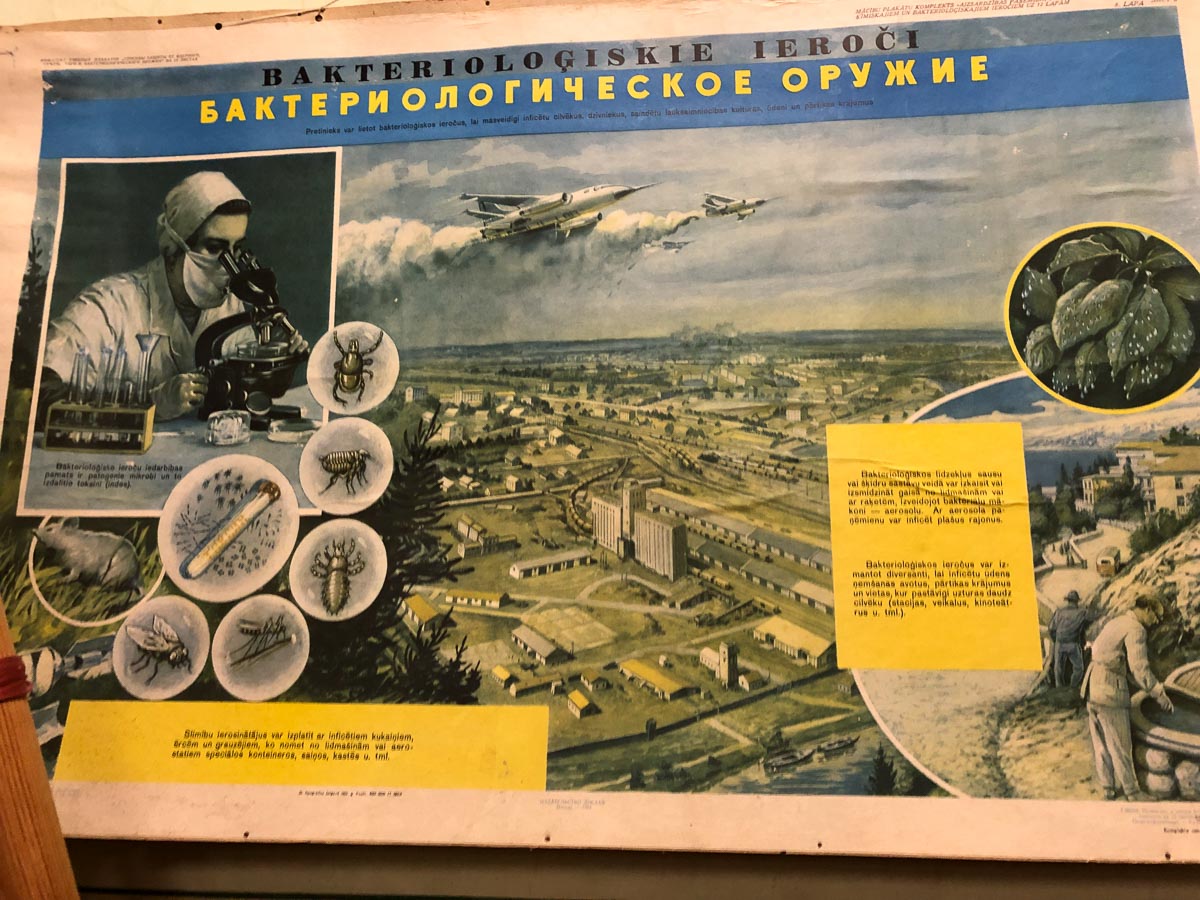
One of the most fascinating places in Latvia was a 1980s bunker, built by, and for, the government, so they could continue during and after a nuclear war (that’d be, ahem, our bombs then. Blush). The Latvian civilian politburo probably weren’t treated to the latest technology available, and, the Soviets didn’t much go on consumer electronics, and it had to work in a nuclear war, and, it was a bunker, so the technology and ambience looked pretty archaic. You could film Stalin, or Hitler, or Churchill working in this bunker and “continuity” wouldn’t baulk at almost all the equipment. It would have impressed Lloyd George or the Kaiser though. And it might still work, unlike modern electronics with a 5 year life. The generators do still work, as they use them to power the sanitorium above the bunker.
It’s ok – Clare doesn’t speak Latviski or Русский!
It might seem a bit of an odd, though pleasant and countrified, location for the, still operating, sanitorium, but apparently it was built there only to disguise the bunker. Did MI6 know about the bunker? Well, Latvia wasn’t alone – try googling “UK cold war bunker”. Indeed – Subterranea Britannica describes several, albeit smallish, cold war bunkers in our home county Sussex alone!
Bunker green by Dulux
They still run, we’re told
Not sure if way in or way out!
Tactfully, there’s no national emblem on those planes
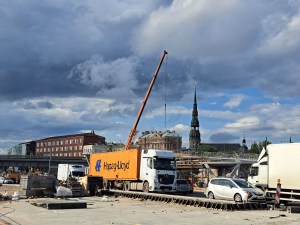
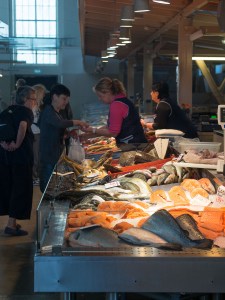
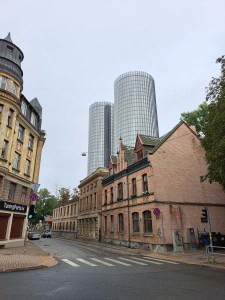
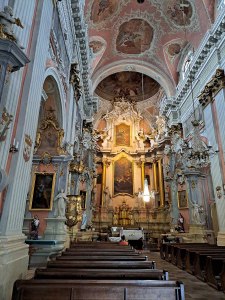
Riga gave us a shock by having an actual, congested, rush hour. After two months of absent or free traffic, this was a shock. Rather smelly, too, as many of the vehicles date from the early days of Europe’s diesel boom. Well, we have one at home, too. Riga’s old town was attractive, but mostly a late 20th century facsimile as it was flattened in WW2. We listened to a church organ concert and visited the city market. Perhaps Latvia has more liberal trade practices than it’s neighbours as I was able to buy medicines that needed a prescription in some countries (not in the UK), and a SIM card for Europe because my roaming had ended after 2 months (thanks Boris). We stayed in a cheap hotel, and were entertained by the top floor guests who were migrant workers – all men – from Uzbekistan, Kyrgyzstan and more. We had language-hampered reminiscences of our time in those lands. The communal kitchen was very well used, but fortunately I didn’t have to take Clare any plov.
Riga, new and old
Babushkas!
Riga, old and new
Out of town, sometimes in town, our time in the Baltics probably produced around one castle a day. There’s loads. Many are in good repair, some are ruins. Trakei was particularly striking.
Trakei, Lithuania
Trakei, Lithuania. What’s she done to deserve that?
Lithuania’s Hill of Crosses grabbed our attention shortly after crossing into Lithuania. Pretty much all summer, if we’d seen a religious site, it was Lutheran, or latterly, sometimes Orthodox. Hill of Crosses is all beads and Popes (three, IIRC). It was sort of charming, attractively scruffy, but also a little creepy. Its actual religious purpose is, well, it just is. No miracles or martyrdoms. It does
to mark an element of national consciousness for Lithuanians. Perhaps in repressive times crosses were tolerated and national symbols not.
We travelled east to Vilnius, capital of Lithuania. Vilnius is scarily close to the Belarussian border. Unusually for us, we didn’t think of going and peering over the fence, to add Belarus to our little list of countries we have seen close over a border, but not visited (for the record: Iran, China, Afghanistan, Russia). This is a tense part of the world: NATO countries’ territory squeezes nervously through a narrow gap between Russia and Belarus; and that exclave of Russia, Kaliningrad, is surrounded by NATO countries except for its Baltic coast.
Vilnius is a nice old town, mostly original as it wasn’t flattened in WW2. It’s also less medieval, less Hanseatic than the coastal capitals (the Hanseatic League was nautical), it’s more 18th or 19th century. But our enduring memory of it is the horrible museum of the worst period of the 20th century when they endured two Soviet occupations and one Nazi one. The small museum is actually in the old KGB premises and mostly details the Soviets’ appalling oppression and methods. It was also eye opening how long resistance against the Soviets endured, nearly till Stalin’s death.
Vilnius Cathedral, outside
Vilnius Cathedral, inside
So it’s no wonder that Vilnius was enthusiastically hosting its second Military Tattoo with bands and parades by many NATO allies. Just the second, in 2023: They started in 2022, odd that. It was free to attend, and we waited on a bench for it to open. We were joined by a military officer off duty with an injury. He had relatives studying in UK, and we chatted about, well, stuff. Alas, that was it for the entertainment, the VIPs were all in situ, the parade descended the boulevard towards our temporary auditorium, prepared for the ceremonial entry, and – the heavens opened. And how. Totally torrential, and it didn’t stop. Military intelligence had warned of it, and they’d been handing out free ponchos for a while, as even the VIPs had no roof. But this was mega rain. Even the submariners gave up*. Also, the wind started blowing parts of the auditorium over. The outside audience, including us, broke and ran, hiding under the great portico of Vilnius Cathedral. Which unfortunately was also very tall, and facing into the wind, so only kept some of the rain off. I think the event was abandoned.
*Fiction on my part, Lithuania does not operate submarines.
Off from Vilnius, by the afternoon we were in Poland …. what? I haven’t written about motorcycling in the Baltics? Oh? Well it’s fine. Pretty good, not too busy, main roads – where there are motorways we avoided them. Pleasant minor roads. A lot of forest, but it’s normally cut way way back from the road. A lot of the minor roads are unsurfaced, and many then have very loose surfaces, but aren’t much corrugated. Most of the countryside is flat, and the population is modest (and doubtless easily displaced in Czarist or Soviet times), so the roads are usually pretty straight. So unless you actively want to ride dirt roads, it’s not especially interesting riding. There were some pleasantly winding bits though. There are campsites, and cheap hotels, and apartments for short rents. Food is cheapish but you won’t find low fat yoghurt and muesli.
Oh yes, Poland. Ah Zlotys. Didn’t have any. But cards accepted, so we’re good. This border area of Poland is quietly pleasant, a sort of Kotzvolds perhaps. Everyone has been friendly all along, this is no different. I can’t remember if there was really a border; it’s all very European and easy. The day after, we arrived in Gdansk, as following our Baltic theme, we’d take the coast, rather than head for Warsaw and other cities. We rented a little apartment. With secure-ish parking, but rubbish instructions to get in. Including, we didn’t know that non-resident motor vehicles aren’t allowed in the day. So the apparent baffling one-way system is, actually, and really, a no-way system. Good job we didn’t know, because we got in, eventually. And, unusually for a flat advertised as in the city centre, it actually was.
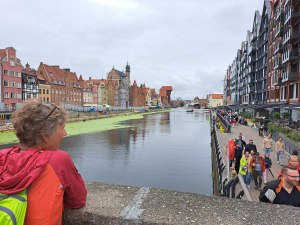
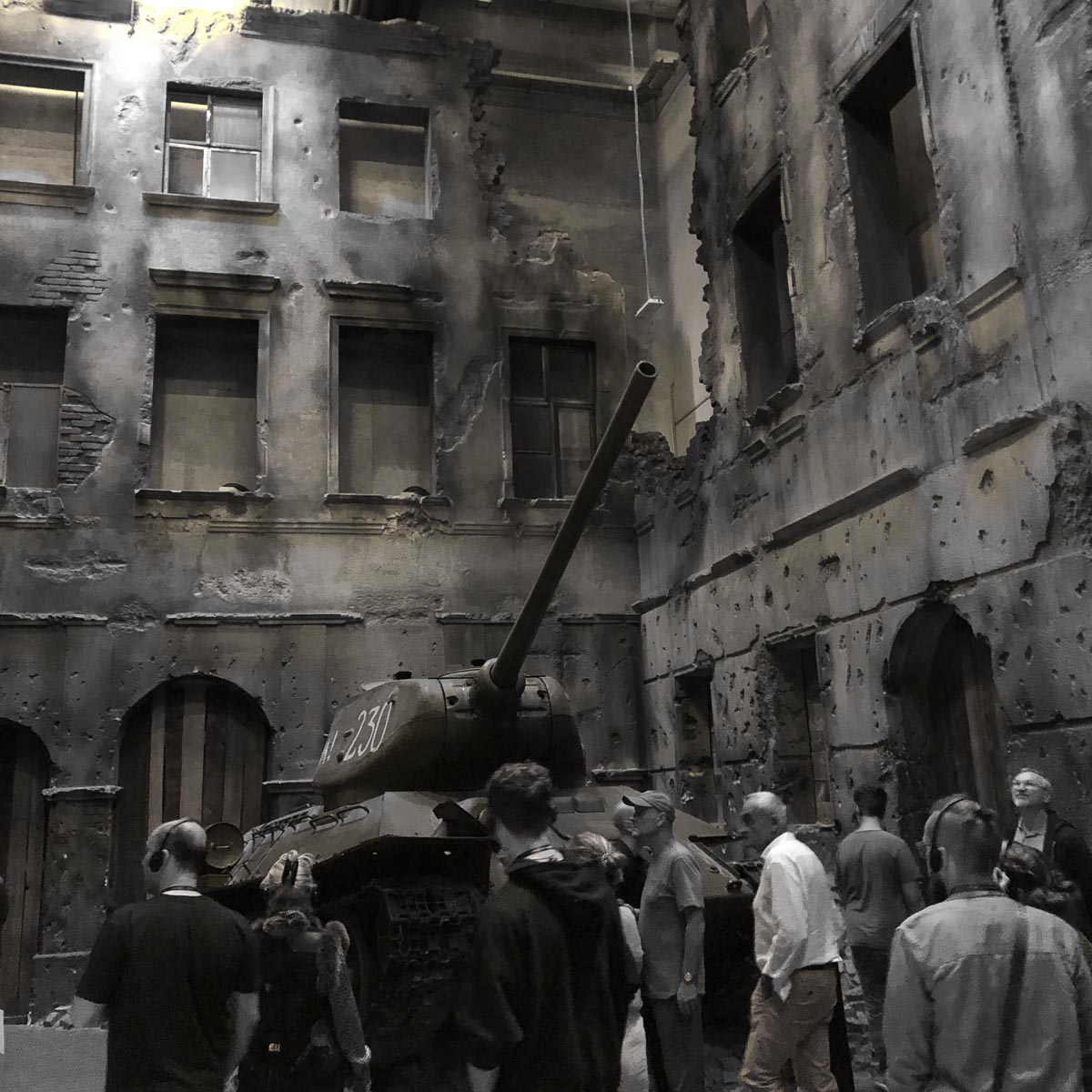
Gdansk is a fair sized city, yet the central old town area is compact and very walkable. Again, “old” town means rebuilt after WW11 to look like the old town. A clue is probably that walls and roofs tend to be straight. Attractive though. We spent a day sightseeing (and getting a haircut) and another day seeing most, though not all, of the WW11 museum. Like the museum in Vilnius, it could, maybe should, give one nightmares. Learned a lot. WW11 was large in Britain’s historical background during my 70s childhood, and I vaguely remembered the 37m+ death toll from WW11 – now we were in areas where the bloodbath was at its worst. In comparison, history I’ve read since suggests that the UK government was quite careful to limit its casualties to under 0.5m, as the memory of losing 4m in WW1 was fresh.
Now, following the Baltic coast west from Gdansk on motorcycles, for us, was a mediocre plan. This is Poland’s riviera, and like England’s, it has an air of having seen better days. But it was still crowded, and even at the fag end of the season, plenty of Poles and maybe others, were ambling about, idling outside tat shops or licking ice-creams. It’s not as pedestrian and bicycle friendly as Germany or Holland, but there’s a lot of crossings! Chug, chug went the bikes, 50kph almost all the way. Still we saw some beautiful beaches, the Baltic was warm and not very salty, and camping was cheapish.
We crossed into Germany, still in a holiday zone. Even though this was our first time ever in the ex-DDR, everything looked smarter, and bigger, and shinier, especially the prices. More cycle lanes. The Ruge campsites were organised to a painful level of do-this, don’t do that. It’s rather the same in our UK Camping and Caravan Club; could it be camping brings it on? Of course, if you actually got past the notices and systems and spoke to the Fraulein of the campsite, she couldn’t be more helpful. I can’t remember whether Poland or Germany, away from the coast, we stayed at a huge, old, much underused, disorganised campsite with creepy dark pathways to giant, echoing, slightly decrepit shower blocks. No notices there.
Although there were still lots of (other) tourists, the roads became much freer. The speed limit went back up to 100kph (for the first time on ordinary main roads since leaving Germany in June). More to the point, we welcomed the end of the ex-eastern bloc habit of posting micro limits covering a few metres, with ambiguous endings. 1 ferry, to island of Ruge, very scenic and perfect, very expensive.
At home we have a Simon Weir guidebook, and before we’d left home, we’d grabbed a few GPS files from it. They were nice roads, strung together with little bits of Autobahn. Little used autobahn at that, so the answers are: Just about 140kph true flat out in 6th, and gets-wobbly-at-the-front at about 170kph. But our IT was frustrating at times, and reversing GPS routes doesn’t work well when there are slip roads onto dual carriageways, especially if you don’t know the local town names. Oops. A cheerful old codger in the welcome caravan at a huge campsite relieved the frustration with a bit of comedy. He was a right joker he was, directed us to a wriggly pitch full of odd noises. Woke up in the morning to a tent full of molehills. I had a minor scare, thinking my bike was leaking oil, but it was just the very thin Norwegian “Racing” chain lube reacting to warm continental temperatures.
Celle, and SilberSee camping. Celle’s a charming old town, with enough to see. We stayed two days. The campsite was lovely, loads of space, freeform pitching, few punters, and a big, warm, lake with a beach. And a simple restaurant. We dived in and caved in. My diary says: “Decided to walk into Celle but bus arrived. Driver chatty, used to play darts with BAOTR at Bergen Belsen (!). Wandered town, old and neat and pretty, homogenous tho. Castle, more palace, outside impressive. Walked back via supermarket, but 500m from home the same bus driver insisted on giving us a freebie. Swam again”. We fixed a minor electrical issue on Clare’s bike and cleaned a leaking fork seal on mine, both satisfactorily.
The next campsite, the distinguished looking owner saw the bikes and became chatty. The more so as we each explored our previous travels. Stunning photos arrayed on his wall. Herr Wolf had had some epic journeys especially in Africa, way back when. On, natürlich, a BMW flat twin. With a sidecar, which, in retrospect, he wasn’t convinced about. The bike was still in his barn, worn and dusty and sans sidecar, but looking sound.
7th Sept. Having decided to skip a flog across the Ruhr and then Essex we entered France. The frontier signage was even less than usual. Clare didn’t notice until we sat down for lunch when I mentioned it. Immediately, a lady passed and said Bonjour, then Bon Appetit. Voila!
Our trip ended with some lovely French roads, charming villages, towns and cafes. A last minute booking on the Dieppe ferry, which drops us almost back home after a 4 hour crossing. Before that, a last leisurely coffee outside a harbourside cafe filled with old radios. Finally we survived the challenge of getting out of Newhaven, on the wrong, or right, side of the road, in the dark.
The Continent sees us off in style – two days before we’d have been thrown out!
We were away for just a few days short of our post-Brexit 90 day limit, and covered almost exactly 8,000 miles. What a lovely trip!
As we made progress down to Singapore we start to hear, it’s great, it’s horrible – which put it on the must see list for me.
We had thought that we might be able to catch a ferry from further north on the Malaysian Peninsula, to out destination Medan (Belawan), in Sumatra, but like so many ferries around the world many no longer run which sealed it, down to Singapore it was then.
I had read up and seen some images showing Singapore’s mega sky scrapers and futuristic buildings and was keen to see them first hand. I was not disappointed, Gid, however was less enthusiastic.
OLYMPUS DIGITAL CAMERA
OLYMPUS DIGITAL CAMERA
OLYMPUS DIGITAL CAMERA
Beneath the surface of the brash super structures are the ancient streets of the old shop-houses, which still exist. China town and Little India nestle in amongst the towers with their splashes of colour, traditional cuisine, cultural essentials and tourist tack. Incense and Lord Shiva, Aarti tracks wafting out onto the streets transport us back to Varanasi.
Youngsters at our hostel enthused about Sentosa, at tiny island on the end of Singapore, saying it was totally synthetic but great fun. Even these words hadn’t prepared us for the over sized ‘theme’ park where every road road / lane lead to yet another glitzy ‘attraction’. We’d caught the tram to the southern end of the island by the beaches and intended meandering back through a couple of nature trails but had arrived too late and darkness was setting in. Our exasperation at trying to find our way off the island finally led us to the waters edge where we stumbled across the Crane Dance mentioned to us by the youngsters. It was truly amazing how mechanical engineering and electronic wizzardery could produce a moving light and water show that was so spectacular.
OLYMPUS DIGITAL CAMERA
Following our Sentosa experience we were drawn to the more enlightening traditional appeal of the Botanical Gardens. Here we were not disappointed but spent several hours wandering around the beautifully laid out lakes, lawns, trees and plants. The Singapore orchid garden was a delight to be savoured with a wealth of splendid colours, sizes and at times intricate shapes that nature has produced. Especially good value for the over-60s – only $1S to get in (about 55p). Made up for by being charged $3S for a small Sprite when we wandered, foolishly, into a premium refreshment kiosk.
OLYMPUS DIGITAL CAMERA
OLYMPUS DIGITAL CAMERA
OLYMPUS DIGITAL CAMERA
OLYMPUS DIGITAL CAMERA
OLYMPUS DIGITAL CAMERA
OLYMPUS DIGITAL CAMERA
OLYMPUS DIGITAL CAMERA
We saw a couple of mid-sized water monitors in the gardens, and unlike wild ones, they were pretty unfazed by people about. They didn’t sit still to pose, though!
Spurred on by the Botanical Gardens we went on to explore the quay side area with its futuristic buildings together with the Garden by the Bay. Which blends nature with technology as super trees tower above vegetation.
As darkness fell, the SuperTrees put on a Star Wars themed sound and light show. We were lucky to catch it, it was out last evening, and one of our few in Singapore where it didn’t rain.













 2silvercyclistsdotnet