On the Road – Jaisalmer to Madhya Pradesh

After the camel trek at Jaisalmer, we finally turned east to resume Australia-wards progress.

The Land

The People

On The Road, By The Road

Ranakpur

In this corner of Rajasthan, there be hills. Before we really got into them, we stopped a day at Ranakpur, where there’s a very large, very beautiful, but seemingly rather under-used, Jain temple.

Udaipur

Last stop in Rajasthan. Christmas in a gorgeously photogenic city, set around a lake. Maybe a special mention for Lal Ghat Guesthouse which was reasonably economical, with a great view, comfy room, and served peppermint tea and porridge.

A nice German tourist on her 18th visit, told us about the town’s Shilpgram festival, in progress, of performance and handicrafts. It’s not publicised to tourists out of deference to (fear of?) the town’s shopkeepers. It was great, the stalls were good value, and the Bangaladeshi guest band that we saw, Joler Gaan, turned out to be staying in our hotel; and tempted us to alter our route to take in Bangaladesh.

Finally, after around a month in Rajasthan, we entered the central Indian state of Madhya Pradesh.

Thoughts on leaving Rajasthan

In amongst our kilometre crunching days, crossing Rajasthan, first retracing our steps east, then veering south, we’ve taken some delightful back roads. It’s always been the case that the minor roads reap the most rewards in terms of seeing rural life and countryside. Rajasthan has been no exception.

Our first detour was to Ranakpur to see the great Jain temple. Garmin was well up for a cross country jaunt and had three attempts at turning left off the highway. At the first two locals were urging us further along the dual carriageway before turning left, flapping their hands to make it clear. At the first we didn’t take much convincing as it was a dirt track; another gem from Garmin. The second looked more promising but no, we must go further on. Fortunately we did as the main road, according to the colouring on our map, started well enough but soon deteriorated into a pot holed narrow lane. Along it there were many elderly men in Indian dress with deep red turbans, herding cattle or sheep together with the odd camel. The views of ploughed fields, the odd village here or there and just the general lush greenery were beautiful. We had now truly left the desert behind us.
Around Ranakpur we, or rather our legs, realised we were cycling in hilly terrain – the first since, err, um, Azerbaijan in August. But the roads were smooth, well graded and the hills minor, so we had a gentle reintroduction to our lower gears.
It was on this route that we discovered, in Rani, that Indian towns don’t have to be squalid dumps in terms of rubbish and muck around the streets. Rani was spotless. It is a reasonable sized town but there was no litter or rubbish to be seen, just a road sweeping lady, that Gid nearly collided with, as she thrust her barrow directly into the stream of traffic, just as if she was riding a motorbike.
Women are frequently employed as road sweeps working away with their stick brooms, dust pans and wheel barrows but it’s the men who drive the dust carts. Very often the men are standing or sitting around while the sweeping goes on. This pattern seems to be establish at an early age with girls and boys in the household, unless perhaps we’ve not spotted that these girls are not family members but servants.
As well as the more traditional role of domestic chores – collecting water in their clay or metal pots which are carried on their heads, child rearing etc, women are frequently working alongside men in building projects. We’ve seen them digging channels with over sized rakes in road building projects, clearing rubble from the newly built central reserve, and chipping away at the edge of the road surface (not quite sure what this one was about). Equally, they quite frequently help out with building projects: mixing cement, delivering the mixed cement on their heads to the men who are laying the bricks, and generally bustling about. And at the blacksmith’s, it’s Mrs who wields the hammer, while Mr holds the workpiece. All this is done in their wildly colourful filmy saris; presumably not their best ones. It’s worth adding that India has elected two women as prime minister, too.
But the gender divide still seems to be firmly ingrained. A few women drive scooters or cars. They take other women as passengers but never a man. We’ve hardly ever been served by a woman in a shop or restaurant, except at checkouts in the few western style supermarkets. In Udaipur I was surprised to see one lady in total control of the traffic, dressed in uniform and wheeling an arm about as she blew her whistle.
As we dashed through one village a mother and daughter were on the steps of their house. The girl was doing school work in an exercise book on the top step, while mum was a step or two down beating up a shirt; with the stone step as a washboard she vigorously attacked it with soap. I wondered about the school child and what opportunities her education would bring her. In India, the female literacy rate significantly lags behind that of the males, so there may be extra barriers for her.
An hotelier, whose chalets are looking shabby and didn’t provide breakfast because there is no chef, explained that the previous owner had got too old to keep it all going. He’d only had daughters, who would take over his business? It had gone rather to ruin (since Lonely Planet’s 2011 glowing review), so now this new guy had just taken on the lease. He had sons.


Various other things are clearly slow to modernise such as road rules, manufacturing materials and methods, and digging holes. In some ways it seems stuck in a time warp with manual labour replacing the machinery we’d expect to see back home.  This is exaggerated for us as Indian English has diverged from English (and American) somewhat, and, Sir, some constructs archaic to us are still normal here. Lorries mostly look like 1960s leftovers: But the cars look modern. Almost everyone has a mobile, a smartphone unless they’re elderly. There’s construction going on almost everywhere, satellite dishes poke out of straw roofed shacks, and modern things keep cropping up. What an interesting place!

Camel trek – Thar desert

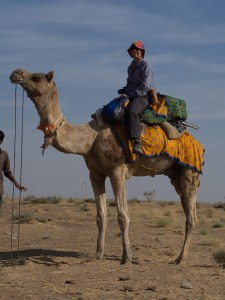
It was with great excitement that I climbed into the jeep to set off on our camel trek. That lasted until I saw the camels and started to wonder what were we doing now. The camels were loaded up, all we had to do was hop on. That was where the trouble started. With no stirrups to help, how was I going to get my leg over that hump. And this camel is as tall as a pony – when it’s still sitting down.
_gro6516-1
The first couple of hours felt rather traumatic. I was so thrilled to be going on a camel trek, I wanted to snap away as we went but was too scared to take my hands off the saddle.  This was compounded by the terrible itch that, it was clear, my camel had.  He regularly half stumbled / lurched into a step, first his front leg kicked back then the back kicked forward but neither could reached this itch.
As time progressed I did get used to it and my camel husbandry improved; we were able to productively assist with managing and loading/ unloading the camels during our lunch break and at the end of the day. The camels wandered off if unhobbled and would have to be rounded up. Gid’s camel, even when hobbled, still made a break for it. The camel was tied into a sitting position, using his rein running down his chest to the hobble rope, only to shuffle along on his haunches. We started using the foot loops, which helped a lot, although locals don’t use them. By day three Gid, who was altogether more confident with the camels, was going solo and I could take photos at a trot.
The trip itself was awesome. We rode the camels, for an hour or two at a time, along tracks through desert scrub, across sandy sections and over dunes, visiting the odd village as we went.
The villagers are used to tourists so we caused some excitement but weren’t mobbed. Rather fabulously we were invited into homes and regularly offered chai which was made on an open hearth in the corner of their courtyard – homes here are designed primarily to keep the sun off and the goats out – any breeze is most welcome.  Most people were happy to pose for photos; some performed a mini concert. Even very old people came out to see us. It was delightful to get a glimpse into village life. A small donation was always exchanged: 50 rupees for chai or photos, or 200 for a mini concert. To put this in context, a  labourer might earn 250 rupees a day, that’s about €4, so a couple of tourist visits in a day is a big bonus, especially at present in Mr Modi’s cash crisis.
Children repeatedly asked for ‘school pen, school pen’. One 15 year old lad, able to speak some English, told us there was a village school. The teacher might come on Monday, Tuesday and Wednesday, he said, but then miss Thursday. He also told us he couldn’t read or write. That, it would appear, is not uncommon. Our guide, Harish, who had picked up English from tourists, proclaimed that he could not read or write but his younger brother could because school had opened, in his village, in 2011. Our second guide, Saleem, couldn’t spell his own name for us when he asked us to mention him in our reviews.
The desert camp experience was fantastic.  We learnt several desert life ‘tricks of the trade’ such as hollowing out a bed in the sand and, in winter, lining it with covered stones from the fire for extra warmth and how to catch a goat to milk it for fresh milk in the chai (someone else’s goat, that is, so it may be, ahem, not entirely welcome). ‘Washing up’ with sand we’re already familiar with from our background in canoeing and kayaking trips but it was a first for sleeping on dunes under the stars with gerbils scurrying around in the shrubs behind us.
The Thar desert is the most populated desert in the world. The Indira Gandhi canal must have done much to improve the water supply but, when the rains fail, as had been the case this year, the crops don’t grow and we passed a few ploughed fields where nothing was growing. Harish had to reach deep to get water from the storage tank. But it seems to be being managed – people and animals get enough to drink, and some fields are irrigated.
There’s quite a bit of wildlife, too, although apart from birds, we only saw gerbils, chipmunks and beetles, during the actual camel trek. There were several different large birds of prey, and also Egyptian Vultures. The high point was a lunch spot near to an eagle’s nest in a tree, we saw them visiting their chicks from a distance, but when Gid tried hiding behind a tree about 70m away, the parents spotted him, and waited on some rocks a km away before returning. So not much in the way of photos from that encounter.
End.

Riding in Rajasthan

Rajasthan, and India generally, seems a land of contrast. Leftwards leaning polititians in the UK sometimes complain about the UK’s “private wealth and public squalor”, compared with European societies: India takes this to spectacular extremes.
But, in India’s use and abuse society where rubbish piles high and waste is abandoned everywhere, not everyone is at one with this policy. Standing with a local man, beside a central shopping area in the bazaar at Jaipur, he mournfully stated that this was swept and clean this morning implying ‘and now look at it’. He shrugged his shoulders in despair. True enough, in the mornings we’ve seen ladies with twig brooms sweeping mess into dust pans, then emptying it into wheel barrows. Where next it goes I’m not sure but there are frequently rubbish mounds along the approach roads to towns and scorch marks where previous rubbish has been burnt, or earth and rubble piled on top; the reverse of our land fill sites I guess. But, the norm here is to drop rubbish in public areas, even by what would be very “respectable” people, businessmen, shopkeepers and the like. Of course, if the rubbish is edible, one if the many cows, dogs, or sometimes goats, will swiftly devour it, so all the discarded packaging is clean, and poorer people sift through the trash looking for stuff to reuse, including cow & camel dung, which are fuel – but there’s still a lot of rubbish left around. It’s different in private areas, which are often pristine, and certainly a fellow who dropped a wrapper in the grounds of Jodhpur’s palace, was very quickly directed to the bin. But public areas certainly are usually littered, shitty, and dusty.
This, together with the honking and hooting, are key things we’ve had to adjust to. Just as we’ve had to adapt to the local style of driving;  pulling out or sweeping across traffic seemingly without looking at all & he who honks the loudest is surely coming through. This latter is never more evident than when traffic is trying to manoeuvre through road works or some other obstruction. One bully boy, horn blaring, will determinedly insist on forcing a way through, other traffic forced aside, including oncoming traffic with, apparently, right of way. There are frequently speed bumps at the boundaries of villages, or in towns, but again, plenty of drivers simply use these as an opportunity to overtake. Although India’s roads are generally very good, the drivers & riders are so bad it feels by far the most hazardous place we’ve found to cycle. However, it probably isn’t quite as bad as it feels, as speeds are generally low, and everyone assumes everyone else is a maniac and not looking where they’re going.
Away from all this madness, Rajasthan  has been delightful. We’re back to the familiar waves, calls of ‘hello’ or ‘welcome’, and friendly hoots from people as our paths cross. This, together with, frequent requests for selfies to splash onto Facebook with a, ‘Look who I met’ comment.  Once stopped it goes one of two ways: crowds appear from every corner, eager to look, poke, pull, gradually trying to engaged in conversation: Which country? Where are you going? Do you like India? A script we’re very familiar with.  Alternatively, and rather less engaging, we are fair game for the hordes of children and sometimes adult village folk who often approach, fingers rubbing, with constant demands for money or gifts; seen elsewhere but more prevalent here.  Or fingers out to you and back to their mouth or that of an infant/ child.
Rajasthan is one of the poorest regions in India. Back in the 70s literacy was estimated to be as low as 18%. It’s catching up but is still in the lowest three states of India and still claims the biggest gender gap in the country with women in villages at the thin end of the wedge. Projects like Roopraj Dhurry Udyog, where 42 families have formed a cooperative, help to raise the independence of women by developing cottage industries. Items are sold locally with all profits going to the artisans but there is a long way to go; the poverty is stark. Actually, although in theory “all profits” go to the artisans, we rarely get to meet any, and they’re very quiet. One suspects the lion’s share of profits are absorbed by the sleek looking men running the shops.
It’s been interesting to see the cast iron hand sewing machines frequently in action. We’ve previously  donated 2 or 3 of these, 1930s Singers, to charitable organisations at home where they were serviced and sent to third world countries. Here they are still in action, still being serviced and still available to purchase brand new. Gid had a repair done. A quick job; less than 5 minutes, less than 15 pence. Every town or village can offer such a service.
Embarrassingly, while we waited at a level crossing in a small village, a local pointed out Clare’s back tyre was flat. We already knew it had a slow puncture but now it was indeed flat. We happened to be right outside a tyre repair place.  In we went! They quickly fixed both slow and fast holes for 10 rupees.
In amongst a great deal of curious chat as they compared our bikes with theirs. Most Indian bikes are (to us) old fashioned roadsters from the 1950s, with one speed, rod brakes, and the old fashioned British Standard metal tab lamp bracket (which is never actually used, and we remember from our childhood is a completely crap design). A newer kids bike, mountain bike looking, but still one speed, was apparently 3,500 rupees – about 50 euros. I guess Tesco, at home, get pretty close to matching both the quality and price of that. Indians often ask how much our bikes cost: We’ve got into the habit of saying it’s about the same as one of their Honda Hero motorbikes, which are about 900 euros, same as the starting price for a decent tourer (before all the upgrades).
Rajesthan has been truly fascinating but I look forward to seeing a more balanced view of the county as we sweep back in an easterly direction towards Kolkata.
Top sights along the way:

On The Road

Villages, cows, decorated lorries, tuk tuks, the army on the move, wildlife. Surprisingly good roads and amazingly bad drivers.

Jaipur

We already wrote a bit about Jaipur, here’s Gid’s photos.

Pushkar

The lake, cows, monkeys, dodgy holy men with their ribbons and paint, new age travellers and view from the hilltop temple.

 Jodhpur

Castle, palace, blue city.

Jodhpurs at Jodhpur

We saw a notice advertising a polo tournament – Jodhpur is a big army town, as well as the Maharajah’s traditions, although actually polo isn’t terribly old. We watched a British Army visiting team narrowly beat the President’s Bodyguard team by 3 1/2 to 3.

Jaisalmer

The roads to and from Jaisalmer, and our camel trek from there, were both rich in sightings of interesting Thar Desert wildlife.
Jaisalmer is twinned with West Sussex at least in the sense they both have a Hawker Hunter plane on a big pole. Ford’s, in Sussex, has more moss than Jaisalmer’s.
They both have military museums.  Jaisalmer’s has more old tanks, Tangmere’s, in Sussex, has more old planes. Jaisalmer’s castle is more impressive, more open, and mostly older than Arundel’s.
See separate posting for our camel trek, and our way out of Rajasthan, via Ranakpur and Xmas in Udaipur, also has its own posting.

After 5 weeks, it’s great to be back on our bikes!

Having learnt that at about 9.30 Delhi’s traffic exponentially increases, we’d planned an early start.  Bill paid, bike checked, tyres pumped, luggage packed, well mine anyway, we tried to get an early night.
Lit up like beacons, with strong beams & flashing lights all round, we actually got away by 6 and, to be fair, the traffic wasn’t too bad. I went for the local approach weaving through the traffic and sod the lights, while Gid wasn’t quite so bold. But we made it, safe and sound, through to Faribadad by 7:30 only to have our way on to the shiny new flyover blocked by two guards. Once off the slip road, Garmin did the job of re-routeing us through the back streets and back onto the main road at the first possible point. That was entertaining!
As always, in the latter countries we have visited, the back streets are very poorly maintained, past ramshackle buildings, with people who are very bemused to see us. Two superbly turned out school children in their uniforms, standing in the mud and squalor, proclaimed they were please to meet us, after being promoted by a proud parent through a round of English practising questions. They were so truly astonishing in their attire, politeness and pride that I was stuck for words as to how to convey my pleasure and surprise at meeting them in these surroundings.
Back on task we continued through the dust, dirt and rubble until we arrived at a railway crossing. On this occasion, Gid was well up for going local and was the first to wiggle his bike under the bent barrier, amongst the motorbikes, only to proclaim,  ‘Oh look, there’s the train’ as he glanced down the track at it approaching some 50 m away.
The Delhi-Agra route was very straight forward, one road, albeit with three designations: NH 2, 19, 44, thanks to an idealistic, but under implemented, renumbering of all India’s highways. It’s flat and well maintained so we made speedy progress. Even the towns we passed through weren’t too onerous; our background across the ‘Stans’ with, in town centres, traffic weaving around all over the place, stood in good stead. The Indians use a lot more horn though! There’s also a lot of vehicles going the wrong way, plus a few other road behaviours which we’ve not seen before, so the road’s never actually relaxing to be on.
We didn’t do a huge distance.  Starting early, it still took maybe 4-6 hours to be clear of Delhi’s satellite towns. We finally reached agricultural areas interwoven with smaller towns. We stopped in roadside cafes for a drink once or twice, but for a late lunchtime managed to pull a little way off the road for an uninterrupted picnic. (Especially after the rat had scurried away.) Looking at maps and mileages, we decided that Hodal, our current location, was already halfway to Agra.  It was time to stop. In fact, from our tree trunk, we could see a potential resting place for the day..
The Rajasthan Motel.
It was a peaceful oasis not only from our days cycling but from Delhi itself, which had been vibrant, noisy, chaotic and cramped. Partly down to Gid choosing a cheap hotel in the main bazaar. Sprawling in extensive gardens, Hodal’s motel was a total contrast. It was a bit over budget but lovely after Delhi and was almost empty of customers because the old highway, although under going an upgrade, is no longer the main road.  That, together with the extremely welcoming and friendly staff, sealed the deal.
It is part of a chain owned by the ex royal family of Rajasthan, and these very nice people looked after us again later.
_ctf5337
India cycling day two was a 119km run into Agra, city of the Taj Mahal. The ride was more of the same: pleasant weather, tailwind, flat, good road. Hooting and horn blasting. Friendly conversations with motorcyclists alongside. In towns, mad traffic and even more hooting. Physically in-taxing but mentally exhausting. Our Agra hotel was picked from Clare’s Lonely Planet guide, but not pre-booked. As in Delhi, cost was a dominant factor, so our room, unsurprisingly, was little bigger than the bed. Again, just like Delhi, there was a rooftop restaurant, but this time it had a really nice view – the Taj Mahal. It ought to have been rather pleasant, but continuous problems with the electricity in  our room meant no light and no fan.
We’d read that the best time to photograph the Taj is dawn. Naturally, Clare was all fired up, so we had our third dawn start in four days, groan. Actually the ticketing and entry process didn’t start until 6:30 am, so it wasn’t really dawn, but still quite early.


Agra itself was similar to Delhi insofar as the Taj Mahal and its surrounding area was very clean and modern; pristine, like the shopping malls we saw in Delhi, but a stones throw away it was back to squalor.  Some areas delightfully quaint but others out of the Tudor era with squalid water channels running between houses and the road.
Keen to move on and find a quieter side to India, we had only a quick stop in Agra. Our next refuge was Bharatpur.  Another short day’s cycle but this was paradise! We spent the afternoon with a guide, Prakash,  leisurely cycling around the spacious Keoladeo bird / wildlife sanctuary. I can understand why British birders holiday here. Apart from the wealth of fabulous bird life, in this UNISCO listed site, the environment is wonderful. Antelope wandering around, cows, deer and at dusk we saw jackals. One area is currently closed because a leopard has moved in.
Our next main town to visit was Jaipur. It’s the first main tourist destination travelling west into Rajasthan; not so big and bustling, the traffic was less hectic here. We bought a two day tourist ticket and spent three days doing it whilst continuing the great 2016 Indian cash hunt, not very successfully at times.

Jaipur sights:

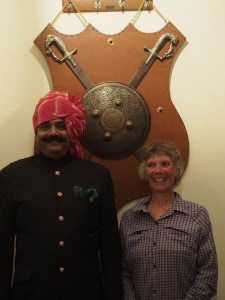
OLYMPUS DIGITAL CAMERAJust a kilometre away from the old city, in Jaipur, is Karuna Niwas. This time a homestay, but still a part of the chain owned by Ajeet and Ninja Singh, first encountered in Hodal.   Again, we were looked after very well with the added attention of  (I guess the term is) the family retainers, Roma and Bhanwer. Ajeet posing in his regalia, prior to going to a wedding:


Dealing with Delhi

Traveling across Europe into central Asia, we thought, would be a gradual adjustment in terms of cultural differences, road traffic conditions, food etc. and I guess that’s been the case. But, arriving in Delhi has been a whole new ball game. From the start, in the shuttle from the airport, we were dicing with death. Our driver must be on a reward for fast delivery, as on the crowded road he weaves for side to side, our battered Suzuki micro van was rolling alarmingly; Clare’s bike box threatening to fly off the roofrack. Vehicles weave across the road trying to fill the smallest of gaps in the blocked solid traffic. Bicycles, scooters and motor bikes (women usually side saddle on the back), a selection of motor vehicles, all palm wedged on the horn, accelerate in every direction regardless of any perceivable traffic regulations such as, travel in the direction of the traffic or pavements for pedestrians. Certainly, the ‘Look left, look right , look left again, use your eyes and ears before you use your feet’ applies on both sides of a dual-carriageway as much as anywhere else.


Stark evidence of poverty is very present in the city. There are not only beggars, as in many countries, but also shanty towns along the streets just off main highways together with debris piled high. Loads of people bedding down in the street (where do they go during monsoon?). Dirt and litter is almost everywhere.

There are so many warnings in the media, on tourist/hotel notices, and in guide books about the ingenuity of Indian people to rob, one way or another, unsuspecting tourists that it has made us uncomfortable talking to the locals, especially when we recognize some of the opening gambits or stock phrases such as, ‘I don’t want any money but …’ or ‘I just want to practise my English …’ . After a week we knew the pick up points and phrases but still got gulled a couple of times; not so badly though, as these fellows were just trying to steer us into their favoured establishments.  An auto-rickshaw driver (tally: 3 ok, 1 maniac) told us that some of the big tourist shops reward drivers with a 1L fuel voucher (about $0.70) for each tourist delivered.

The general atmosphere is one of hectic bustle and over crowdedness. If there is a space someone or something will fill it rapidly. Amusingly, dogs have cracked the system. Whilst we’ve already seen a starving horse who had a broken or deformed leg and just enough flesh to stretch over it’s bone structure, the dogs look fine and seem to find a safe place to hangout or kip. Cows roam about, apparently eating garbage. Some folk keep a few goats. In Delhi, ox carts aren’t uncommon; later in more open country, horses were preferred. A few donkeys seem to be used for riding or carrying loads. But small motorbikes and scooters dominate the transport sector, at least, numerically.

This is good fun…

http://m.driving-tests.in/learners-licence-practice-test-3/

I got 26 out of 30, a pass. But some of the questions seem a bit unrelated to real road practices here.

Delhi has been a place of many firsts:

-first time we’ve seen oxen pulling carts in the centre of a city,

-first time we’ve had to call reception to get our water heater turned on for a shower,

-first time I’ve watched people washing their clothes on the ground in the streets (a few had bowls most didn’t),

-first time I’ve seen ladders up to dwellings on the first and second floors above shops,

-first time I’ve watched a man tapping off the drips in one of the many recessed ‘toilets’ along the streets, which leave an ever present stink of urine,

-first time I’ve watched a man spit three metres out onto the street (I wonder what the world record is?),

-first time I’ve seen so many electric cables draped along outside of the buildings and spewing out of a sub station.

Gradually we have got used to the chaotic nature of Delhi. Like chrysalis slowly emerging from our hotel room, we have now been out and about seeing the sights and still have all limbs intact, despite a few close shaves.

Cycling out of Delhi still fills us with fear and trepidation. To conquer this one we took a cycle tour of old Delhi – their bikes, our helmets and gloves. A definite plus was that I lowered the saddle so that I could comfortably touch the ground. A real plus when constantly stopping in the many tight, crowded situations. The tour itself was fantastic. We frequently ‘whizzed’ along streets and passages wiggling in and out of traffic, people and other obstacles, initially waking people from their slumbers. Nerves of steel were required for the ‘Russian roulette’  or ‘balletic’ interactions between traffic. We soon cracked the rapidly repeating bell manoeuvre to add to the constant cacophony. The main tip, though, was “start at dawn”. And later on, going out of Delhi, it worked well.

At times, modern sky scrapers graced the sky while at ground level they seemed precariously close to the decay, detritus and dirt of the old town, despite, we were told, that the government having cleaned up the area by removing the slums.

Our tour took us round the back streets, starting with a visit to Jama Masjid, on to Delhi’s traditional bread making industry, next to a lofty view of both the Shah Jahan’s wife’s mosque and the spice center of the world, inside a Sis Ganj Sihk Temple, further on to one of the four remaining city gates and a number of other notable land marks and sights. All jigsawed in and around a four kilometre radius.

Deteriorating pockets of ornate architecture amidst the hotch-potch of cables, crumbling brickwork, faded signs, patched repairs, mark, we were told, India’s rich heritage and are left over from the Mugal society, dating back to 1857 or earlier.

Under our own guidance, and mostly in search of cash (India’s government having just invalidated all the currency over about $1 value, causing something of a nationwide crisis), we visited Connaught Place and other parts of New Delhi, built towards the end of the British period, and travelled on the shiny new metro out to some new malls, at Noida, to get some bike parts at the big Decathlon store (note to other cycle-tourists: Don’t expect much in terms of spares, we took the only 9 speed chain).

Bye bye Bishkek, Farewell Central Asia

Tomorrow morning we fly to India. Here’s a final mini-blog for Bishkek.

At the AtHouse

Where we’ve been so wonderfully put up, and put up with. And met so many other travellers.

Between the snowfalls

With today’s and yesterday’s snow

That’s 16th and 17th November, for posterity.

By Bus Around Lake Issy Kul

Sight seeing is fairly limited in Bishkek: a few statues, the tourist shop, the square, the goose step guards who are currently ‘off’ due to the building being under repair, and the bazaar. We’d done the lot, with many visits to the bazaar and needed another diversion.  Ysyk-Kol Lake did the trick: not too far away, public transport so it’s cheap, a nature reserve and local holiday spot.  Angie, our hostess at the AtHouse, sorted out our first nights accommodation; a second outing for Nathan’s old rucksack and we we’re off.

Tamara, our hostess at Tamga, booked her ‘cowboy’; we were all set for a morning’s horse ride. 10 she said and the deed was done.  At 10 we we’re ready: togged up, breakfasted up, camera sorted or so we thought. 10 came and went. Tamar’s cowboy couldn’t find his horses.  Once he arrived it was easy to see why as they must have been deeply submerged in a briar patch. Both manes and tails were matted to a lump with burs.  The ubiquitous padded sleeping mats came in handy again as they we’re draped over the saddles for our comfort and under the wooden runners to protect the horse.  Plaited string reins were given, together with the usual instructions: left, right, stop & fast ahead with the use of a birch twig whip, and we were off. The first hiccup occurred as our horses headed off the track, down a small bank into a stream for a drink. Eider, our guide, already had the measure of our riding skills coming quickly across to chivvy the horses back on track. My horse was keen to be the leader of the pack. It frequently broke into a trot and occasionally a canter, much to my alarm,  to make sure it’s nose was ahead. Gid was less fortunate and had the opposite problem, it wouldn’t budge. Eider soon sorted the problem. Along we went; down steep banks, across mountain streams, along mountain side sheep trails, all of which I would have baulked at on foot, until we reached an open meadow where Eider eagerly suggested we could canter. I firmly declined the offer. I’d grown quite fond of my saddle and didn’t wish to part with it.
It was a superb day, not a cloud in the sky, and a light dusting of snow visible on the sharp-edged mountains behind the foothills we climb. The dusty track rose straight from the village, up the valley. It wiggled and dipped through scrubby, hilly, grassland and a few streams. About ten times we saw a vehicle lurch up the bigger track up the valley. We greeted a couple of farmers. The two dogs were annoying; otherwise, outside the village it was just us.
We ambled back down, once I’d managed to convince my horse we weren’t going to canter for home the whole way. That was until a rare occasion when we’d dropped behind and watched three dogs aggressively worrying the two horses ahead; one hanging off the tail of Eider’s horse. It didn’t seem such a bad idea when my beast took flight and delivered me some 30 metres up the track to the front of our group again, with Eider brandishing his whip at the dogs as I flew by.

Fairytale Canyon

Barskoon Valley Waterfall

Around Tamga

Moving on from Tamga was entertaining in itself. Tamara had warned us that the bus timetable was approximate, not deterring an ambitious driver from speeding away early despite the bus having a schedule. True enough, 15 mins early we were chased up the road by the bus that did a quick flit round and was off again.
Being already full didn’t deter a further four of us piling on. I  was given a seat as usual, with Kyrgyz politeness showing deference to age. On this occasion it may have been the short straw. Gid clung to the single roof rail in a throng of people who surged forward when someone want to depart, until one burst out, whereupon, a ripple of people retreated in a backwash. I was perched on an upturned metal, bottle crate; one leg slowly going numb. My face was approximately at arse height as I sat amongst the throng. One pair of legs squeezed mine in a pincer gripe as I tried to casually glance away. Gradually, as we passed through the villages, space became available. I moved to a comfy seat to admire my former perch and truly admire the view.  My admiration sank as a man near us repeatedly rasped up a mouthful of spit ready to gob. Inhibited, perhaps, by the enclosed space the final deed was unfinished, much to our relief.

Karakol Valley – Walk up to the Ski Resort

Karakol Museum

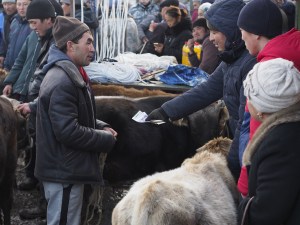
Karakol Animal Market

The animal market, Angie from the AtHouse in Bishkek had said, was quite a spectacle. The biggest in the region the Lonely Planet guide claims.  For once we were in the right place at the right time. I woke at 5:50 my internal alarm well tuned in and was instantly absorbed by thoughts of the animal market. Early in the morning, all over by 10 were phrases ringing in my head.

I got a groan or two out of Gid, who mentioned something about 01:30 bed time;  6am wasn’t going to happen for him.  I lay there trying to content myself with thoughts such as; we’d seen animals at Kumtepa Bazaar in Margilon so presumably it would be similar but bigger.  We’d also seen herds of animals spilling out onto the dual carriageway way-back-when so I had conjured up something in the middle: loads of wild fowl, loads of herds and maybe a pen or two like our now discontinued sheep fair, in Sussex. But my thoughts were running wild.  I’m here, I’m awake, my only chance.

I bounded out of bed and shortly after was ready to leave. Our windowless room gave no hint of the pitch black outside. Gid, now awake, agreed to come and let me out.  Through one locked door, on to the next, but the final door was locked and we couldn’t find the key. Our efforts had woken the receptionist who came to investigate.  By now Gid was fully sort of awake and agreed to join me.  The receptionist phoned a taxi, a whole 70 som, to save us the 30min walk.

I became apprehensive sitting in the taxi waiting for Gid. I’d dragged him out and it was still pitch black.  What on earth would we be able to see?  Nearing the venue the roads were becoming more and more  blocked by lorries whose loads were nowhere to be seen.

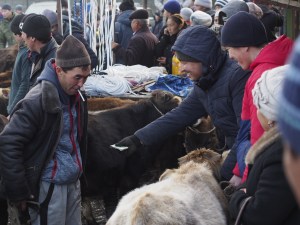
Spilling out of the taxi into the dark, we followed the throng; many people had torches but ours were tucked up in bags at the hostel.  Most people were leading small flocks of sheep, the odd single one or cows, through copious amounts of ‘mud’.  All were either lining the edge of the road together with the vehicles or squeezing along it.  We went with the flow bearing left into a large opening stuffed full of cows and horses.  As there was barely anywhere to stand we tried to tuck in at the edge, finding a couple of rocks raised us up to get a better view.  Traffic passed backwards and forwards; all squeezing through.  The occasional beast refusing to budge. The huge area was absolutely filled.  As the sun rose the spectacle opened out before us; deals started to take place, animals were inspected and some exchanged hands.

Cholpon-Ata

Petroglyph park dated 8th century BC – 5th century AD

From the bus on the homeward journey

I shall miss the ‘Stans’ as we move on into India. I have grown quite fond of the vast plains dotted with numerous herds of horses, cows, sheep & goats as they mooch across from one side to the other in search of a mouthful to eat. Especially here where the plains span right across to the foothills of the snow capped mountains. Herdsmen, frequently on horseback grace the scene. Their former nomadic lifestyle is evident with ‘sheep’s people’ high up on the mountains together with the occasional sight of a yurt.
Passing along the lakeside highway idly admiring the view, with vast expanses of golden ‘fields’ has been delightful. Hay stacks piled high in gardens nestling between fruit trees, on roof tops or jammed up beside the house. The houses, no frills, working machinery sits amid the ancient relics,  museum piece tractors splutter along with over filled trailers, donkeys dwarfed as they trudge along with the last of the seasons crops. All add to the atmosphere that for me captures rural Kyrgyzstan.


Pamirs Take Two – Gideon’s Pictures

As explained in the previous post, we took too many pictures on our Pamir trip to fit in one post. So the previous post has the Pamir text and Clare’s pictures. This post separates out Gideon’s pictures.

Best Shots

Phone Snaps

This little collection shows some of the character of the trip, but doesn’t quite measure up to the quality standards we’d like to set. There’s a limit to time when shooting from a moving car, especially on bumpy roads. But thanks to both drivers for keeping the windows clean!

Road Trip

Mountain Textures

Landscape

Around Town

The Pamirs by Toyota Land Cruiser

The Pamirs, a highway across the ‘roof tops’ of the world, a dream destination for well ‘ard cyclists that had been on my wish list since Gid gave me a 501 must do trips book for Christmas 2013 and there, together with the Karakorum Highway, it was. Then he gave me the Adventure Cycle Touring Handbook for Christmas 2014 – was there a plot?

We took far too many pictures! The area is both photogenic and varied, and, we had loads of time for photography. Even half of our pics is blog-bursting, slow to edit and view. So all the pictures below are Clare’s. Gid will make a separate posting for his photos.

I had nurtured my dream, but Gid was more in touch with reality and had realised we wouldn’t be able to do it quite early on in our trip.   Something to do with my groaning and state of depression when faced with endless mountains.  I had kept on trying to convince myself that I would miraculously: shed half the weight on my bike, toughen up both mentally and physically, and fit large mountain bike tyres to cope with the dirt road conditions, by the time we reached Dushanbe.  Not to mention the further difficulties such as the likelihood that there would be snow and very few places to get drink, food or shelter along the way. The advice, also, was to take two to three weeks to acclimatize before attempting any strenuous exercise at high altitudes and time was running out.
As mentioned in an earlier blog, we went to visit the CBT office to see what was on offer as a possible excursion around the Bishkek area having been told that the Pamirs were off the cards – this is Kyrgyzstan, they wouldn’t be organising or promoting trips in Tajikistan.  A three day hunting trip with eagles was very attractive, well, to me at least, but nothing really hit the spot so I thought I’d drop the Pamirs into the conversation.  At that point there was no looking back. Eye wateringly expensive with just two of us in a 4×4, it could all be organised from Bishkek.  At least we already had Tajikistan visas…
A flurry of activity ended up with us in a shared taxi – 11 hrs, two snow covered passes and numerous dodgy overtaking manoeuvres later we were in Osh, the starting point for the Pamirs from the eastern end.
In Osh we met Baktir, our driver, who made us very comfortable from the start. His broken English was enough to make some conversation and he ablely informed us of the sights and some historical information 0nroute .   Equally, he readily stopped for us to visit and take photos at major sites, and whenever we asked, although we frequently snapped away as we went along.  It was only when snaking down a mountain road into the Wakhan Valley with Baktir peering out across his left shoulder that I started to panic about cliff edges.
The central plateau of the Eastern Pamirs is classified as desert due to the lack of rain. Temperatures, Baktir told us, can drop as low as -40/50C but generally it will only snow in January or February – true enough it was brown mud/rock mountains unlike the snow covered passes and mountains we’d seen earlier, especially north of Osh.  This didn’t stop the ‘sheeps people’ who live in the mountains and have permits to cross into China to access ‘pastures’ for their sheep and goats, from being there.  Together with the ‘sheeps people’ were the yak people.  Some yaks wandering freely; others were vaguely linked to a village while some, miles from anywhere, were with a herdsman. Cattle, chickens, horses and donkeys also roamed freely or at times with a herdsman. Sometimes the herdsman was on foot, sometimes on a horse, sometimes on his mobile. The prized Marco Polo wild sheep, although occasionally near the road side we were told, where nowhere to be seen.  This, to me, wasn’t surprising; despite being a listed endangered species they are still hunted in the area by wealthy tourists – and probably hungry locals.
The Pamir area is huge, but has a tiny population. Down in the deep river valleys on the Afgan border,  the climate is mild; grain, vegetables and fruit all grow, as well as keeping livestock. These areas looked more prosperous, although large numbers of working age men at the roadside testified to a significant employment problem. Up on the higher plains everything looks much worse, and indeed, Murghab is about the poorest place in Tajikistan, which is itself a very poor country. Wikipedia’s Tajikistan entry is not up to date but reported, in droughty 2015, imminent famine conditions in the Murghab area.  This would have greatly  affected the population of 4,000; probably the largest town in the eastern Pamirs.

Murghab

Our route was a bit of a whistle stop tour, Osh – Karakul, Murghab, Langar, Khorog, Murghab, Osh.

Wakhan Valley

There were many highlights along the trip.  The numerous snow covered mountains were truly breath taking but for me the sight of a caravan, all be it of horses, was truly awesome.  As always, yesterday, we were later told,  it had been 15 camels.  But, we were close enough to chat across the River Panj to the Afghan riders who were on their way down the river to sell produce at a bazaar.

Way Home

Baktir decided his Land Cruiser need a wheel bearing fixed before it moved from Khorog. But guess what – his cousin Kusbai has a Land Cruiser too.