Category Archives: Asia
And into Azerbaijan.
A Last Bit of Georgia – And a Big Day
Finally, having calculated, and re-calculated the interaction between the Azerbaijan visa period, the Kazakhstan visa validity, and travel times, we left Tbilisi (really late in a day, see previous blog post about postage), for a fairly horrible main road ride east. Can’t remember where we stayed that night, but towards the end of the day, the traffic was much less of a problem – it was all Tbilisi traffic, not long distance. The next day’s ride was pleasant enough but unmemorable (at least, I can’t remember much of it). Nino, our Tbilisi landlady had recommended a friend’s guesthouse in Sighnaghi, which apart from being up a big hill, was a fine choice. Well, the whole town was up the hill, and a very nice, if totally touristic, town it was too. In Georgia, it’s the town of love, and popular for honeymoons. The guesthouse made a bit of a thing of the family’s folk music, so in the evening, after we’d come back from a nice meal, there was Georgian wine, Georgian brandy and travellers from all over (especially Israel, including Vicky and Aaron we’d met at Nino’s). This sing-song was especially appropriate as it was CLARE’S 60TH BIRTHDAY! Happy Birthday my love!
After a 12km winding route down hill we cruised along on the next day, crossing the flat plain towards the Greater Caucasus (see picture above). We experienced a new kind of road side stall.
We stopped in the afternoon under a random tree for a swig of water and handful of nuts. Along just a bit someone was working in a bit of field. After our “gamma joba”, somehow, they decided we were worthy of inviting in for chai. We didn’t have much language to share, muddling by with a bit of Russian phrasebook, Google Translate, and pointing and laughing. The old couple showed us a postcard – they’d previously invited in a Swiss cyclist(s?): So, lacking a postcard, we had to sketch them one to add to their collection. Chai was on offer, these were Turkic folk, Azerbaijanis – if they’d been Georgians it would probably have been wine. It’s an interesting difference to Northern Europe, this: borders have been stable for at least 95 years, and in nationality terms these were Georgians – to go to Azerbaijan they indicated they need a visa. But one of the first things they said – about the time we said we were English – was they were Azerbaijanis. For all these Caucasus countries, statistics are quoted X% Georgians Y% Azerbaijanis, Z% Russians, etc. The ethnic identities are (I think) defined from the mother tongues, which is why in the early-mid twentieth century, the big governments (Turkey, Russia), made efforts to stamp out, or at least discourage, the local languages, and teach only the “empire” lingo. They also at times forcefully moved tens of thousands of people about, to achieve particular ethnic mixes to suit their purposes. Not so nowadays AFAIK, but a lot of the border troubles in the region must be because of the mismatch between culture/ethnicity, and state borders. Some of which is our own government’s fault (up to Mr W. Churchill’s generation), as the British Empire was very much a force in the region, and had a particular habit of setting borders to divide peoples, and create weak, manipulable states. Together with our lot, the Czars, the Ottomans, and the Persians were all meddling away in their “Great Game”, it’s hardly surprising the borders, people and politics are rather unsettled. Anyway, these folk were extremely friendly and generous, and I for one felt rather guilty we had no present to leave. Perhaps we should have a stash of postcards from Worthing. The old couple (err, well, they may not have been much older than us) lived in very humble circumstances. Their house was tiny and made of bits. Shady in summer but, if they didn’t move to town in winter, rather horrible then, I expect, even in the mild, plain winter. The kitchen area was out back and roofed, but unwalled and a mud floor, running water from a piped spring . Yet, it was a nice place to be, shady, with a cooling breeze, and everything vital close to hand (yes, including a mobile). They also offered us milk – fresh, but scalded & warm: This was delicious. It seemed to be a truly subsistence farming operation; the cow chewed the cud nearby, ducks on the pond, the agriculture looked like a smallholding, little bits of everything.
Next stop was Lagodehki, chosen as a town to let us cross the Azerbaijan border early in the day. It’s also the edge of Georgia’s easternmost national park, a remote area that runs up into the Greater Caucasus mountains and the Russian border. We knew there’d be guesthouses, and arriving mid-afternoon, were cruising relaxedly up one of the main streets, looking for somewhere to stay. We passed one or two but carried on. A young man seemed to be dozing on a bench, but leapt up as we passed, to ask (in Georgian) if we needed a guesthouse. Well, we didn’t understand the words, but the context made it all plain. The house was unsigned. This seems common for Georgian guesthouses. A cynical British view would suspect something to do with the tax system. In Tbilisi we’d been mildly scammed when a fellow enticed us into a restaurant, which afterwards presented an appalling bill (and didn’t offer change, when we certainly didn’t intend leaving a tip): Fortunately we’d only consumed one hot drink each, so the “appalling bill”, while infuriating, wasn’t actually much. So we were wary in this case, but with no reason. After a small delay while the landlady whizzed up from the village centre, we inspected, learnt the cost of (amazingly cheap, so we lazily opted for breakfast and dinner, which was still good value, especially as the breakfast was enough to doggy-bag for lunch), and were soon ensconced. Nino (most Georgian landladys seem to be called Nino) provided us with a self contained ground floor apartment. She also wielded a sheaf of leaflets, and indicated we were only about 500m from the National Park office, and how nice the park was, etc, etc, again all in Georgian, or was it Russian. It’s amazing how clear it can be without understanding a word. So after a shower, we wandered up to the park office for more information. Reassuringly, the stuffed & mounted bear was quite small.
… and replanned again, so we’d hike tomorrow, staying two nights not one, delaying our entry to Azerbaijan another day. The hike involved a 14km cycle to the start, blissfully unloaded. It was only a day hike, so only a picnic, camera, and swimmers were needed.
The hike had a few tiny scrambles, but the only challenge really was the log river crossings. Compared to the earlier Georgia hike, the logs were wider, and less high up, and the exercise felt less committing – so we managed to walk across them this time. At the top there was a lovely waterfall, a nice pool for a dip, and a dozen or so Georgians also enjoying the day out and a picnic. One suspects Georgians should be rather good at picnics.
Tourists in Tbilisi
Heading into Tbilisi from Mtskheta we’d tried to miss the main road. The Garmin had come up with another route that seemed fairly direct. All was going well until it directed us to turn right onto a dirt track directly up a hill. No way! The total journey was only 26km but that could take us all day if we hit a really lumpy dirt road, and we were cruising along nicely without too much traffic.
Shortly after this decision the motorway merged with our main road; the traffic increased exponentially. With a few hair raising moments you’d expect when cycling in a city we made it into the tourist centre and from there to our accommodation.
We had a few days to kill, while waiting for our Azerbaijan visa to become valid. So off we went exploring.
Churches – the most prominent being the new cathedral built in time for the millennium (that doesn’t include decorating the inside, which may take decades). Others date from Byzantine times.
Balconies are a special feature of old Tbilisi.
We also visited museums: one on Tbilisi itself, another on Georgia, and the outdoor Ethnographic museum (very similar to Sussex’s Weald & Downland Museum). We baulked at the 11GEL each for the music museum where it is compulsory to have a guide. Most of the museums, so far have had information within the cabinets in the home language, Russian, and English and we prefer to wander round at out own pace.
The Flea Market is another feature of Tbilisi. It’s also good for buying original paintings, or at least, it appears so to our unschooled eyes. Generally the city wears its artistic endeavours on its sleeve, including where we stayed, in Nino’s Guesthouse, which is like a mini gallery.
And there’s lots more to see, out and about on the streets.
New Tbilisi arises in any big gaps. Glass, steel, new and classical shapes. Just as long as it doesn’t look remotely soviet.
The Museum of Ethnology – most houses are between 100 and 200 years old.
All in all, a thoroughly photogenic city, with lots and lots of cheap accommodation.
Day trip to Davit Gareji Monastery Complex (yet more caves)
Errand
Finally, 19th Aug, we left Tbilisi. We had one errand to do first – post the Tbilisi souvenirs home. It took quite a while to find the Post Office, but as from Turkey on, the helpful chap serving wanted to know what was in there, for the customs declaration. Whereupon we came unstuck! The main item is a saddle bag, made in the same way as a kelim rug. Clare’s wanted one since Cappadocia. Normally, carpet shops claim they are “antique”, although often the age is faked, and want well north of $100 (yes, dollars, for some reason). However, Tbilisi’s flea market made no claims of age, and Clare beat the seller down to 110 GEL, much more realistic (about $40). Good. But. Both online and in Nino’s LP guide, there are warnings about the potential difficulty of taking out of countries, or sending, carpets especially and anything that might be part of the nation’s cultural heritage. So, post office man sends us off to the Ministry of Culture to get a letter certifying it isn’t old, and while we’re about it, also covering the two felt glove puppets. They obviously are not antiques, but to be fair, customs might have to open the package to see that. The ministry sent us on to the correct agency. All three are within about a square kilometre of central Tbilisi, but the bikes, one way system, and step-ridden pedestrian accesses, plus the moderate difficulty of finding the places, means it takes a while. The letter itself takes about 30 minutes, and a pleasant surprise is – no charge. Then, embarrassingly, it takes us an hour at least to find the same post office again. Now it’s lunchtime, so everyone is in there, except most of the staff. An hour queueing, then at least 30 minutes to send the thing (lots of forms). We finally set off from Tbilisi at 14:30. Good job we’d planned only a 55km ride to Sagarejo, where, fortunately, it was very easy to find what we think was the only hotel. Let’s hope the donkey bag proves as useful as expected once (if) it gets home.
Georgia – first impressions
- 2 swims in the (warm) sea, one accompanied by a couple of surprises – eurrgh!
- 2 ambles round sights in the town.
- 2 or 3 thrillers read.
- Extra laundry washed.
- 2 new chains, Gideon’s bar tape and bus-damaged brake cable replaced.
- Slept lots.
- Cooked evening meals with potatoes.
- Failed to significantly improve our Georgian or Russian.
On the way to Tbilisi
Goodbye Turkey
So, we bussed out of Dogubayazit, in a Dolmus to Igdir (50km, 16TL for us and 20TL for the bikes as they used all the Transit’s luggage space. Didn’t stop driver heaping more on top). On the bus we met Harun, a final year student. We chatted for a bit, struggling with Google Translate. He was also going to Kars, and offered to help us with the transfer. Most appreciated.


Ignorance is bliss – Van Golu to Dogubayazit
The big bus dropped us off in Tatvan, at the western tip of Van Golu, at about 5am.

From there we cycled to an early stop at Adilcevaz. A small town trying to make the best of its scenic lakeside situation.
The next day’s ride took us off the north-east end of the lake to Muradiye. We stopped on the edge of town to ask a man in a van where the centre or an “oojooz otel” might be. He turned out to be a policeman (yes, that is a holster!), and promptly led us to the town’s teachers hotel, for another comfortable yet economical night.
For a while now a few people have been saying cycling in Turkey is dangerous. But then so is cycling in Romania, India, the Stans and numerous other places. It’s been difficult to ascertain why! Firstly, it was Zoe and Adrian, who were selling their bikes in Istanbul and flying across Asia & going to continue their trip by hitch-hiking round India. Secondly, there was the man from Istanbul who thought we were mad cycling in his city but didn’t mention else where in Turkey. His concern was linked to the drivers. However, Secil, from the bike touring store in Istanbul, advised us to take the southern route through Turkey so that we could enjoy the sights with no mention of any problems. And indeed, away from Istanbul and especially it’s developing third airport, traffic has been light and the roads feel safe enough.
We’d also done our research on the British Government site too, checking where it was ‘safe’ to go but this info., although explicit in saying where we needed to avoid, did not expand on the information and give reasons. We had assumed it was linked to the Syrian troubles as the restricted areas are down south near the border and we’ve seen more and more refugee camps – all small – as we have travelled further south. So we had fast tracked, by intercity bus, out of the strip of Turkey that was between the marked problem areas on the UK site. Safe, we thought.
We set off the following morning, with a couple of sight seeing spots to visit on the way, in mind.
Having done the visits and got the photos it was nearly lunch time. We stopped at the next town, Caldiran, to get some provisions.
We didn’t manage to swallow much of the lunch. The pass reached an all time high for us at 2644m, but we took very few breaks, anxious to keep going. It’s amazing what adrenalin can do. At first we saw a watch tower high on the eastern hill top. This we now think may have been the Iranian border. Shortly after, we passed armed soldiers perched high up on an out-crop on the western side, who, like everyone else, called ‘hello’ and waved. Thankfully, although in two places the road was constricted, presumably to facilitate road blocks, there was some traffic on the road which felt reassuring. So, not many photos from this spectacular ride…
After a nights sleep we were determined to keep a balanced outlook so decided to visit the tourist sites just out of Dogubayazit. The Ottoman – Ishak Pasha Palace, built in 1700, was spectacular. No need for bikes, a dolmus was only 2TL each, each way. The over looking castle was curious as it seemed to be a wall, with occasional towers , around the mountain top, with nothing inside, but climbing up it gave spectacular views of the palace.
While there, we very definitely heard automatic-gun fire coming from the mountains. On returning to our hotel we rechecked government warnings. The UK website was still the same – we were safe! The New Zealand site, on the other hand, was more cautious and gave specific towns, a number of which we have passed through, as well as saying all of Turkey was high risk and to be avoided. Hmmmm. We decided to visit the local police station which is currently behind barricades, with armoured vehicles with guns on top, parked at the front, 50 odd metres from our hotel, for further advice. They were quite explicit that we should not be cycling in this area and were prepared to accompany us to the local bus station to help arrange bus transport out.
This we did the next morning – dolmus to Igdir, then a mini-coach to Kars in north east Turkey.
Out and About in Malatya
East Central Anatolia – Interesting Times
Cycling across these rural, untouristy areas it was common for the menfolk to invite us to join them for cay. Increasingly small groups of younger kids would come up as well, try their English, and poke and prod the strange bicycles. Turkey’s harvest, and thus school holidays, are earlier than in the UK, and in many places we could see parents delighted something was diverting the kids. The kids are often pretty adept with Google Translate! They showed me how to enter Turkish characters that my EN keyboard doesn’t show.
Saris is a small town and probably only has one otel. The old chaps on the street corner called the otel owner and then insisted on cay, which absolutely wasn’t a problem. The otel owner ambled across the road and soon we were in the small, simple but very good value Otel Hilal, especially nice breakfast. We set off reckoning on another garage camp. However, the road proved especially arduous, very steep, especially the first few km from Sariz seemed to go straight up. The locals had warned us about this, and contrasted the twice-as-far southern route. We weren’t the only ones to struggle with this road – see the picture of a tuck that had been coming down before we got there. The picture does not show the 60 degree slope the other side of the crash barrier – they were lucky to be alive. The route was also mostly barren of supplies, even water, until near the end. Just before Hurman Calesi, we stopped at a riverside picnic area, and met a big family of friendly Turks, all travelling in Dad’s small lorry. The younger ones were really intrigued by the bikes, and filled our bottles from the clear stream that ran through. A few miles further, and we finally found a village shop. Although goods for sale were limited, they pampered us with extras… Tasty chickpea treats, salad leaves, ayran, watermelon, and of course cay.
Getting towards Afsin, we decided we were too tired and dirty to rough or garage camp, and to seek an Otel. Going directly to the busy town centre, we quickly found…. Oh, that’s going to be pricey. We pull over opposite, and get out phones, but as usual in Turkey, a guy pops up willing to help. There’s a bit of miming and phrasebooking. Another guy appears, speaks some English. We’re in luck, he’s a teacher! We follow his car a short distance to the teacher Hotel, he checks us in and we chat for a bit. Although only separate single rooms are available, it’s comfortable and very good value. As evening turns to night, the town seemed to be having a bit of a party that night, lots of noise, hooting (pretty normal in Turkey) and maybe…. Guns fired into the air?
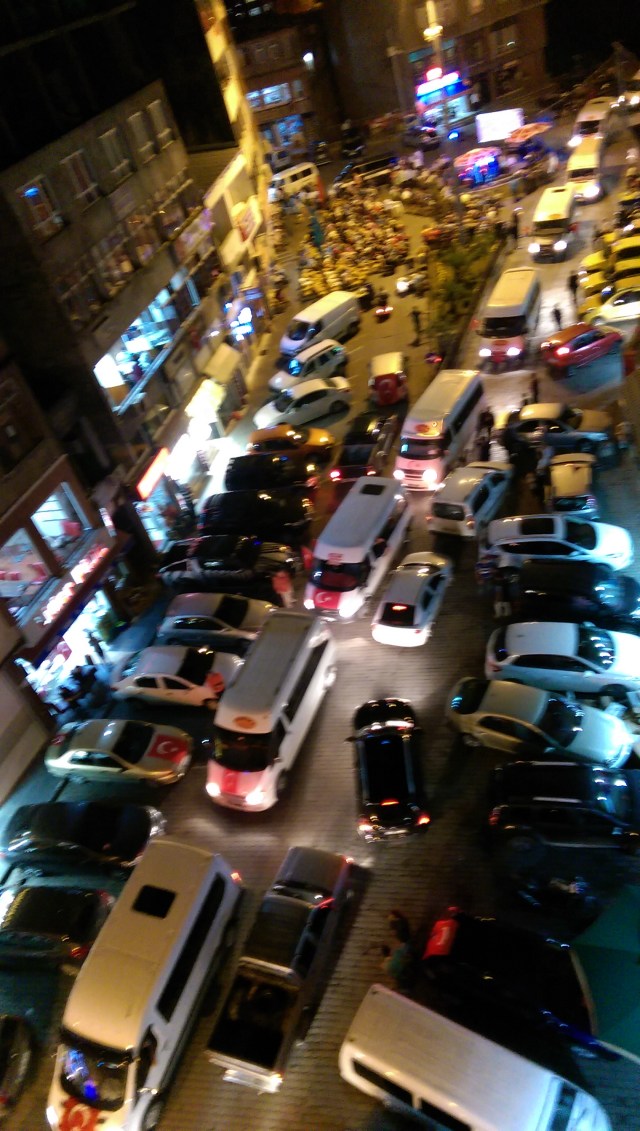
Next morning, early, Clare shows me a message from her big brother: “you’re in a coup!”. A look online, and yes, Turkey has had a coup attempt. It seems to have failed. At breakfast, and around the lounge television, older folk are tense. We check the UK foreign office advice, it says “stay in”. There’s no problem staying another night, so we do so. An enforced rest day results, so the blog gets more content! We also spent some more time replanning, of which more below. Gid nipped out for a few errands, including a beard trim, but otherwise we stayed in until it was time to find dinner. At which event, things seem normal, except for the young men parading on scooters and cars, blowing horns, playing load music, and, especially, waving Turkish flags.
Sorry – no photos – we though it rather unwise to wield cameras in the circumstances.
Next morning, online advice is things are pretty much normal, so off we go…. Due West. Because everyone in the town said “you must go and see the Seven Sleepers”. This is a legend common to Islam and Christianity, and others too. Unfortunately, although Afsin seems to be recognised (eg by UNESCO) as the likely location, other claimants are much more dominant online. Local directions were vague… Eventually we found out enough to set off.
Eshab-i Kehf was 5km West, all uphill, and the last bit steep. A mosque is built around the cave, and complex of other old buildings around that. Before the mosque there was a Byzantine church. It was interesting and peacefully lovely, a few other Turkish tourist and staff there, friendly and helpful and keen on sharing photos.
Eventually we had to come down and we set off eastward about 11.
This was a minor main road. After 20km or so to Elbistan, it was single carriageway and very quiet. There was quite a bit of flat, but toward the end of the day, a big climb. This took us up onto a relatively flat plateau, largely rough grass and rocky bits. It was a bit reminiscent of an upland Scottish moor, but drier and hotter. Then, the road dived down a grassy, scrubby, rocky valley which resembled a Yorkshire dale, except for the large, flat roofed houses. And the heat.

Just west of Darika, scenery resembled England’s in some ways.
The problem with this road, we’d suspected from the start, was it didn’t really go through anywhere, and was too long, with its hills, to do in one day. We didn’t fancy rough camping with the country so nervous. We decided to go on as far as the first garage the navi indicated, and try our luck there. We expected – without reason – a typical Turkish main road garage, which in UK terms, is a small service station, standing alone, or several together. The generous spacing means there’s usually room for our tent, and the restaurant means they can sell us dinner. It turned out to be a small petrol station and various small shops and a small restaurant, spread out along the dual carriageway, hemmed in by a steep slope. Anyway, we asked about, had a meal, bought supplies, asked a bit more… We could camp on a rough patch of gravel at the end of the village very near the road, this looked uncomfortable and unsecure. Or, we could kip on the floor of an office at the end of the row.
We chose the latter, it was fine, especially as it had its own toilet. We felt a bit awkward, because we’d definitely been scrounging, but we really we getting a bit desperate. We did offer to pay, but this was declined. We were settled in by the owner’s sons Oguzhan and Mevlut, and Google Translate. The shops closed at 11:30, and the shop owner, Durmus, then called by to ask if we’d prefer to move to his sitting room floor? But we were already comfortably camped, and Clare sound asleep.
In the morning, Durmus declined Clare’s attempt to buy provisions, and invited us in for breakfast. The flat above the shop was large and cool, compared to England, less furniture and much nicer carpets. Breakfast arrived on an huge tray, and we all sat around in a circle on the carpet and ate. We were impressed how much of the many cheeses were home made. It really was a lovely start to the day.
Just as well, as again, there was a fair bit of climbing, as so often, on a broad, lightly used, dual carriageway. But after maybe 30km, we reached the plains of rich agricultural land around Malatya, and had a smooth run in to our biggest city since Istanbul, passing mile after mile of the famous apricot orchards.

Apricots drying in the sun on the way into Malatya.
Malatya wasn’t on the original plan. We’d envisaged going further south to historic Nemrut area. But at detail planning stage, we realised Nemrut by bike would consume many days to get in and out. The roads hairpin their way about 100km of steep mountains. So we cut out the Nemrut loop, and Clare fixed us up a motor excursion, from a 2 night stop in Malatya. The excursion has its own post.
We stopped in the hotels area in the city centre, intending to search around for a cheaper sort of place. But it’s a tough year for tourism in Turkey, and the staff ran out of the nearby Kent hotel, almost dragged us off the bikes, and agreed to our budget. Err, ok. And very comfy we were too. We would have been even comfier if someone hadn’t mistaken the AC remote for the TV, and tucked it out of sight. Malatya isn’t an intensive tourism centre, but it is a good centre for historical visits, and at least the hotel sector is feeling the effects of the abuse Turkey is presently suffering.
Malatya’s hotel area is very central, and the post-coup political rallies in Turkey are noisy, festive, but slightly intimidating affairs. Both nights we were in Malatya, people rallied in a central square just the other side of our block, lots of noise, speeches, chanting but didn’t stop us sleeping one jot. Again, no photos of this, sorry!
Now, confession time! At the same time we realised Nemrut by bike wasn’t practical, we confirmed we were running late, in terms of the timing of our Azerbaijan visa. Then the attempted coup underlined how Turkey is presently a bit tricky security-wise, especially in the south. So as we’d long thought might happen, we used public transport to speed things up, taking an overnight otobus to Tatvan, three or four days ride East. Even with some 90 minutes delay, this dropped us off about 4am. We then had an easy 65km alongside Van Golu to Adilcevaz and a Pansiyon.