A Plain of Ancient Pagodas, Tops Peeking Through the Mist – Bagan

Bagan is famous for its plain of ancient pagodas and a ‘must see’ on the tourist trail in Myanmar. If you’ve only seen one photo of Myanmar, it’s probably Bagan.
We arrived with a couple of days in hand to do the circuit. The electronic version of the Lonely Planet guide, now downloaded on to my Kindle for every country we’re visiting, does an excellent job of outlining the key sights, so off we pedalled along with hoards of other tourists on rented e-bikes, each clutching the same tome.
Around 1100AD, this area was the centre of a growing kingdom, that converted to Buddhism, so enthusiastically that they went and raided all the Buddhist treasures from nearby kingdoms, and over about 250 years, built thousands of temples, pagodas, and stupas. Some very grand, many small, and anything in between. Since then, many have fallen into disrepair or been demolished by earthquakes. A few are restored, many are maintained, somewhat, and still used. The people who built them are largely forgotten, historians theorise they spent so much building temples that they were economically and militarily overtaken by neighbours. A few photos are at the bottom of this posting, but first, how we got lost in the country….

Lost

DSC_0649-3Around we trudged with a trail of others to all the top sights stealing a bit of respite from the heat in Bagan’s magnificent new Archaeological museum where we saw room after yet another large room displaying dozens of Buddha images, and some interesting cultural displays.
Day two we took a different approach. I hunted out a few of the lesser pagodas with a more interesting commentary. One had passages underground, a second had a ghost and promised excellent views; with a couple of others along the way our day was sorted.
The route connecting them was cross country on adjoining tracks. That’s where the fun started.
We’d had some experience of off road the night before when following our sunset viewing spot, another tourist ‘must do’, we had taken a short cut across the tracks to the main road, in the dark. The trails often disintegrate into sand and as our front wheels carved deep and the back wheel slides sideways we frequently came to an abrupt stand still.
In daylight, ‘map’ to hand, off we set. And we had GPS too, even Google maps, thanks to spending about a fiver on a Myanmar SIM card. All were useless, the tracks unrelated to the maps. The only thing that worked was: mark 1 – eyeball, the compass on Gid’s bike, and the sun. The sand track was big enough for a bus initially, indeed, there were several on it. Then it got a bit smaller, then smaller again, but fine for motorbikes and us. Then smaller still, really just a footpath across a field until it finally petered out altogether. We walked the bikes along the field edge, heading north, towards the road. Beckoned by a farmer tending his field, we pushed through a sort of hedge to regain a track across a field. Finally, we got back to something navigable. Whose plan was that?

Temples of Bagan

And we found a yard of abandoned carriages – two wheelers are still widely used for tours, but these bigger jobs are discarded. A B&W treatment seems to work nicely for these.

Alternative transport tried and tested

On leaving Yangon airport, after our flight from India, it was like stepping back into normality albeit with a sauna full on. The taxi had four – count them – wheels, and four – listen – cylinders, real springs, and the driver’s style had only a soothing effect on our blood pressure. Other cars travelled along marked lanes with the occasional brief hoot as we listened to the purr of motor car engines. Motorbikes are banned! Buses cruised along. All very orderly and blissfully peaceful. Melodic bird song returned to our ears.
The city itself was, by comparison, clean, although as we explored further we found many similarities with India: crowds, street vendors, wires draped along the buildings and criss-crossing the streets, surface drainage channels and food stalls filling the pavement. But no cows, no hasslers, and the wares now carried on shoulder poles. And did we mention, no hooting? We visited quietly busy pagodas and restocked on memory cards and a few bike bits.
Our plan for Myanmar was designed to show us some of the country, bearing in mind that we’d flown into almost the “end” of it, near the Thai border. So, we used alternative transports to backtrack about halfway up the country, back towards the border with India. Not that riverboats or Myanmar trains go much faster than a bicycle, but they do keep going for longer and don’t collapse from exhaustion.
Decidedly top heavy, perched on a one metre wide gauge, the sleeper train from Yangon to Bagan lurched and jolted along, frequently caterpillar style whilst wobbling from side to side. Sharing the carriage with Anton from Germany and the many bugs and mosquitoes, left us all with ample space but the mossies seemed rather greedy. Gid resorted to a bug net overnight, carefully tucking me in as well. Lurching along in the train we were submerged in village life: fields being watered or tended to, traffic waiting for us to pass, children, and those young at heart, keen to wave. Vendors tempted us with their wares peering into our gaping windowless chasms, other locals sat just biding their time or peeking from behind their doors but all were near to be seen.
The river boat from Bagan to Mandalay was not as interesting as the train trip from Yangon to Bagan. Bustling along the river that was  a good half mile wide, despite winding our way back and forth avoiding the shallows, we were rarely in touch with the people. Dancing dots on the horizon appeared to be children playing on the bank. Others were attending laundry or fishing nets, just distinguishable in the distance. Photos taken require dramatic cropping to give a feel of the people and scenery around us. River traffic trundled past but was frequently industrialized; clearly not from the villages that periodically line the banks.
On the boat itself there was an on going game of musical chairs as views versus the sun battled for the prized seats first facing one way then the other.  With about 20 tourists aboard (and one local passenger), there was a chance for some chat. Especially as Nicolas and Elise were also cycle touring. Navigating through the sand banks that were intermittently marked, was highly technical.  Two people stood on the bow of the boat elegantly welding depth gauge poles, arm actions directing the helmsman left or right.
Motorbikes are banned only in Yangon, elsewhere in Myanmar they are ubiquitous. Like India, they’re all small, if a little newer in design. Unlike India, there’s an assumption of observation, and a concept of right of way,  so hooters are used sparingly. Sometimes one can hear a motorbike approaching by the voices of the people on it! We’re still trying to take this on, after immersion in India for three months. In Mandalay, it was our voices, as we took motorbike taxis at one point. They also gave us helmets, but had they just got their motorbikes and wanted to practice? The two times we went on the back of Indian’s bikes, helmetless and three up, admittedly in the middle of nowhere, the riders were much smoother and assured, whereas our Mandalay taxis, two times two up, felt a bit wobbly and less secure. Were we paying for their learner petrol?
Our second train trip, Mandalay to Tsipaw, notable for two feats of engineering back in the early 1900s, was also marked by higher levels of sophistication seen in the farming. Although still mainly small scale stuff with every last patch of fertile land cultivated,  the watering cans on shoulders and the ox ploughs had been replaced by rotavators, hose pipes, sprinklers systems and strimmers.
Unbelievably the train jolted to a halt then went backwards. It was plenty slow enough surely it didn’t need to cover some bits twice. It gradually became obvious; as day was breaking we could see the track layers beneath us. We were gaining height up the side of a mountain onto a plateau, the train can’t do hairpin bends, so it had to switch direction for each zig or zag. A panoramic view opened up before us, lined with receding hills.
The second spectacular event was marked by people peering out of the windows and cries of, ‘There it is’. Fleeting glimpses developed into a full view until the train stopped just before we curved round to cross the Goteik Gorge viaduct. Crowds clambered down onto the track for a better view framing the ‘must take’ photographs.
Think that’s about covered it: Plane, taxi (4 wheels), train, riverboat, motorbike, train. Oh and then  in Tsipaw, tuk tuk, hiking, and in Lyaung Shwe, long tail boat.

May your God be with you

‘Safe journey, may your God be with you’ were the parting words of one Indian gentleman we have spoken to.

We got used to the high profile of religion in Turkey. Our first experience was in Kirklareli, where an Imam very kindly welcomed us into the mosque, explaining the symbolism on the walls and the practise of Muslims. The frequent calls to prayer and tidal rush of men accompanied us across the country.
In Indian, the birth place of four now global religions (Sikhism, Buddhism, Hinduism and Jainism) where, by law, Indians have a freedom of choice,  religious practice is all around us. Red ribbons mark a sacred tree and shrines, erected in the smallest of stone hearths, are placed at seemingly random places along the road, desert and countryside. On a bigger scale there are frequently larger shrines and full sized temples in and around villages and towns. These are usually brightly decorated with incense and flowers around the deity being worshipped with plenty of places to buy these things nearby.
On the way to Ranakpur, to see the famous Jain temple, a man passing us on his motorbike guessed where we were heading but was very insistent that we should see his village’s temple. 5 km down the road he was waiting for us to arrive, eager to point out ‘his’ temple which turned out to be a couple of flags placed on a hill sized rock.
Later, another proud villager sped after us on a motorbike imploring us to rethink our hasty transit as ‘his’ temple was not to be missed. It had been quite impressive to have such a grand building in such a small village but it appeared to be of a similar structure to many we have already seen on our route across India and time was running short. We very guiltily continued on our way.
It’s not uncommon to start the waking process at 6 am with an hour of chanting which can give way to a lengthy session of ‘random’ bell ringing or drum thumping which can be followed by the call to prayer enabling many Indians to start their day with worship.
At numerous other times along our way we have been accompanied by banging and crashing as a religious service takes place. Occasionally a procession escorts a highly decorated truck that emits, from its loud speakers, volumes of thumping music. It all seems to add to the general melee of high noise level the Indians don’t appear to notice.
At the other end of the scale there are many silent almost fleeting gestures. Another moment to be noted was when our bus, on the way to Bimbetka, stopped for the conductor to leap out and purchase a garland of flowers. On passing the sacred river Narmada the bus stopped while the man placed the garland on a roadside shrine. On our return trip the bus slowed while a coconut and garland of flowers were thrown into the river demonstrating a religious side to the maniac bus drivers who invariably scream along the roads with horns blaring.
At Maheshwar, on the sacred river, we stayed for a couple of days to again visit temples. Late one afternoon we took a boat trip out towards Baneshwar temple.  The oarsman wasn’t fussed about us actually landing on the tiny island but set off up river to a religious ceremony taking place at the water’s edge. Singing and playing, accompanied by setting afloat candles in tiny dishes to create a light trail as they drifted off down river, made a magical moment in the fading light.
Washing in sacred water, to cleanse both body and soul, are very much are part of the Hindu tradition. Many Hindus make at least one pilgrimage to a sacred water site in their life time. On foot, with a knap sack, often wearing something orange and sometimes with no shoes, they are a frequent and unmistakable sight, especially as we approached the sacred places. One, we came across in the middle of nowhere, having just explained that he was on foot, to our amusement, jumped on the back of a passing motorbike and sped off ahead of us.
We’ve followed the course of the Narmada crossing it several times observing shrines, religious practice and places of pilgrimage. The marble rocks on the Narmada at Bheraghat, and Pushkar’s sacred lake, that originated from a lotus petal, are two such places but none are more important than Varanasi. Situated on the Ganges Varanasi is one of India’s seven sacred cities and of major importance in the passage of life and death in Hinduism. It is here, in a ceremony on the river bank, that the cycle of rebirth can be broken releasing the person from the caste system and setting their soul free. The ‘burning ghat’, as it is known, is ablaze 24 hrs. as the public cremations take place.

Varanasi is one of three sacred cities in India where aarti takes place. Aarti is a ceremony performed by priests, where fire is sacrificed to the Goddess Ganga, and a number of other deities.


Thoughts on leaving Rajasthan

In amongst our kilometre crunching days, crossing Rajasthan, first retracing our steps east, then veering south, we’ve taken some delightful back roads. It’s always been the case that the minor roads reap the most rewards in terms of seeing rural life and countryside. Rajasthan has been no exception.

Our first detour was to Ranakpur to see the great Jain temple. Garmin was well up for a cross country jaunt and had three attempts at turning left off the highway. At the first two locals were urging us further along the dual carriageway before turning left, flapping their hands to make it clear. At the first we didn’t take much convincing as it was a dirt track; another gem from Garmin. The second looked more promising but no, we must go further on. Fortunately we did as the main road, according to the colouring on our map, started well enough but soon deteriorated into a pot holed narrow lane. Along it there were many elderly men in Indian dress with deep red turbans, herding cattle or sheep together with the odd camel. The views of ploughed fields, the odd village here or there and just the general lush greenery were beautiful. We had now truly left the desert behind us.
Around Ranakpur we, or rather our legs, realised we were cycling in hilly terrain – the first since, err, um, Azerbaijan in August. But the roads were smooth, well graded and the hills minor, so we had a gentle reintroduction to our lower gears.
It was on this route that we discovered, in Rani, that Indian towns don’t have to be squalid dumps in terms of rubbish and muck around the streets. Rani was spotless. It is a reasonable sized town but there was no litter or rubbish to be seen, just a road sweeping lady, that Gid nearly collided with, as she thrust her barrow directly into the stream of traffic, just as if she was riding a motorbike.
Women are frequently employed as road sweeps working away with their stick brooms, dust pans and wheel barrows but it’s the men who drive the dust carts. Very often the men are standing or sitting around while the sweeping goes on. This pattern seems to be establish at an early age with girls and boys in the household, unless perhaps we’ve not spotted that these girls are not family members but servants.
As well as the more traditional role of domestic chores – collecting water in their clay or metal pots which are carried on their heads, child rearing etc, women are frequently working alongside men in building projects. We’ve seen them digging channels with over sized rakes in road building projects, clearing rubble from the newly built central reserve, and chipping away at the edge of the road surface (not quite sure what this one was about). Equally, they quite frequently help out with building projects: mixing cement, delivering the mixed cement on their heads to the men who are laying the bricks, and generally bustling about. And at the blacksmith’s, it’s Mrs who wields the hammer, while Mr holds the workpiece. All this is done in their wildly colourful filmy saris; presumably not their best ones. It’s worth adding that India has elected two women as prime minister, too.
But the gender divide still seems to be firmly ingrained. A few women drive scooters or cars. They take other women as passengers but never a man. We’ve hardly ever been served by a woman in a shop or restaurant, except at checkouts in the few western style supermarkets. In Udaipur I was surprised to see one lady in total control of the traffic, dressed in uniform and wheeling an arm about as she blew her whistle.
As we dashed through one village a mother and daughter were on the steps of their house. The girl was doing school work in an exercise book on the top step, while mum was a step or two down beating up a shirt; with the stone step as a washboard she vigorously attacked it with soap. I wondered about the school child and what opportunities her education would bring her. In India, the female literacy rate significantly lags behind that of the males, so there may be extra barriers for her.
An hotelier, whose chalets are looking shabby and didn’t provide breakfast because there is no chef, explained that the previous owner had got too old to keep it all going. He’d only had daughters, who would take over his business? It had gone rather to ruin (since Lonely Planet’s 2011 glowing review), so now this new guy had just taken on the lease. He had sons.


Various other things are clearly slow to modernise such as road rules, manufacturing materials and methods, and digging holes. In some ways it seems stuck in a time warp with manual labour replacing the machinery we’d expect to see back home.  This is exaggerated for us as Indian English has diverged from English (and American) somewhat, and, Sir, some constructs archaic to us are still normal here. Lorries mostly look like 1960s leftovers: But the cars look modern. Almost everyone has a mobile, a smartphone unless they’re elderly. There’s construction going on almost everywhere, satellite dishes poke out of straw roofed shacks, and modern things keep cropping up. What an interesting place!

Riding in Rajasthan

Rajasthan, and India generally, seems a land of contrast. Leftwards leaning polititians in the UK sometimes complain about the UK’s “private wealth and public squalor”, compared with European societies: India takes this to spectacular extremes.
But, in India’s use and abuse society where rubbish piles high and waste is abandoned everywhere, not everyone is at one with this policy. Standing with a local man, beside a central shopping area in the bazaar at Jaipur, he mournfully stated that this was swept and clean this morning implying ‘and now look at it’. He shrugged his shoulders in despair. True enough, in the mornings we’ve seen ladies with twig brooms sweeping mess into dust pans, then emptying it into wheel barrows. Where next it goes I’m not sure but there are frequently rubbish mounds along the approach roads to towns and scorch marks where previous rubbish has been burnt, or earth and rubble piled on top; the reverse of our land fill sites I guess. But, the norm here is to drop rubbish in public areas, even by what would be very “respectable” people, businessmen, shopkeepers and the like. Of course, if the rubbish is edible, one if the many cows, dogs, or sometimes goats, will swiftly devour it, so all the discarded packaging is clean, and poorer people sift through the trash looking for stuff to reuse, including cow & camel dung, which are fuel – but there’s still a lot of rubbish left around. It’s different in private areas, which are often pristine, and certainly a fellow who dropped a wrapper in the grounds of Jodhpur’s palace, was very quickly directed to the bin. But public areas certainly are usually littered, shitty, and dusty.
This, together with the honking and hooting, are key things we’ve had to adjust to. Just as we’ve had to adapt to the local style of driving;  pulling out or sweeping across traffic seemingly without looking at all & he who honks the loudest is surely coming through. This latter is never more evident than when traffic is trying to manoeuvre through road works or some other obstruction. One bully boy, horn blaring, will determinedly insist on forcing a way through, other traffic forced aside, including oncoming traffic with, apparently, right of way. There are frequently speed bumps at the boundaries of villages, or in towns, but again, plenty of drivers simply use these as an opportunity to overtake. Although India’s roads are generally very good, the drivers & riders are so bad it feels by far the most hazardous place we’ve found to cycle. However, it probably isn’t quite as bad as it feels, as speeds are generally low, and everyone assumes everyone else is a maniac and not looking where they’re going.
Away from all this madness, Rajasthan  has been delightful. We’re back to the familiar waves, calls of ‘hello’ or ‘welcome’, and friendly hoots from people as our paths cross. This, together with, frequent requests for selfies to splash onto Facebook with a, ‘Look who I met’ comment.  Once stopped it goes one of two ways: crowds appear from every corner, eager to look, poke, pull, gradually trying to engaged in conversation: Which country? Where are you going? Do you like India? A script we’re very familiar with.  Alternatively, and rather less engaging, we are fair game for the hordes of children and sometimes adult village folk who often approach, fingers rubbing, with constant demands for money or gifts; seen elsewhere but more prevalent here.  Or fingers out to you and back to their mouth or that of an infant/ child.
Rajasthan is one of the poorest regions in India. Back in the 70s literacy was estimated to be as low as 18%. It’s catching up but is still in the lowest three states of India and still claims the biggest gender gap in the country with women in villages at the thin end of the wedge. Projects like Roopraj Dhurry Udyog, where 42 families have formed a cooperative, help to raise the independence of women by developing cottage industries. Items are sold locally with all profits going to the artisans but there is a long way to go; the poverty is stark. Actually, although in theory “all profits” go to the artisans, we rarely get to meet any, and they’re very quiet. One suspects the lion’s share of profits are absorbed by the sleek looking men running the shops.
It’s been interesting to see the cast iron hand sewing machines frequently in action. We’ve previously  donated 2 or 3 of these, 1930s Singers, to charitable organisations at home where they were serviced and sent to third world countries. Here they are still in action, still being serviced and still available to purchase brand new. Gid had a repair done. A quick job; less than 5 minutes, less than 15 pence. Every town or village can offer such a service.
Embarrassingly, while we waited at a level crossing in a small village, a local pointed out Clare’s back tyre was flat. We already knew it had a slow puncture but now it was indeed flat. We happened to be right outside a tyre repair place.  In we went! They quickly fixed both slow and fast holes for 10 rupees.
In amongst a great deal of curious chat as they compared our bikes with theirs. Most Indian bikes are (to us) old fashioned roadsters from the 1950s, with one speed, rod brakes, and the old fashioned British Standard metal tab lamp bracket (which is never actually used, and we remember from our childhood is a completely crap design). A newer kids bike, mountain bike looking, but still one speed, was apparently 3,500 rupees – about 50 euros. I guess Tesco, at home, get pretty close to matching both the quality and price of that. Indians often ask how much our bikes cost: We’ve got into the habit of saying it’s about the same as one of their Honda Hero motorbikes, which are about 900 euros, same as the starting price for a decent tourer (before all the upgrades).
Rajesthan has been truly fascinating but I look forward to seeing a more balanced view of the county as we sweep back in an easterly direction towards Kolkata.
Top sights along the way:

On The Road

Villages, cows, decorated lorries, tuk tuks, the army on the move, wildlife. Surprisingly good roads and amazingly bad drivers.

Jaipur

We already wrote a bit about Jaipur, here’s Gid’s photos.

Pushkar

The lake, cows, monkeys, dodgy holy men with their ribbons and paint, new age travellers and view from the hilltop temple.

 Jodhpur

Castle, palace, blue city.

Jodhpurs at Jodhpur

We saw a notice advertising a polo tournament – Jodhpur is a big army town, as well as the Maharajah’s traditions, although actually polo isn’t terribly old. We watched a British Army visiting team narrowly beat the President’s Bodyguard team by 3 1/2 to 3.

Jaisalmer

The roads to and from Jaisalmer, and our camel trek from there, were both rich in sightings of interesting Thar Desert wildlife.
Jaisalmer is twinned with West Sussex at least in the sense they both have a Hawker Hunter plane on a big pole. Ford’s, in Sussex, has more moss than Jaisalmer’s.
They both have military museums.  Jaisalmer’s has more old tanks, Tangmere’s, in Sussex, has more old planes. Jaisalmer’s castle is more impressive, more open, and mostly older than Arundel’s.
See separate posting for our camel trek, and our way out of Rajasthan, via Ranakpur and Xmas in Udaipur, also has its own posting.

Dealing with Delhi

Traveling across Europe into central Asia, we thought, would be a gradual adjustment in terms of cultural differences, road traffic conditions, food etc. and I guess that’s been the case. But, arriving in Delhi has been a whole new ball game. From the start, in the shuttle from the airport, we were dicing with death. Our driver must be on a reward for fast delivery, as on the crowded road he weaves for side to side, our battered Suzuki micro van was rolling alarmingly; Clare’s bike box threatening to fly off the roofrack. Vehicles weave across the road trying to fill the smallest of gaps in the blocked solid traffic. Bicycles, scooters and motor bikes (women usually side saddle on the back), a selection of motor vehicles, all palm wedged on the horn, accelerate in every direction regardless of any perceivable traffic regulations such as, travel in the direction of the traffic or pavements for pedestrians. Certainly, the ‘Look left, look right , look left again, use your eyes and ears before you use your feet’ applies on both sides of a dual-carriageway as much as anywhere else.


Stark evidence of poverty is very present in the city. There are not only beggars, as in many countries, but also shanty towns along the streets just off main highways together with debris piled high. Loads of people bedding down in the street (where do they go during monsoon?). Dirt and litter is almost everywhere.

There are so many warnings in the media, on tourist/hotel notices, and in guide books about the ingenuity of Indian people to rob, one way or another, unsuspecting tourists that it has made us uncomfortable talking to the locals, especially when we recognize some of the opening gambits or stock phrases such as, ‘I don’t want any money but …’ or ‘I just want to practise my English …’ . After a week we knew the pick up points and phrases but still got gulled a couple of times; not so badly though, as these fellows were just trying to steer us into their favoured establishments.  An auto-rickshaw driver (tally: 3 ok, 1 maniac) told us that some of the big tourist shops reward drivers with a 1L fuel voucher (about $0.70) for each tourist delivered.

The general atmosphere is one of hectic bustle and over crowdedness. If there is a space someone or something will fill it rapidly. Amusingly, dogs have cracked the system. Whilst we’ve already seen a starving horse who had a broken or deformed leg and just enough flesh to stretch over it’s bone structure, the dogs look fine and seem to find a safe place to hangout or kip. Cows roam about, apparently eating garbage. Some folk keep a few goats. In Delhi, ox carts aren’t uncommon; later in more open country, horses were preferred. A few donkeys seem to be used for riding or carrying loads. But small motorbikes and scooters dominate the transport sector, at least, numerically.

This is good fun…

http://m.driving-tests.in/learners-licence-practice-test-3/

I got 26 out of 30, a pass. But some of the questions seem a bit unrelated to real road practices here.

Delhi has been a place of many firsts:

-first time we’ve seen oxen pulling carts in the centre of a city,

-first time we’ve had to call reception to get our water heater turned on for a shower,

-first time I’ve watched people washing their clothes on the ground in the streets (a few had bowls most didn’t),

-first time I’ve seen ladders up to dwellings on the first and second floors above shops,

-first time I’ve watched a man tapping off the drips in one of the many recessed ‘toilets’ along the streets, which leave an ever present stink of urine,

-first time I’ve watched a man spit three metres out onto the street (I wonder what the world record is?),

-first time I’ve seen so many electric cables draped along outside of the buildings and spewing out of a sub station.

Gradually we have got used to the chaotic nature of Delhi. Like chrysalis slowly emerging from our hotel room, we have now been out and about seeing the sights and still have all limbs intact, despite a few close shaves.

Cycling out of Delhi still fills us with fear and trepidation. To conquer this one we took a cycle tour of old Delhi – their bikes, our helmets and gloves. A definite plus was that I lowered the saddle so that I could comfortably touch the ground. A real plus when constantly stopping in the many tight, crowded situations. The tour itself was fantastic. We frequently ‘whizzed’ along streets and passages wiggling in and out of traffic, people and other obstacles, initially waking people from their slumbers. Nerves of steel were required for the ‘Russian roulette’  or ‘balletic’ interactions between traffic. We soon cracked the rapidly repeating bell manoeuvre to add to the constant cacophony. The main tip, though, was “start at dawn”. And later on, going out of Delhi, it worked well.

At times, modern sky scrapers graced the sky while at ground level they seemed precariously close to the decay, detritus and dirt of the old town, despite, we were told, that the government having cleaned up the area by removing the slums.

Our tour took us round the back streets, starting with a visit to Jama Masjid, on to Delhi’s traditional bread making industry, next to a lofty view of both the Shah Jahan’s wife’s mosque and the spice center of the world, inside a Sis Ganj Sihk Temple, further on to one of the four remaining city gates and a number of other notable land marks and sights. All jigsawed in and around a four kilometre radius.

Deteriorating pockets of ornate architecture amidst the hotch-potch of cables, crumbling brickwork, faded signs, patched repairs, mark, we were told, India’s rich heritage and are left over from the Mugal society, dating back to 1857 or earlier.

Under our own guidance, and mostly in search of cash (India’s government having just invalidated all the currency over about $1 value, causing something of a nationwide crisis), we visited Connaught Place and other parts of New Delhi, built towards the end of the British period, and travelled on the shiny new metro out to some new malls, at Noida, to get some bike parts at the big Decathlon store (note to other cycle-tourists: Don’t expect much in terms of spares, we took the only 9 speed chain).

By Bus Around Lake Issy Kul

Sight seeing is fairly limited in Bishkek: a few statues, the tourist shop, the square, the goose step guards who are currently ‘off’ due to the building being under repair, and the bazaar. We’d done the lot, with many visits to the bazaar and needed another diversion.  Ysyk-Kol Lake did the trick: not too far away, public transport so it’s cheap, a nature reserve and local holiday spot.  Angie, our hostess at the AtHouse, sorted out our first nights accommodation; a second outing for Nathan’s old rucksack and we we’re off.

Tamara, our hostess at Tamga, booked her ‘cowboy’; we were all set for a morning’s horse ride. 10 she said and the deed was done.  At 10 we we’re ready: togged up, breakfasted up, camera sorted or so we thought. 10 came and went. Tamar’s cowboy couldn’t find his horses.  Once he arrived it was easy to see why as they must have been deeply submerged in a briar patch. Both manes and tails were matted to a lump with burs.  The ubiquitous padded sleeping mats came in handy again as they we’re draped over the saddles for our comfort and under the wooden runners to protect the horse.  Plaited string reins were given, together with the usual instructions: left, right, stop & fast ahead with the use of a birch twig whip, and we were off. The first hiccup occurred as our horses headed off the track, down a small bank into a stream for a drink. Eider, our guide, already had the measure of our riding skills coming quickly across to chivvy the horses back on track. My horse was keen to be the leader of the pack. It frequently broke into a trot and occasionally a canter, much to my alarm,  to make sure it’s nose was ahead. Gid was less fortunate and had the opposite problem, it wouldn’t budge. Eider soon sorted the problem. Along we went; down steep banks, across mountain streams, along mountain side sheep trails, all of which I would have baulked at on foot, until we reached an open meadow where Eider eagerly suggested we could canter. I firmly declined the offer. I’d grown quite fond of my saddle and didn’t wish to part with it.
It was a superb day, not a cloud in the sky, and a light dusting of snow visible on the sharp-edged mountains behind the foothills we climb. The dusty track rose straight from the village, up the valley. It wiggled and dipped through scrubby, hilly, grassland and a few streams. About ten times we saw a vehicle lurch up the bigger track up the valley. We greeted a couple of farmers. The two dogs were annoying; otherwise, outside the village it was just us.
We ambled back down, once I’d managed to convince my horse we weren’t going to canter for home the whole way. That was until a rare occasion when we’d dropped behind and watched three dogs aggressively worrying the two horses ahead; one hanging off the tail of Eider’s horse. It didn’t seem such a bad idea when my beast took flight and delivered me some 30 metres up the track to the front of our group again, with Eider brandishing his whip at the dogs as I flew by.

Fairytale Canyon

Barskoon Valley Waterfall

Around Tamga

Moving on from Tamga was entertaining in itself. Tamara had warned us that the bus timetable was approximate, not deterring an ambitious driver from speeding away early despite the bus having a schedule. True enough, 15 mins early we were chased up the road by the bus that did a quick flit round and was off again.
Being already full didn’t deter a further four of us piling on. I  was given a seat as usual, with Kyrgyz politeness showing deference to age. On this occasion it may have been the short straw. Gid clung to the single roof rail in a throng of people who surged forward when someone want to depart, until one burst out, whereupon, a ripple of people retreated in a backwash. I was perched on an upturned metal, bottle crate; one leg slowly going numb. My face was approximately at arse height as I sat amongst the throng. One pair of legs squeezed mine in a pincer gripe as I tried to casually glance away. Gradually, as we passed through the villages, space became available. I moved to a comfy seat to admire my former perch and truly admire the view.  My admiration sank as a man near us repeatedly rasped up a mouthful of spit ready to gob. Inhibited, perhaps, by the enclosed space the final deed was unfinished, much to our relief.

Karakol Valley – Walk up to the Ski Resort

Karakol Museum

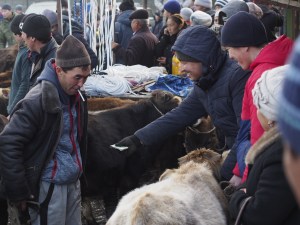
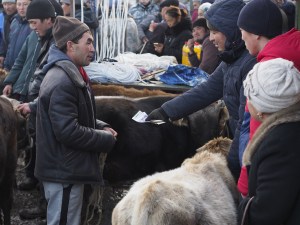
Karakol Animal Market

The animal market, Angie from the AtHouse in Bishkek had said, was quite a spectacle. The biggest in the region the Lonely Planet guide claims.  For once we were in the right place at the right time. I woke at 5:50 my internal alarm well tuned in and was instantly absorbed by thoughts of the animal market. Early in the morning, all over by 10 were phrases ringing in my head.

I got a groan or two out of Gid, who mentioned something about 01:30 bed time;  6am wasn’t going to happen for him.  I lay there trying to content myself with thoughts such as; we’d seen animals at Kumtepa Bazaar in Margilon so presumably it would be similar but bigger.  We’d also seen herds of animals spilling out onto the dual carriageway way-back-when so I had conjured up something in the middle: loads of wild fowl, loads of herds and maybe a pen or two like our now discontinued sheep fair, in Sussex. But my thoughts were running wild.  I’m here, I’m awake, my only chance.

I bounded out of bed and shortly after was ready to leave. Our windowless room gave no hint of the pitch black outside. Gid, now awake, agreed to come and let me out.  Through one locked door, on to the next, but the final door was locked and we couldn’t find the key. Our efforts had woken the receptionist who came to investigate.  By now Gid was fully sort of awake and agreed to join me.  The receptionist phoned a taxi, a whole 70 som, to save us the 30min walk.

I became apprehensive sitting in the taxi waiting for Gid. I’d dragged him out and it was still pitch black.  What on earth would we be able to see?  Nearing the venue the roads were becoming more and more  blocked by lorries whose loads were nowhere to be seen.

Spilling out of the taxi into the dark, we followed the throng; many people had torches but ours were tucked up in bags at the hostel.  Most people were leading small flocks of sheep, the odd single one or cows, through copious amounts of ‘mud’.  All were either lining the edge of the road together with the vehicles or squeezing along it.  We went with the flow bearing left into a large opening stuffed full of cows and horses.  As there was barely anywhere to stand we tried to tuck in at the edge, finding a couple of rocks raised us up to get a better view.  Traffic passed backwards and forwards; all squeezing through.  The occasional beast refusing to budge. The huge area was absolutely filled.  As the sun rose the spectacle opened out before us; deals started to take place, animals were inspected and some exchanged hands.

Cholpon-Ata

Petroglyph park dated 8th century BC – 5th century AD

From the bus on the homeward journey

I shall miss the ‘Stans’ as we move on into India. I have grown quite fond of the vast plains dotted with numerous herds of horses, cows, sheep & goats as they mooch across from one side to the other in search of a mouthful to eat. Especially here where the plains span right across to the foothills of the snow capped mountains. Herdsmen, frequently on horseback grace the scene. Their former nomadic lifestyle is evident with ‘sheep’s people’ high up on the mountains together with the occasional sight of a yurt.
Passing along the lakeside highway idly admiring the view, with vast expanses of golden ‘fields’ has been delightful. Hay stacks piled high in gardens nestling between fruit trees, on roof tops or jammed up beside the house. The houses, no frills, working machinery sits amid the ancient relics,  museum piece tractors splutter along with over filled trailers, donkeys dwarfed as they trudge along with the last of the seasons crops. All add to the atmosphere that for me captures rural Kyrgyzstan.


Pamirs Take Two – Gideon’s Pictures

As explained in the previous post, we took too many pictures on our Pamir trip to fit in one post. So the previous post has the Pamir text and Clare’s pictures. This post separates out Gideon’s pictures.

Best Shots

Phone Snaps

This little collection shows some of the character of the trip, but doesn’t quite measure up to the quality standards we’d like to set. There’s a limit to time when shooting from a moving car, especially on bumpy roads. But thanks to both drivers for keeping the windows clean!

Road Trip

Mountain Textures

Landscape

Around Town

The Fergana valley

Ferghana is a watered, fertile and temperate valley in this dry and mountainous region. It’s been the centre of ancient empires, and fought over many times. Now it is mostly part of Uzbekistan, spilling into Kyrgyzstan and Tajikistan, with very complex borders that don’t match the (mostly old Soviet) road and rail networks. Until a month before, travelling from Tashkent into the Ferghana Valley meant going via Tajikistan, which involves two border crossings and significant wasted time – and for the round trip we’d needed a double entry Tajik visa and a triple entry on our Uzbek!  But only three weeks before we embarked, a new rail line was opened, which stays entirely on Uzbek territory, albeit pretty winding, and thus slow, for a significant part. The carriages were new, and by UK standards, extremely roomy and comfortable. One suspects a UK operator would put twice as many seats in the space, and charge at least double. The line was built with Chinese help, and includes a substantial tunnel. Which we never saw. Because, it’s secret! As the train approaches it, the staff draw the curtains, and then, one stands at each end of the carriage to ensure nobody peeps. Goodness knows what they keep in there – the world’s only plov mine, perhaps? Anyway, it does translate to a splendidly attentive train crew for the rest of the journey.

Margilon, being roughly in the centre of the valley, was a great place from which to explored by bus and shared taxi, with Al Cave, another travelling retired teacher from the UK.

Yodgorlik  silk factory Margilon – Clare

 Yodgorlik  silk factory Margilon – Gideon


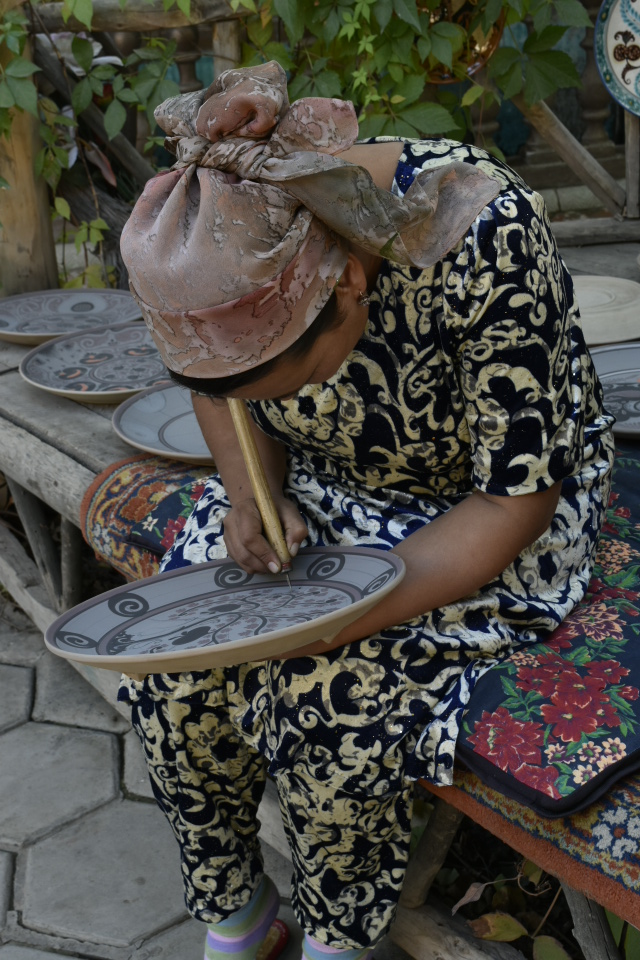
Rishton ceramics museum

Where the clay is so pure that they only need to add water before putting it on the potters wheel.

_ctf3020


Kumtepa Bazaar, Margilon

Kokand / Qo’qon – Khan’s Palace

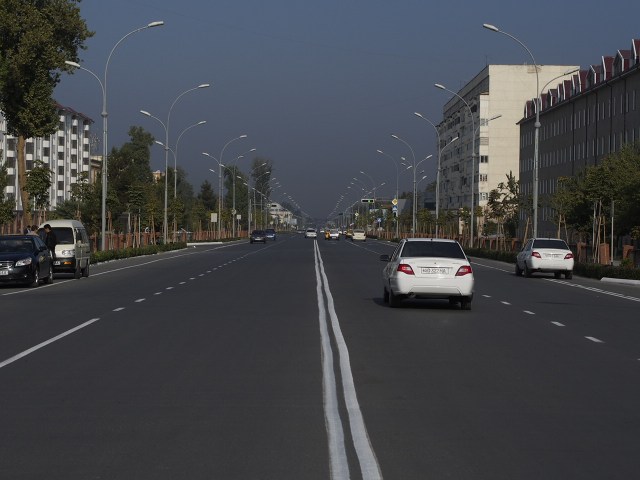
And, in case anyone thinks the entire Ferghana Valley is only full of old things, here’s a photo of downtown Ferghana itself:

OLYMPUS DIGITAL CAMERA

Photo gallery – The ancient silk route cities, Uzbekistan

We took shed loads of pictures in these gorgeous historic cities. So this posting is organised a little differently. There’s no narrative of the actual cycling, it’s just a number of panels by each of us from each city.

Khiva – Clare

Khiva – Gideon 1

 Khiva – Gideon 2

Bukhara – Clare

Bukhara – Gideon

Samarkand – Clare 1

Samarkand – Clare 2

Samarkand – Gideon