Category Archives: Off The Bikes
Alternative transport tried and tested
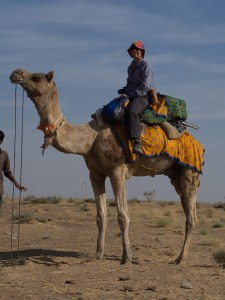
Camel trek – Thar desert

Dealing with Delhi
Traveling across Europe into central Asia, we thought, would be a gradual adjustment in terms of cultural differences, road traffic conditions, food etc. and I guess that’s been the case. But, arriving in Delhi has been a whole new ball game. From the start, in the shuttle from the airport, we were dicing with death. Our driver must be on a reward for fast delivery, as on the crowded road he weaves for side to side, our battered Suzuki micro van was rolling alarmingly; Clare’s bike box threatening to fly off the roofrack. Vehicles weave across the road trying to fill the smallest of gaps in the blocked solid traffic. Bicycles, scooters and motor bikes (women usually side saddle on the back), a selection of motor vehicles, all palm wedged on the horn, accelerate in every direction regardless of any perceivable traffic regulations such as, travel in the direction of the traffic or pavements for pedestrians. Certainly, the ‘Look left, look right , look left again, use your eyes and ears before you use your feet’ applies on both sides of a dual-carriageway as much as anywhere else.
Stark evidence of poverty is very present in the city. There are not only beggars, as in many countries, but also shanty towns along the streets just off main highways together with debris piled high. Loads of people bedding down in the street (where do they go during monsoon?). Dirt and litter is almost everywhere.
There are so many warnings in the media, on tourist/hotel notices, and in guide books about the ingenuity of Indian people to rob, one way or another, unsuspecting tourists that it has made us uncomfortable talking to the locals, especially when we recognize some of the opening gambits or stock phrases such as, ‘I don’t want any money but …’ or ‘I just want to practise my English …’ . After a week we knew the pick up points and phrases but still got gulled a couple of times; not so badly though, as these fellows were just trying to steer us into their favoured establishments. An auto-rickshaw driver (tally: 3 ok, 1 maniac) told us that some of the big tourist shops reward drivers with a 1L fuel voucher (about $0.70) for each tourist delivered.
The general atmosphere is one of hectic bustle and over crowdedness. If there is a space someone or something will fill it rapidly. Amusingly, dogs have cracked the system. Whilst we’ve already seen a starving horse who had a broken or deformed leg and just enough flesh to stretch over it’s bone structure, the dogs look fine and seem to find a safe place to hangout or kip. Cows roam about, apparently eating garbage. Some folk keep a few goats. In Delhi, ox carts aren’t uncommon; later in more open country, horses were preferred. A few donkeys seem to be used for riding or carrying loads. But small motorbikes and scooters dominate the transport sector, at least, numerically.
This is good fun…
http://m.driving-tests.in/learners-licence-practice-test-3/
I got 26 out of 30, a pass. But some of the questions seem a bit unrelated to real road practices here.
Delhi has been a place of many firsts:
-first time we’ve seen oxen pulling carts in the centre of a city,
-first time we’ve had to call reception to get our water heater turned on for a shower,
-first time I’ve watched people washing their clothes on the ground in the streets (a few had bowls most didn’t),
-first time I’ve seen ladders up to dwellings on the first and second floors above shops,
-first time I’ve watched a man tapping off the drips in one of the many recessed ‘toilets’ along the streets, which leave an ever present stink of urine,
-first time I’ve watched a man spit three metres out onto the street (I wonder what the world record is?),
-first time I’ve seen so many electric cables draped along outside of the buildings and spewing out of a sub station.
Gradually we have got used to the chaotic nature of Delhi. Like chrysalis slowly emerging from our hotel room, we have now been out and about seeing the sights and still have all limbs intact, despite a few close shaves.
Cycling out of Delhi still fills us with fear and trepidation. To conquer this one we took a cycle tour of old Delhi – their bikes, our helmets and gloves. A definite plus was that I lowered the saddle so that I could comfortably touch the ground. A real plus when constantly stopping in the many tight, crowded situations. The tour itself was fantastic. We frequently ‘whizzed’ along streets and passages wiggling in and out of traffic, people and other obstacles, initially waking people from their slumbers. Nerves of steel were required for the ‘Russian roulette’ or ‘balletic’ interactions between traffic. We soon cracked the rapidly repeating bell manoeuvre to add to the constant cacophony. The main tip, though, was “start at dawn”. And later on, going out of Delhi, it worked well.
At times, modern sky scrapers graced the sky while at ground level they seemed precariously close to the decay, detritus and dirt of the old town, despite, we were told, that the government having cleaned up the area by removing the slums.
Our tour took us round the back streets, starting with a visit to Jama Masjid, on to Delhi’s traditional bread making industry, next to a lofty view of both the Shah Jahan’s wife’s mosque and the spice center of the world, inside a Sis Ganj Sihk Temple, further on to one of the four remaining city gates and a number of other notable land marks and sights. All jigsawed in and around a four kilometre radius.
Deteriorating pockets of ornate architecture amidst the hotch-potch of cables, crumbling brickwork, faded signs, patched repairs, mark, we were told, India’s rich heritage and are left over from the Mugal society, dating back to 1857 or earlier.
Under our own guidance, and mostly in search of cash (India’s government having just invalidated all the currency over about $1 value, causing something of a nationwide crisis), we visited Connaught Place and other parts of New Delhi, built towards the end of the British period, and travelled on the shiny new metro out to some new malls, at Noida, to get some bike parts at the big Decathlon store (note to other cycle-tourists: Don’t expect much in terms of spares, we took the only 9 speed chain).
Bye bye Bishkek, Farewell Central Asia
Tomorrow morning we fly to India. Here’s a final mini-blog for Bishkek.
At the AtHouse
Where we’ve been so wonderfully put up, and put up with. And met so many other travellers.
Between the snowfalls
With today’s and yesterday’s snow
That’s 16th and 17th November, for posterity.
By Bus Around Lake Issy Kul
Sight seeing is fairly limited in Bishkek: a few statues, the tourist shop, the square, the goose step guards who are currently ‘off’ due to the building being under repair, and the bazaar. We’d done the lot, with many visits to the bazaar and needed another diversion. Ysyk-Kol Lake did the trick: not too far away, public transport so it’s cheap, a nature reserve and local holiday spot. Angie, our hostess at the AtHouse, sorted out our first nights accommodation; a second outing for Nathan’s old rucksack and we we’re off.
Fairytale Canyon
Barskoon Valley Waterfall
Around Tamga
Karakol Valley – Walk up to the Ski Resort
Karakol Museum
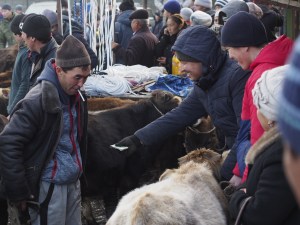
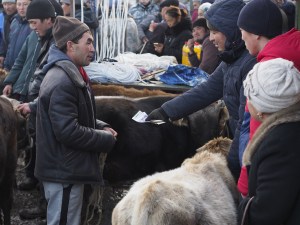
Karakol Animal Market
The animal market, Angie from the AtHouse in Bishkek had said, was quite a spectacle. The biggest in the region the Lonely Planet guide claims. For once we were in the right place at the right time. I woke at 5:50 my internal alarm well tuned in and was instantly absorbed by thoughts of the animal market. Early in the morning, all over by 10 were phrases ringing in my head.
I got a groan or two out of Gid, who mentioned something about 01:30 bed time; 6am wasn’t going to happen for him. I lay there trying to content myself with thoughts such as; we’d seen animals at Kumtepa Bazaar in Margilon so presumably it would be similar but bigger. We’d also seen herds of animals spilling out onto the dual carriageway way-back-when so I had conjured up something in the middle: loads of wild fowl, loads of herds and maybe a pen or two like our now discontinued sheep fair, in Sussex. But my thoughts were running wild. I’m here, I’m awake, my only chance.
I bounded out of bed and shortly after was ready to leave. Our windowless room gave no hint of the pitch black outside. Gid, now awake, agreed to come and let me out. Through one locked door, on to the next, but the final door was locked and we couldn’t find the key. Our efforts had woken the receptionist who came to investigate. By now Gid was fully sort of awake and agreed to join me. The receptionist phoned a taxi, a whole 70 som, to save us the 30min walk.
I became apprehensive sitting in the taxi waiting for Gid. I’d dragged him out and it was still pitch black. What on earth would we be able to see? Nearing the venue the roads were becoming more and more blocked by lorries whose loads were nowhere to be seen.
Spilling out of the taxi into the dark, we followed the throng; many people had torches but ours were tucked up in bags at the hostel. Most people were leading small flocks of sheep, the odd single one or cows, through copious amounts of ‘mud’. All were either lining the edge of the road together with the vehicles or squeezing along it. We went with the flow bearing left into a large opening stuffed full of cows and horses. As there was barely anywhere to stand we tried to tuck in at the edge, finding a couple of rocks raised us up to get a better view. Traffic passed backwards and forwards; all squeezing through. The occasional beast refusing to budge. The huge area was absolutely filled. As the sun rose the spectacle opened out before us; deals started to take place, animals were inspected and some exchanged hands.
- Never mind that, got a light?
- I’m kinda fond of this calf, not sure I want to sell it!
- They never did nail the deal. I think the wad offered was about 8,000 com, that’s roughly $100.
Cholpon-Ata
Petroglyph park dated 8th century BC – 5th century AD
From the bus on the homeward journey
Pamirs Take Two – Gideon’s Pictures
As explained in the previous post, we took too many pictures on our Pamir trip to fit in one post. So the previous post has the Pamir text and Clare’s pictures. This post separates out Gideon’s pictures.
Best Shots
Phone Snaps
This little collection shows some of the character of the trip, but doesn’t quite measure up to the quality standards we’d like to set. There’s a limit to time when shooting from a moving car, especially on bumpy roads. But thanks to both drivers for keeping the windows clean!
Road Trip
Mountain Textures
Landscape
Around Town
The Pamirs by Toyota Land Cruiser
The Pamirs, a highway across the ‘roof tops’ of the world, a dream destination for well ‘ard cyclists that had been on my wish list since Gid gave me a 501 must do trips book for Christmas 2013 and there, together with the Karakorum Highway, it was. Then he gave me the Adventure Cycle Touring Handbook for Christmas 2014 – was there a plot?
We took far too many pictures! The area is both photogenic and varied, and, we had loads of time for photography. Even half of our pics is blog-bursting, slow to edit and view. So all the pictures below are Clare’s. Gid will make a separate posting for his photos.
Murghab
Wakhan Valley
The Fergana valley
Ferghana is a watered, fertile and temperate valley in this dry and mountainous region. It’s been the centre of ancient empires, and fought over many times. Now it is mostly part of Uzbekistan, spilling into Kyrgyzstan and Tajikistan, with very complex borders that don’t match the (mostly old Soviet) road and rail networks. Until a month before, travelling from Tashkent into the Ferghana Valley meant going via Tajikistan, which involves two border crossings and significant wasted time – and for the round trip we’d needed a double entry Tajik visa and a triple entry on our Uzbek! But only three weeks before we embarked, a new rail line was opened, which stays entirely on Uzbek territory, albeit pretty winding, and thus slow, for a significant part. The carriages were new, and by UK standards, extremely roomy and comfortable. One suspects a UK operator would put twice as many seats in the space, and charge at least double. The line was built with Chinese help, and includes a substantial tunnel. Which we never saw. Because, it’s secret! As the train approaches it, the staff draw the curtains, and then, one stands at each end of the carriage to ensure nobody peeps. Goodness knows what they keep in there – the world’s only plov mine, perhaps? Anyway, it does translate to a splendidly attentive train crew for the rest of the journey.
Margilon, being roughly in the centre of the valley, was a great place from which to explored by bus and shared taxi, with Al Cave, another travelling retired teacher from the UK.
Yodgorlik silk factory Margilon – Clare
Yodgorlik silk factory Margilon – Gideon
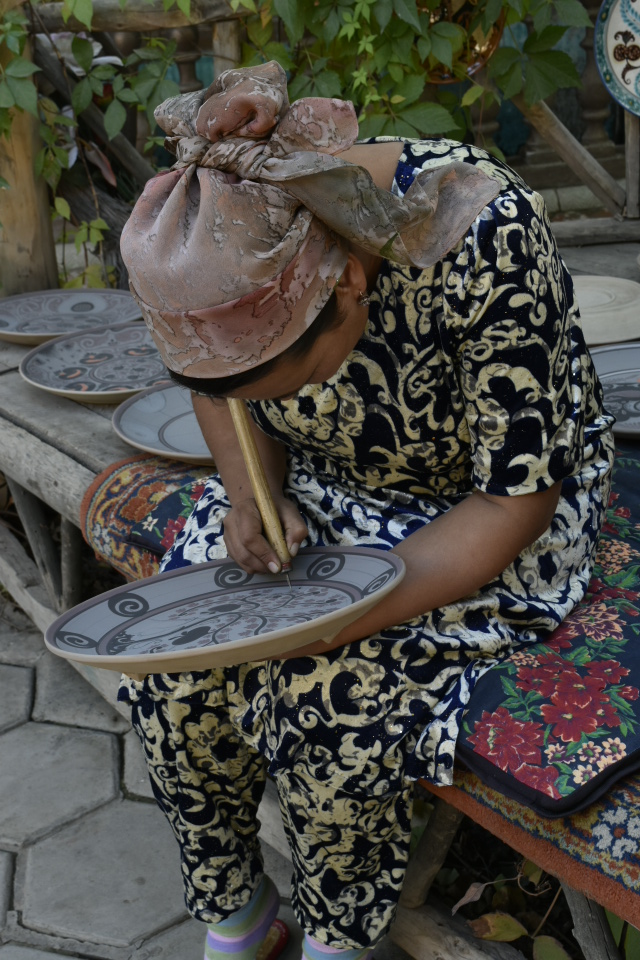
Rishton ceramics museum
Where the clay is so pure that they only need to add water before putting it on the potters wheel.

Kumtepa Bazaar, Margilon
Kokand / Qo’qon – Khan’s Palace
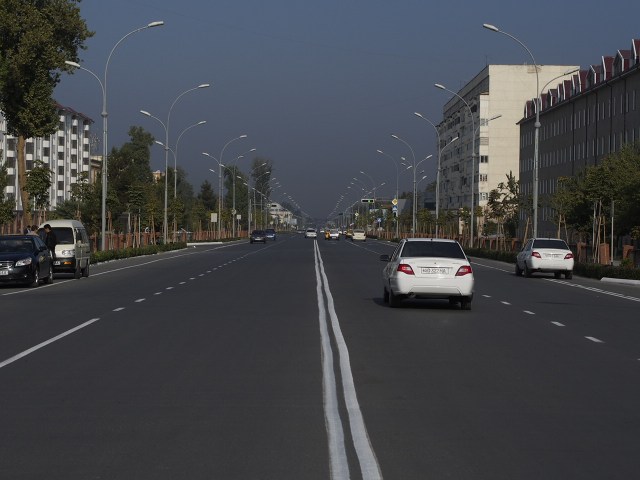
And, in case anyone thinks the entire Ferghana Valley is only full of old things, here’s a photo of downtown Ferghana itself:

The Aral Sea, or rather Not the Aral Sea
Sorry folks: This posting from the beginning of our time in Uzbekistan is published out of order, after some ‘later’ ones. We went on this taxi trip during a rest day at Kungrad.
Kungrad (also transliterated as Kongirot/Qo‘ng‘irot, all of which seem an improvement on an old name of Zheleznodorozhny) is not a major, or even minor, tourist town, but for a road traveller entering Uzbekistan from the west, it’s the first town of any size (see end of the last posting).
This western area of Uzbekistan is also known as Karakalpakstan, which in some senses can be regarded as a different country, with its own language, Karakalpakstani. We realised, too late to take much of a photo, it has its own hats, too – giant fuzzy wool ones, making the wearer resemble Michael Jackson circa 1975, if not usually so cute. As discussed in earlier postings from Georgia or Azerbaijan, in this part of the world there’s a complex overlap, or often difference, between the citizenship of the states, and the identity of individuals. There’s significantly more edge to being, for example, a Tajik in Uzbekistan (thus an Uzbekistani, but not an Uzbek), than being, say, a Scot in England, assuming you can work out who is such (Sorry Nicola). We were told by one local that Kyrgyz and Tajiks can be distinguished by nose size, and it is true that in the four ‘stans we visited, one can roughly distinguish different numerically dominant facial types. But just in case this doesn’t work, each ethnicity has its own hat as well.
Kungrad is about the nearest place on the main west-east road to the Aral Sea. The owner of the place where we stayed was happy to arrange a taxi excursion to Muynak, previously a significant port on the Aral Sea, now a desert town. To actually set toe in the remains of the sea involves a much longer road trip, substantially off road (If I remember correctly), we couldn’t face the hours in a car to see not much, so we settled for Muynak.
It’s rather a sad place, as you might expect. The town has helpfully lined up the abandoned hulks near the war memorial.
After Kungrad, we cycled on to Nukus, capital of Karakalpakstan. It has one tourist attraction – an outstanding modern art gallery. Where, naturally, we didn’t take pictures.